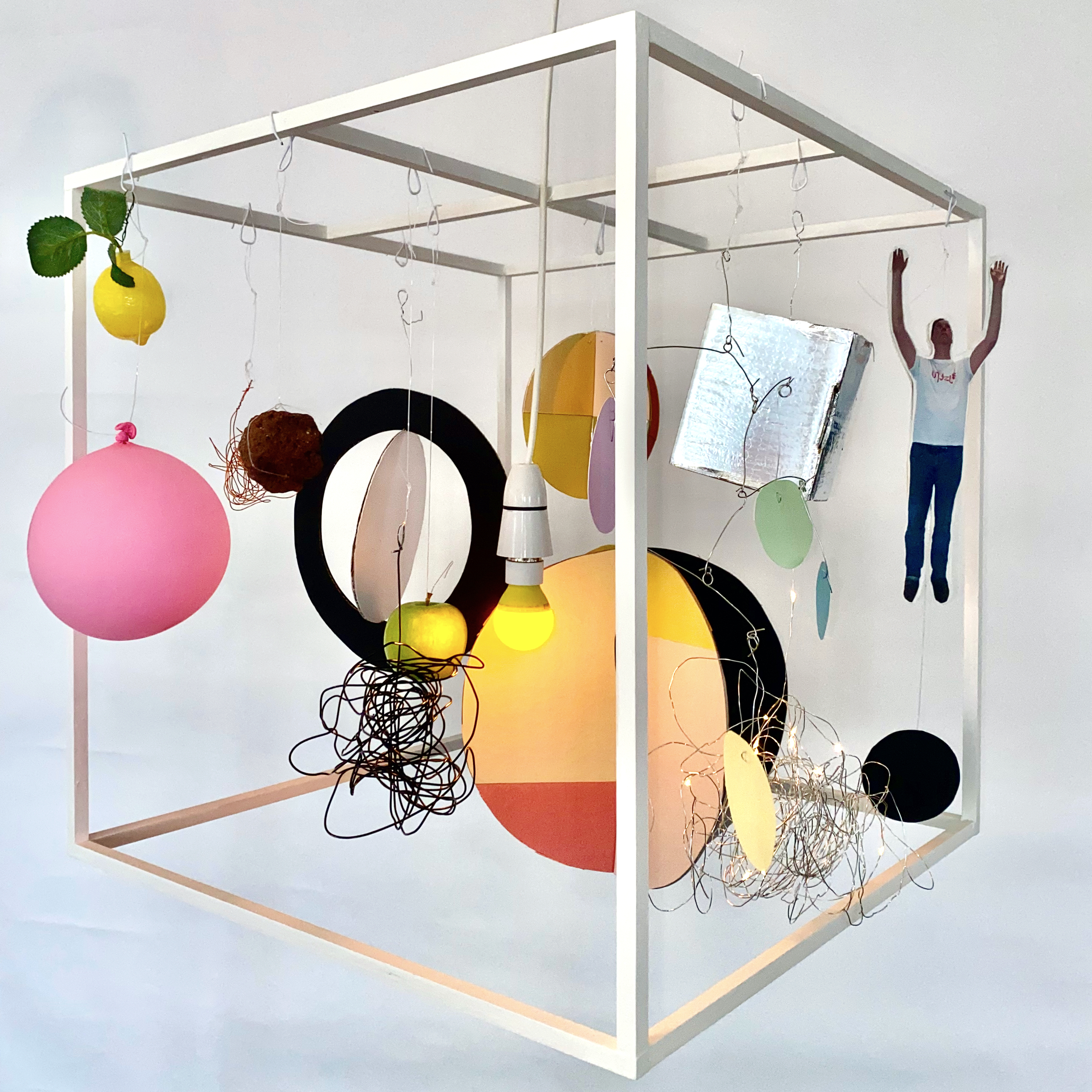
There is an artwork made for an art space, which looks like a white cube (but is only really a frame, and has no walls) which contains a number of things. The objects dangle and move around. They are all different. There is a squiggle of black wire, a plastic lemon, a cardboard circle with a white inside circle, a small rock, two 3D spheres of coloured paper, a squiggle of copper-coloured wire, a pink balloon, an apple, a shiny box with a squiggle of LED lights on wire, a traditional-looking wire mobile and a small full-length picture of me with my arms up wearing a t-shirt which says “#jstfu”.
This artwork is being shown in a domestic flat, along with other artworks, and the space has no furniture, or kitchen. So, it is not a flat that is lived in just now. The walls are mostly bare plaster, some are bare brick. The floor is bare wooden floorboards, no lino, no carpet. It has been named as a gallery, but this gallery has no white walls, apart from one. We arrange the artworks knowing how to do it. We consider the arrangement in relation to the space and the other artworks, giving each its own space.
I’ve just finished re-reading Brian O’Doherty’s book, Inside the White Cube: The Ideology of the Gallery Space (expanded edition, 1986). I thought that I should remind myself about the task that someone gave themselves to articulate meaning from the spaces where we exhibit and experience contemporary art. The original 3 articles – I. Notes on the Gallery Space, II. The Eye and the Spectator, and, III. Context as Content, which were published individually in US art magazine Artforum in 1976, stand as the core texts. O’Doherty has also included an additional article, IV. The Gallery as Gesture, written in 1986. He also includes an Afterword where he reflects on the work and ideas that he wrote about ten years earlier, which he now seemed a bit unsure about. I know the feeling. It has been a useful re-read, but the language that Doherty uses seems overly academic for the subject, like he’s trying too hard to be meaningful, philosophical, and sort of ironic and humorous.
I understand what he’s saying in terms of –
“The ideal gallery subtracts from the artwork all cues that interfere with the fact that it is ‘art’[1]
and “The wall, the context of the art, had become rich in a content it subtly donated to the art”[2].
But please, keep it simple. Things brought into a selected space become art; as long as there is nothing else in there. But there is now a bit of a conundrum – what with spaces that are painted a colour, God forbid, or have walls which are rough, unplastered with cables hanging out of them, and so not ‘white cubes’. Therefore, can we tell when something is art when it is not inside the white cube?
I have arranged and hung a number of exhibitions in my lifetime: problem-solved the perfection of the gallery spaces, painted many a wall white, moved the artworks around to determine the sweet spot that it needed to be placed or hung on the wall. There was always the pressure to do it the ‘correct’ way, I had learnt to do it correctly. It became a habit. We all realised that it was done the way it should be. It does help artists to know these conditions, so that whatever they make and display is art.
The context of a gallery space is safe ground.
Phew.
The lyrics in Steely Dan’s 1977 song, “Home at Last“, spring to mind –
Well the danger on the rocks is surely past
Still I remain tied to the mast
Could it be that I have found my home at last
Home at last [3]
To complicate matters, the musician David Byrne, in his book How Music Works (2012)[4] explains that the spaces where music is played is really important and gives context to the music being performed. He says that musicians make music to fit these spaces, so the space is where you would hear a certain type of music. Music has a broad range of styles, therefore various types and scales of spaces exist. Also, the walls of the music venue spaces act in a reverse way to a white cube gallery. The music venue walls are recording the sounds (and atmosphere) in the room, they become saturated. White cube gallery walls are rigid, they don’t absorb, they just project from their hard surface.
So, the thing is…
Do we make our art/music as a thing in itself, and therefore is self-defined or do we make our art/music knowing if we put it into a space where things are seen/experienced it will be defined as art/music through the venue and by those who experience it?
Art has an evolving range of the styles and exhibiting spaces where we experience it, but do artists make their work to fit the white cube gallery, knowing it’s where it would be seen as art?
Hence, knowing the context defines what things are. But how and when do we know the context.?
The artwork which I have made for this exhibition has its own white cube. The artworks inside the white cube are safe together, in a group, sharing the space, giving space to each other. They are different shapes and colours. They are all three-dimensional. They are geometric, abstract or realistic.
They all seem to be happy together.
Home at last.
[1] O’Doherty B. Inside the white cube: The ideology of the gallery space. Berkeley: University of California Press; 1986. p. 14.
[2] ibid., p. 29.
[3] Becker W, Fagen D. Home at Last. Anchor Music Ltd / ABC Records Inc.; 1977.
[4] Byrne D. How music works. Edinburgh: Canongate Press Ltd; 2012.

