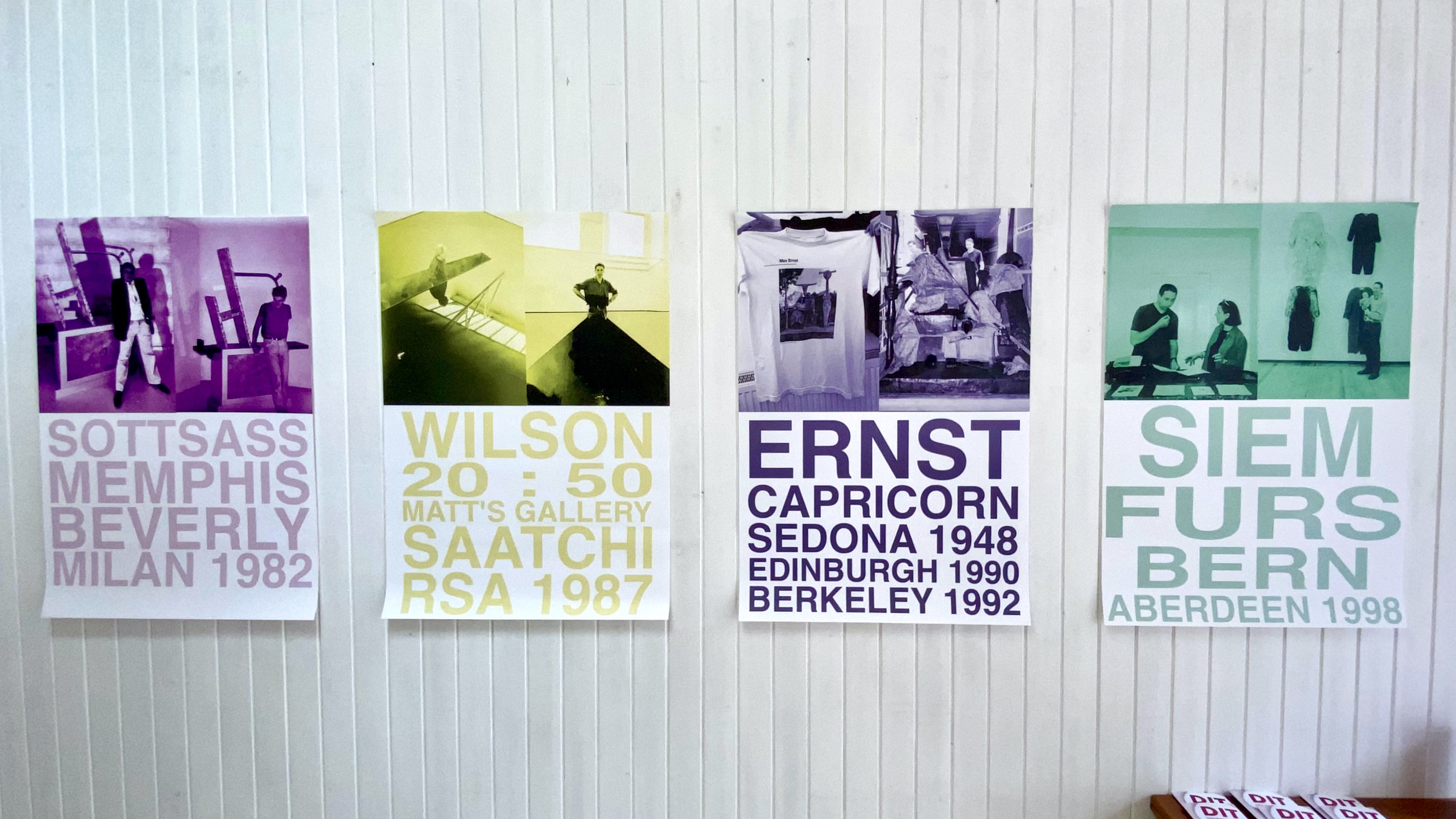
In my past life I’ve had a number of significant cultural and personal experiences while going about my studies and jobs within the arts and design world. On reflection and going through old photos I have kept I could place myself in these memorable scenarios and make connections with who I am and how these particular experiences inform my interests and how they might form some sort of ‘self-portrait’. It may be that by placing myself beside these people Im looking for recognition of my own work, but it’s more that I was there. I have photos of me in direct relation to these people, directly or indirectly.
I firstly made a series of posters which included just images of me and the other people along with contextual words (place, dates, works), as a series of four. They are like very very short visual essays. Text and image. What else needs to be said?
Anyway, when presenting these works, I have had to mostly tell the background stories about the text and images – are they too obscure? I’m not keen on over explaining works, they are what they are. I work with context, I include and I am influenced by narratives, I find them interesting – the serendipitous connections, new angles and information that others bring to the work, I don’t presume people don’t know what I’m showing them. They may know none of it, some of it or all of it, and add to it.
The context of these works spans a period from 1982 to 1998. I was at college studying product design, then I installed contemporary art exhibitions, then curated exhibitions.
SOTTSASS
At art college, I was a product design student. Not an artist or not a maker. We made prototypes of ideas for products that didn’t exist, yet. I loved it. Having had to repeat a year from failing in interior design, I had found my niche. There was problem-solving, thinking of new ways to do things. Making ideas. I designed lamps, knives, clothes stand and I was taught how to render products. We used the spray booth with glee. Making our forms from wood and aluminium, and laying on a sandwich of primers, wet ‘n dry, top colour coat and sometimes clear lacquer. I loved the ritual of the paint job. It was like custom car-ing your new idea. Like those American west coast fetish-finish sculptures. They were like nothing that existed: Smooth. The course was good in encouraging us to explore social and cultural references, which we would use to inspire or communicate our products.
We also made trips out in Scotland. We went to the Burrell Collection in Glasgow, the Caithness Glass factory, Hospitalfield, Arbroath, and McIntosh furniture factory. We went up to Lewis and Harris, all 9 of us, in a hired campervan. Two of us could drive, so we had turns about. Some got to sleep in the van, the others in a tent we had brought with us. We took turn about with this arrangement too. We visited a weaver in Harris, all cramming into her work shed. She said she would pee on the Harris tweed fabric once it was woven. We believed her. We went to London too. Visiting the V&A, Design Museum and the shops in Covent Garden. There was the One-Off studio run by designer and maker Ron Arad. He reused existing products and turn ed them into new exciting ideas. There was the Rover seats, car ariel lamps. I remember the staircase down into the workshop basement made of timber railway sleepers made a heavy bas note when they were tread on – they were performance products.
In September 1982 we also went to Milan, Italy. Only 4 of us went, including our tutor. He knew a previous student, Gerry Taylor, who had got a job with the design company Sottsass Associates, so we had a direct way into what was the Memphis design phenomenon. I was a big fan, still am. I had written an essay about Memphis, and looking back, my early ideas seem to be influenced by their forms, colours and experimental ideas as how products can be. Anyway, we were in Milan, staying in a hotel above some rock club. We met some of the other designers who were working for Sottsass, and were able to go to the Sottsass studio, where we sat waiting to meet Ettore Sottsass, who was across the room from us – but we didn’t, directly. He was busy, we were just students from Dundee, they were designing bus stop shelters for Turin, so time was tight. Our tutor asked us the draw out a few of our ideas in preparation that we might get a moment with him, that was nerve wracking. I drew out a desk lamp that I had designed and prototyped. We were taken into another studio space where we got to meet and share our time with Michele De Lucchi, George Sowden, Nathalie Du Pasquier, and significantly for me in retrospect, Daniel Weil. Weil was a friend of Taylor, and had come to Milan with him. His work was included in the 1982 Memphis exhibition but his association as a formal Memphis designer was not encourage it seemed. His design work – radios, fruit bowls, lamps and clocks were influenced by Marcel Duchamp’s artworks and ‘readymades’. Their creativity came from conceptual art ideas, crossing the boundaries between art and design. This suited me fine, and still does. Interestingly, Weil doesn’t mention his inclusion with Memphis on his Wikipedia biography.
While we were in Milan, Memphis had an exhibition opening for the 1982 Milan furniture Fair, so we got to hang-out and experience all the new products and ideas that they had produced. I had seen a photo of Sottsass leaning against an important new furniture product, the Beverly sideboard. I loved that piece, so a had my tutor take a photo of me trying to take up the same pose as I had seen Sottsass doing.
WILSON
It’s 1987, and I’m working at The Fruitmarket Gallery in Edinburgh. Mark Francis was the Director and he’s got a great address book of contacts of interesting artists. He brings in John Cage, Jean Michel Basquiat, Nancy Spero and many others. I think I was helping with the Dan Graham exhibition when Mark came down to the gallery downstairs and asked if anyone wants to help install the Richard Wilson work at the RSA.
“I’ll do it!”, I say
“Okay, it’s an installation with oil, and they need a wooden platform built in the gallery. Can you help with that?” asks Mark
“Yeah, I can do that” I say
The exhibition at the RSA was a show of the Saatchi art collection. It included Warhol, Rothenberg, Stella, Kiefer and Schnabel. Very big names. The RSA co-hosted the exhibition, and at this time Charles Saatchi and his wife Doris Lockhart, had constructed a big collection of mainly paintings and sculptures by American and European artists. This was pre-Saatchi collecting the YBA artists (Hirst, Emin, Lucas etc) and pre the Sensation exhibition times. But Saatchi had just purchased the Richard Wilson 20:50 artwork, and wanted to show it as soon as possible. Saatchi had seen and purchased the work at Matt’s Gallery in London. This gallery was run out of artist Robin Klassnik’s Hackney studio, and had enabled Wilson to make this work there. The Edinburgh exhibition seemed good timing. Also, good timing for me.
I joined another guy Andrew, who was from London at the RSA to start to work on the installation. Richard Wilson and Robin Klassnik were there, planning out how to practically do this. The gallery room was downstairs to the left of the front door. It had windows along one wall, which looked out onto the Mound area, and doors at the far end which had a strange arrangement of steps and handrail in front of it.
“Can we remove this handrail, it’s in the way?” asks Klassnik
“I’m afraid not” say the RSA
“Why not?” questions Klassnik. “The room needs to be clear to the walls, so we’ll see what we can do, but it might have to go”.
We build a 4-foot-high wooden platform across the whole room. Shaped around the room, and handrail. We use a long water filled hose attached to small ladders and stretched it across the room to check so that the platform is perfectly flat. Richard and Robin then worked on installing the sump oil, so that the dense material would act as a black mirror, reflecting the room in the oil. Very magical.
I didn’t get involved with bring in the oil, which came in the window, but during the duration of the exhibition while everyone else went back to London, I had the task every week to go underneath the platform. The oil was only 4 inch deep on top of the platform, and I had to unscrew a panel at the end of the walkway, collect the oil-filled buckets from under the platform and then slowly empty them back into the oil pool. I felt I was getting to know the work by taking care of it.
Over the years I experienced the work in London at the Saatchi collection in Boundary Road and in County Hall building at Westminster, when Saatchi used that space. It would be good to see it again. I never met Richard or Robin again. I was just the keen hired help to get the job done. I think I maybe saw them across the room, at a Saatchi opening in the 1990s, as the YBA work took over the art scene.
Then, last Saturday, 9th May 2026, I’m at the opening of Jake Harvey and Tjibbe Hooghiemstra’s exhibition at Mark Haddon’s No.31 gallery in Duns in the Scottish Borders. And I look into the mingling crowd there, it’s made up of mainly older artist types, all chatting away. I spot someone I think is Richard Wilson. I go across, he’s with friends, but I just butt in.
“Are you Richard Wilson?” I ask
“Yes, it’s me, nice to meet you, who are you? “, he says
I then launch into my memories I had with him and Klassnik back at the RSA, installing his work. Richard was also in the Bow Gamelan Ensemble with Anne Bean and Paul Burwell, who I had also seen in Edinburgh, at a performance of their metal bashing and noise making in the St Mary’s Cathedral in the 1980s.
“Yes, of course, it was amazing. And in Dundee, at the art school just a few years ago, all the Bow Gamelan archive and everything” Richard recalls.
“Yes, I saw that too, we were that close then, but now here we are, an unplanned but meant meeting? ” I say.
ERNST
In the early 1990s, I was involved with a Max Ernst exhibition which focused on his sculptures. One particular sculpture, titled Capricorn is a bit of an icon, not just for its large size and heavy weight, or its form as a large throne-like seat which depict animal-like king and queen figures, but as a key component for a photograph of Ernst and Dorothea Tanning in Sedona, Arizona where they had moved to, by John Kasnetsis in 1948. The photograph depicts Ernst leaning over the back of the sculpture; just his head, shoulders and forearms are visible. Tanning has reclined on the sculpture with her eyes shut, leaning into the strong arms of the king figure. This original sculpture had been made of concrete, scrap iron, and shells in their Sedona garden. Once they had left in 1957 to live in France, plaster moulds of the sculpture were taken and it was cast in bronze a number of times.
When the Ernst exhibition opened in Edinburgh, in 1990, Dorothea Tanning was present at the opening and we all got introduced to her and she shook our hands. In retrospect, this was quite a moment, having since then, visited a major Tanning retrospective at the Tate Modern in 2019, which gave her the status her own art work deserved. Also, while in Edinburgh, she was keen to buy some Scottish knitwear, so my colleague Susan took her in her car up to the St. Andrews Woollen Mill to buy some cashmere.
Following the Edinburgh exhibition, we organised the exhibition to tour in the USA to Newport Art Museum, Berkeley Art Museum and Indianapolis Art Museum during 1991. My job for the US tour was to arrange the transport of the artworks from venue to venue, and assist with the installation of the exhibition at the venues. The Capricorn sculpture was over a tonne weight, so I was always amazed to go to the venues and see the sculpture had arrived safely in the loading bays of the museums.
For the exhibition and tour, we produced some Ernst merchandise. Posters, cards and t-shirts. I carried a suitcase of t-shirts from Edinburgh to the American museums every time I needed to go to the venue, it seemed to be cheaper than posting them, so I was the courier. I also didn’t get one for myself at the time. The t-shirts have become a rare garment, and over the years, I completely forgot what image was used on the t-shirt. I thought it was just a bare-chested Ernst. So, only over a year ago, Susan told me that she had found two of the original t-shirts, and it was the Kasnetsis photograph of Ernst and Tanning on the front. She wanted to keep the originals, but…
“Do you want us to make a version of the original t-shirt?” she asked
“Yes please, I think that would be amazing” I said.
So, after 35 years, I finally got my own Max Ernst t-shirt (see my previous 3 Art Stories text for more).
SIEM
In 1997, I was asked to curate an exhibition of contemporary German sculptors. Nicola, who I had worked with at the CCA in Glasgow, gave me this opportunity. The exhibition had already gained some funds and a title, The House in the Woods, but there were no artists selected and no other venues other than the CCA to show it at.
“Sure, I’ll do that” I said nervously, “I think I’m ready for this”, and off I went.
So, I’m in Bern, Switzerland at the Kunsthalle, where Wiebke Siem had an exhibition of her sculptures. They looked like large toys, carpets, wigs, dresses, stones and fur coats, but they weren’t these things. They were sculpture, I was informed. They may look like those things but they are definitely sculptures. They were to be looked at as art, not functional objects. It was easy to misinterpret them as they looked very much like the items they represented, but the materials and scale were not quite right. Maybe that’s the point. Sculpture can be anything. Duchamp’s readymades come to mind. It may look familiar but it isn’t what you think it is. I really liked Wiebke. We talked through which of her artworks could be included in the exhibition. She was a friendly creative contemporary German sculptor, and I needed them, for the exhibition.
On my trip to select and gain permission to include certain artists’ artworks in the exhibition, I went to see Thomas Schütte in Düsseldorf. He was very cool, had a maid and gave me catalogues, confidence and chocolate cake (see my previous 3 Art Stories text for more). He showed me images of works he’d like to include and where I could loan them from.
“There’s a museum in Keil which has some of my work, try them” he advised me.
So, I did. They had The Studio on the Hill work, which was a small red-coloured model, a large piece of green felt material and a very long yellow ribbon. When we showed it, we just put lots of cardboard boxes under the green felt to create the hill and placed the studio on the top with the ribbon cascading down it to create a pathway, to make the sculpture.
I’m glad I convinced Schütte to be in the exhibition. I think I might have said the right things, as he came to the opening in Glasgow, along with Wiebke Siem, and Marielle Neudecker who was also in the exhibition. The exhibition also included artworks by Martin Honert and Stephan Balkenhol, but I never met them; I just loaned their artworks from the Saatchi Collection and a gallery in Cologne. I did try and get other artworks from museums in Frankfurt and from other artists I wanted to include such as Katherina Fritsch, but they wouldn’t have worked as the exhibition needed to tour in the UK – which was another challenge.
Aberdeen Art Gallery signed up early on in the schedule, and I just needed another one to justify the funding. I tried various other venues in the UK, and eventually convinced Ormeau Baths Gallery in Belfast to programme the exhibition.
After all that, I saw the exhibition in Glasgow and Aberdeen but I never saw the exhibition in Belfast. I presume it happened, as I was sent some newspaper cuttings, which I included in my after exhibition report.
–

