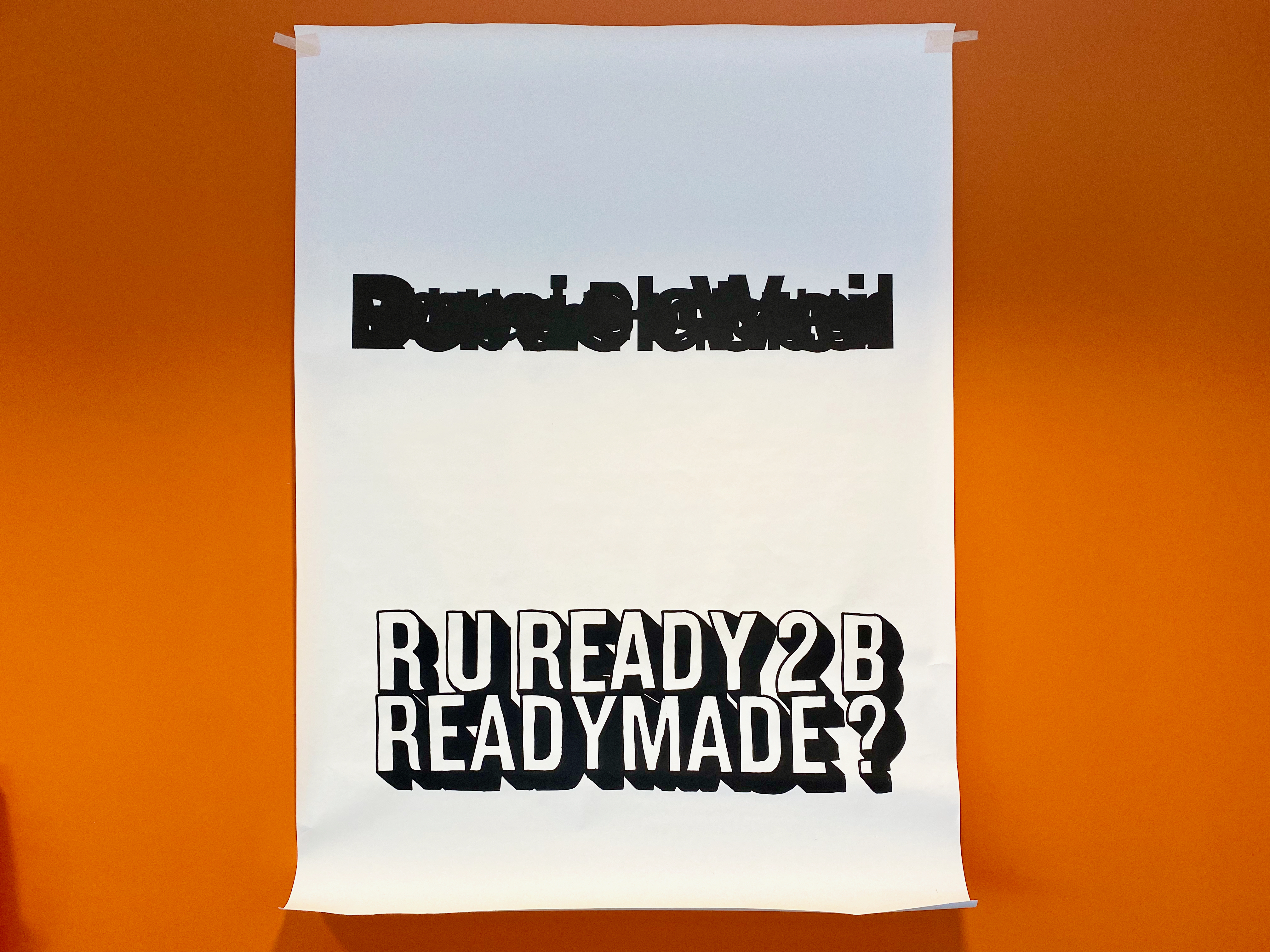
I once attempted to get the American artist Robert Gober to take part in an exhibition I was putting together in Scotland. I had never seen his work here before, and I was really keen on showing his sculptures. I also approached some other American artists – Cindy Sherman, Mike Kelley and Jessica Stockholder. I received a few fax messages back saying, ‘thanks but we are too busy,’ apart from Stockholder, who agreed in principal but wanted to know much more about the exhibition. The fax messages are now starting to fade with time. Stockholder eventually sent a framed drawing for the exhibition. I was hoping for some sort of sculptural work, like her other artworks, which are made from found materials and objects: fridges, oranges, timber, strip-lights, carpets, mattresses; some of which are painted, and collaged into enormous room-filling installations. But at least she took part in a small way, and was listed in the participating artists. It was the first time Stockholder had exhibited her work in Scotland.
Robert Gober, and the other American artists contacted for that exhibition, are all now significant names in western art history. They have become the modern masters. Mike Kelley, is still showing, even although he died in 2012, and he continues to have major retrospectives and touring projects.
Gober’s art is well-crafted and handmade. Pieces which represent everyday objects, which live around us, in our homes. They look like the things they are trying to be. Gober has made lots of sculptures that look like sinks, urinals, beds, chairs, plug-holes, dresses, wallpaper, bags of donuts, kitty-litter bags, and even a sheet of plywood. He is a sculptor, and an artist, so he makes things, and things that mean things. He uses sculptural techniques to mould and form his pieces, with plaster, wood, paper and fabrics. He could just go out and buy these items, sign them and call them art, like Marcel Duchamp, but he doesn’t. Gober is directly referencing Duchamp’s ‘ready-mades’ in his choice of objects he makes: this object, which looks like a chair or sink is art. The urinals give it away the connection.
While I was at college, we went to Milan in September 1982. It was a special trip to the annual furniture fair. All the current and contemporary products and objects were on display. We were product design students, but not everyone from the class group came on the trip so we were a small group. Our tutor knew some young designers who were working for Sottsass Associates. These designers had lured Ettore Sottsass to see their work – small lamps and radios which they had blatantly set up in the foyer of the V&A in London, where they were living and they knew he was visiting. From this encounter they were asked to come to Milan, to see how it would go. The designers were Gerry Taylor, who was from Glasgow, and Daniel Weil, who was Argentinian. They had both studied at the Royal College of Art in London. It was the early 1980s, products didn’t concern themselves with environmental or user-friendly concerns. It was the time of post-modernism, messing around with form, colour, materials and creating new products for the sake of it. Sottsass had been designing products in Italy, through the 1960s and 1970s, and we had became familiar with a few of his key products, such as the wire-formed fruit bowls and the Olivetti Valentine typewriter – a bright red plastic object which had a cover with a handle, so turning it into a portable office. These products were only available to us through photographs in library books and product catalogues. So being in Milan to see products directly was influential and important. The year before, Sottsass had established the Memphis design group. There are various reasons why “Memphis” became the project name, the best might be, I like to think, was during a relaxed evening that the designer friends were hanging out in their flat, drinking wine and listening to pop music, particularly Bob Dylan. Memphis quickly became a worldwide phenomenon in the design world which then became highly influential throughout the 1980s. It lost favour as tastes changed but continues to be traded as design ‘classics’, being collected and sold for high prices. Sottsass was maybe looking for sharp creative young designers and Taylor and Weil potentially fitted in. In the creation of Memphis as a project within Sottsass Associates – it originally was just a pet project not intended to make money – they continued to design municipal projects for Italian councils, such as bus stop shelters in Turino, for income. Along with the core designers, Memphis was also overseen by Sottsass’ partner Barbara Radice. When Taylor and Weil arrived in Milan, Taylor was incorporated into the Memphis group, Weil wasn’t. Radice apparently wasn’t so sure about his design work. Weil’s ideas and style didn’t really fit with the Memphis stylebook. His radios, fruit bowls and lamps were maybe too clever; too meaningful, maybe too art.
Weil was a thinker. His products had reference points, there was a point to them: why they were the form they were, why they were designed and why they existed. They referenced Marcel Duchamp’s sculptures and artwork. Those readymades, the found objects, appropriated and turned upside-down to become something else. Duchamp’s readymades are products. They were manufactured to accomplish an everyday task. The snow shovel, bicycle wheel, wooden stool, bottle rack, coat hanger and the urinal. These ‘readymades’, are designed and manufactured objects, which have purpose. It is their selection, altered to non-purpose, with an added signature which made them art. Duchamp’s selected ‘readymades’ were objects taken out of context of their purpose. They were identified by Duchamp for their sculptural essence.
Duchamp seemed a supportive, practical and problem-solving type. He selflessly limited his art making through his career, and gladly participated in the production and organising of projects and exhibitions for other artists. Duchamp also realised that he could potentially make money from making small reproductions of his existing artworks, so he developed and produced his multiple work, La Boîte-en-Valise (Box in a Suitcase) (1935-41).
Daniel Weil made products which he could prototype himself before they were batch manufactured in Japan. His ‘Radio-in-a-Bag’ was simply dismantled radio parts sealed into a clear PVC bag which had been screen printed with colour strips, black and white check squares and the word ‘RADIO’. I saw these for sale in London in the early 1980s, on a previous college trip, but didn’t buy one. There is an example of this radio in the V&A London collection. Weil’s products were integrating a conceptual idea, a new way of thinking about a product and its function, but also producing an inspiring design product. They also encouraged people learn a new way to achieve something.
In 1985, Weil had an exhibition of his work at the Architects Association, London. For the exhibition he also made a box, which was the same size as an LP cover but a box set width. Weil’s ‘Light Box’ housed a wood-effect palette-shaped paper pocket containing cards illustrated with coloured drawings of his products, a booklet of essays about his work, a rolled-up textile with images of his drawing products, etched plastic component boards and behind these items was a black and white checked paper insert. This box was a direct reference to Duchamp’s La Boite-en-Valise box, which had contained small replicas of his readymades and artwork.
On the National Galleries of Scotland website, it states that you can contact them about viewing an artwork from their collection, which is not on exhibition in their galleries, but is stored in their warehouse spaces or in the print room archive drawers. I checked their catalogue as I knew that they had an edition of the Duchamp Box. I had seen it on show, I’m sure, years ago. Yes, it was there, listed, stored in the Modern 2 building print room. I was keen to see it. It’s catalogued as a ‘deluxe edition 2/20’, and if so, it is quite significant in the early stages of production of the boxes. It may be the one which was given to Henri Pierre Roché, who was initially described as ‘a general introducer’ [1] by Gertrude Stein, and became a close friend of Duchamp’s for forty years. So, I contacted the galleries and received an email reply saying that the box was too fragile to be seen, and could only be handled by their conservationists. A bit disappointing, as I didn’t need to handle the work per se. I was aware that it would be very fragile, particularly due to the materials that it was made from. I was informed that a film of the box being ‘handled’ and opened up was available on their website. I had watched this already, but I just wanted to see the work in real life, so that I could take in its aura. It is just made of card, paint, cellulose film, plastic, ceramic and adhesive tape. The deluxe editions had been produced by Duchamp (the regular Box edition, which ran into 300 were put together by the artist Joseph Cornell and Xenia Cage), and included one unique piece made by Duchamp. So, I thought this would be interesting to see, and enable me to make connection with the Daniel Weil’s ‘Light Box’ which I own a copy of.
As well as the readymades, Weil also referenced Duchamp’s ‘The Large Glass’ artwork. He made 3-dimensional versions of the ‘Bachelor Apparatus’, which were perspective studies of elements making up the imagery on the glass surface. Weil took these and made lamps of the ‘Sieves’, made from plastic kitchen funnels, arranged in the same form. The British artist Richard Hamilton of course, had been interested in Duchamp’s ideas and work. He became a colleague friend of Duchamp’s and followed him to Los Angeles in the 1960s, where he discovered American art. His painting of a cheap lapel badge saying ‘Slip It to Me’ was indeed an epiphany to him, of the ‘audacity and wit’[2] in American art, and returning to Britain would work on art which would be considered ‘Pop’. In 1966 the Tate Gallery in London organised a Duchamp retrospective, for which Hamilton was commissioned to remake a new physical version of ‘The Large Glass’ for the exhibition. The original work was in the permanent collection at the Philadelphia Museum of Art, and had been famously damaged in transit, so a replacement piece; a readymade piece, seemed a good solution. These versions of versions, gave each new object an informed context, the ideas and concepts became the reason to make the physical works they became. Weil was trying to integrate Duchamp’s ideas into his own work by making from remade versions of Duchamp’s and by consequence Hamilton’s art.
Unfortunately, my visit to the National Galleries of Scotland storage was not to be. I tried again but I didn’t get to compare and contrast the Weil and Duchamp works. The conservation department were too busy to allow me to view the Duchamp work. But at least I know that it is there, that is being taken care of, wrapped and stored, until a time when it is appropriate to bring it out and enable us to view it. Of course, the irony is that there are new cheap versions of this work available online, as ‘readymades’ of the box of Duchamp readymades and other works. Perhaps they could just make a new version, to be seen and handled, without the danger of damage.
Although Duchamp limited his artistic output, other artists and designers since have made their new work from these sources, producing art and design work, mixing up the subjects, allowing art to be design, and design to be art. The subtle slippage of what-is-what challenged those who thought they knew what things are. New ideas, products and art already exist, we just need to be ready to accept the remakes of the readymades.
[1] Tompkins C. Duchamp: A Biography. New York: The Museum of Modern Art; 2014. p171.
[2] Hamilton R. Collected Words: 1953-1982. London: Thames and Hudson; 1982. p55.
 Iain Irving