Missing Bill

IMG_6137-side

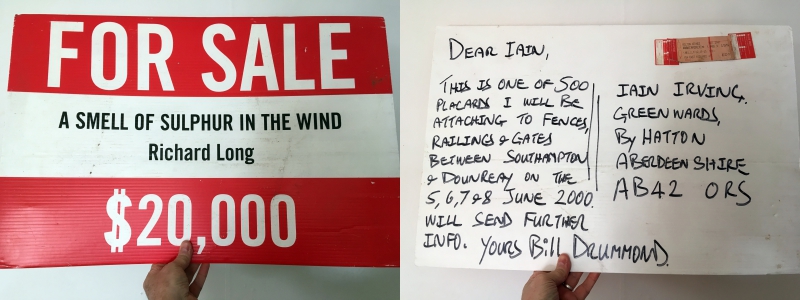
“That’s Bill Drummond on the phone”, calls Judith, “Bill Drummond? Really?”. Apparently, he had been given my name, as he wanted to put on his, For Sale performance on in Aberdeen and needed a hand. After his call he sent me a large ‘FOR SALE’ sign, one of those estate agent type things on corrugated plastic, through the post. ‘Will send further info’ it said, very impressive that it got through the postal system. So, in June 2000, Bill turned up in his Land Rover, set up his carpet and Richard Long’s photo, A Smell of Sulphur in the Wind and gave his performance at the Limousine Bull artists’ collective space when it was in Justice Street.

I’ve always been drawn to a cultural maverick, a sort of leader but also a connector. Those ones who are creative, individual and seem like they are having fun. I feel Drummond is one such, through his activities as band manager, writer, artist and performer.

I was in Liverpool a couple of months ago. It was freezing and windy, but I wandered about, taking in the sights. I had been there many years ago, and had gone to the Tate, and Bluecoat but they seemed in my memory to be somewhere else other than where they were now. This time they more central and seemed smaller. And the Tate was closed, I was too early. Bluecoat was now different and concrete-like but had an interesting exhibition about the Art Schools of NW England. Within the exhibition, there were some contextual artefacts identifying various alumni, including Drummond and his book How to be an Artist.

Even walking around Liverpool, I’m sensing, “Where is Bill?”, never mind those other guys with their mop tops, Drummond’s Zoo records office had been somewhere round here. The iPhone is saying this is where it was, ‘1 Chicago Buildings, Whitechapel, Liverpool 1’, the address on the sleeve of Lori & The Chameleon’s single, Touch. The band was actually Drummond and friends. Chicago Buildings is now wrapped up, being renovated, which in a way could be seen as metaphorical. A cleansing of the past, but really it’s just as an upgrade, a taking care of, like the rest of the city centre. It’s always interesting and special to go to places where things started from or happened. They might just be places on a map or a building but they can become a significant and meaningful site of pilgrimage, a mecca, sites that perhaps sanctify something. This makes me remember when Walter Dahn, the German artist and his friends asked about going to Edinburgh College of Art to experience the studio space where Joseph Beuys had made his performances in the 70’s, or the young couple who seek out Memphis’ Sun Studio in Jim Jarmusch’s film, Mystery Train.

So, now I’m in Shetland. Having never been here before it seems the same as anywhere else, but somewhere something special could happen, being so northerly. I’m leaving on the Lerwick ferry back to Aberdeen on Friday, and I see that Bill Drummond will be in Shetland on the following Sunday, doing a performance lecture, Imagine Waking Up Tomorrow And All Music Has Disappeared at Baltasound Hall in Unst, and I’ll miss him. So near; even cornered in the most northerly place in Britain. Although, it’s also heartening that he’s here, and still out there.

Artist Meets Artist

img_e2318 (1)

The artist is traditionally seen as an individual type, working in solitude, reluctant to collaborate. But what happens when an artist meets another artist. Is there a clash of egos or a respectful mutual admiration of each other’s work and life? Images of Joseph Beuys and Andy Warhol chatting together, or Beuys in Richard Hamilton’s design-conscience home, seem to capture a mutual celebration of creativity, position and power.

Meetings which happen away from the exhibition or show, off stage, out of the limelight and in the everyday, seem significant. It’s not about the artists showing together in the exhibition or sharing the same bill at a concert, which is particularly interesting, it is the meetings which are impromptu and private (although it can help to have someone present to document it). These meetings must have some sort of effect on each artist. It’s stimulating to think of this coming together of artists. How much do they influence each other with their ideas, skills and techniques or is it just through the mutual sharing of their own personal experiences and journey?

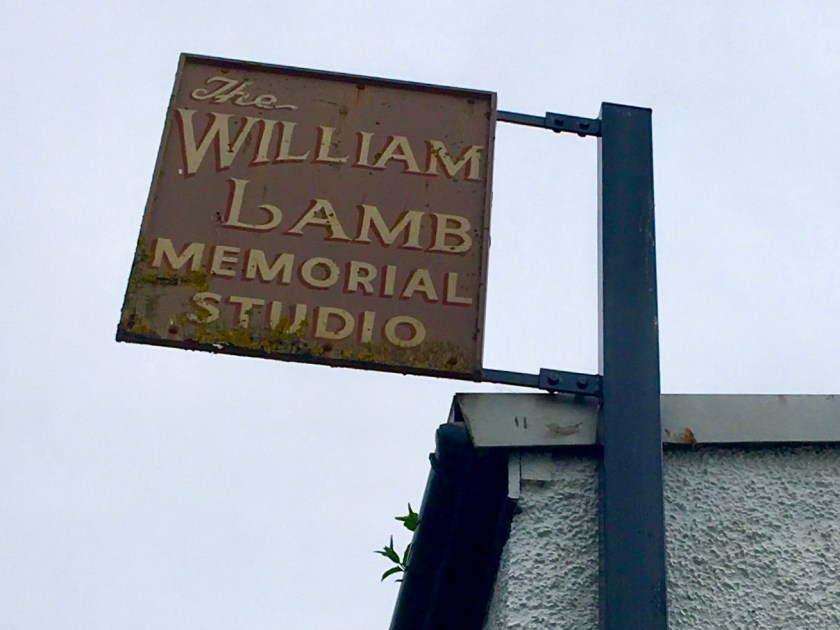
John Stansfield’s book, The People’s Sculptor: The Life and Art of William Lamb mentions the crossing of artistic paths between William Lamb and Adam Christie. Lamb was living and working in his home town of Montrose, and it was there that he had met Adam Christie, who himself was an artist living at Sunnyside also in Montrose. In his book, The Gentle Shetlander, Kenneth Keddie also identifies a relationship between the two. Lamb was intrigued by the individuality of Christie’s art, and had offered him tools to help him carve the stones, but Christie refused, preferring the six-inch nail and glass that he had been using. Lamb modelled Christie into his, The Daily News sculpture in 1935. The sculpture is of a heavily coated figure, grappling with newspapers, and it has the face of Christie. Lamb would have been aged 42 and Christie, aged 67.

Lamb also met and related with other artists and writers in Montrose, including Edward Baird, Violet Jacob and Hugh MacDiarmid, during the 1920’s. But, Lamb was visibly much more technically skilled than Christie, so there could have been some influence in the creativity and interpretation of the subject from Christie to Lamb’s art when they met.

Black Panda Kills Deer

2016-05-19 18.17.17 (1)

I’m driving myself back home in my wife’s Black Fiat Panda, on the A90 approaching the long bend, when suddenly out of nowhere a deer leaps over the central reservation and tries to outrun my fast moving vehicle. We violently collide at a right angle. It disappears under the front of the car then lurches out onto the pavement struggling for life. I pull off the busy road in a frenzy to look at the damage. The front grill has deer hair jammed in the broken plastic, and the radiator is spilling its hot liquid onto the road. Luckily that’s all, nothing more. You hear of deer being flung over the car bonnet and smashing through the windscreen. But where is the deer? I look along the road and there it is, lying about 50 metres away, safely off of the road but lying still. I call my wife, I call the Police – “it’s not an accident” I’m advised, “next time call 101 but we’ll contact the Council about the carcass”. I hope there isn’t a next time. I walk along to see if the deer is definitely dead. It’s quite a large animal probably a roe deer I think, quite solid but its head is twisted round, it has small antlers and its intestines have come out. Not good, but what could I have done? Out of all the cars on the road at this time it chooses to run in front of the Black Panda. Where was he going? (I decide it’s a male).

I take some photos of the dead deer as evidence for the insurance claim then walk back to the car. “The rescue vehicle will be another hour” I’m told by the AA man, so I just sit and quietly wait in the car at the side of the A90. What were the chances of this happening? Why now? I’ve run over other wildlife in my time – a young pheasant running like a micro dinosaur across in front of the Fusion. The impact blasting its body across the road and removed a piece of plastic bumper and I’m never quite sure if the small rodents that dart across in front of the car at night in the brightness of the car lights ever make it in one piece. These animals are constantly risking their lives. I wish that they could learn to live safely away from the roads and live a less risky and traumatic existence. I seem to remember seeing some gorillas on TV who have mastered the act of safely crossing a busy jungle road.

Maybe this tragic incident is a sign of how man directly affects nature or it is nature showing us it is there, telling us to slow down, to be more aware of what is living around us and give them some space.

James Leslie Mitchell Goes For a Walk

James Leslie Mitchell goes for a walk

By the early 1930’s, James Leslie Mitchell had already written the first part of his planned trilogy. While in The Garden City, he made the decision to come back to Scotland to work on the other parts. One day he felt the need for a long walk; to generate ideas stimulated by the North-East coast landscape.

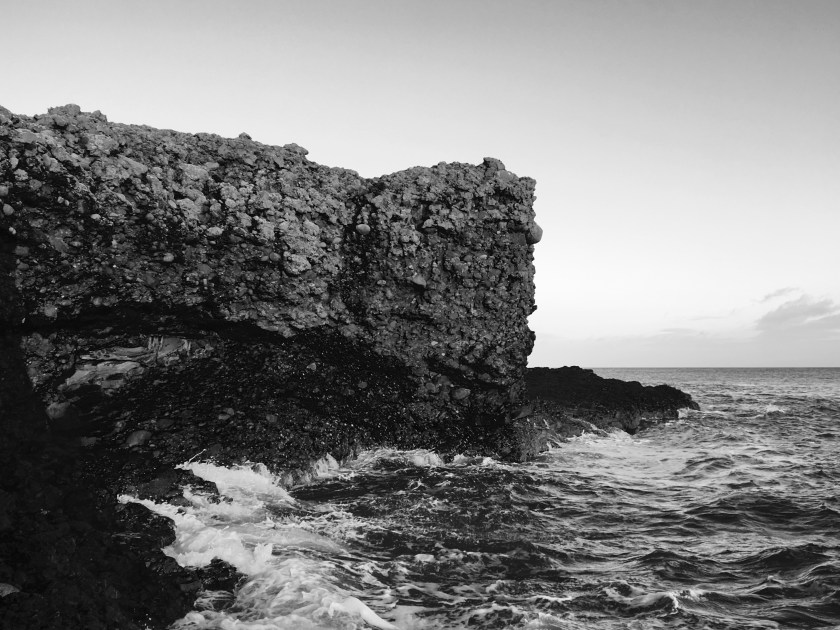
So, he went back to where he grew up, deciding to walk along the coast, up from Bervie via King’s Step, Rob’s Cove, Big Rob’s Cove, Ha’ Cove, Little John’s Haven, Crooked Haven, Rough Haven, Swirl Cove, Powdam Head, The Slainges, Todhead Point, Braidon Bay to Catterline Bay. It was a tough walk, climbing along the rocks and avoiding the incoming North Sea. The goal was not to get soaked by the waves, to keep dry as the sky was blue and it was un-seasonally warm on that early December day so it didn’t really matter too much what happened.

Mitchell’s walk took him most of the day, but it soon got dark, around about four o’clock in the afternoon. Going through Catterline Bay, he finally clambered across the coastal rocks and eventually getting to Swallow Cove, where he knew there was a small cave right by the sea. The dramatic coastline had given him challenges and ideas along the way so the little cave was a gift, giving him shelter, peace and warmth to sit in and write.

Saracen Chopper

_DSC0142

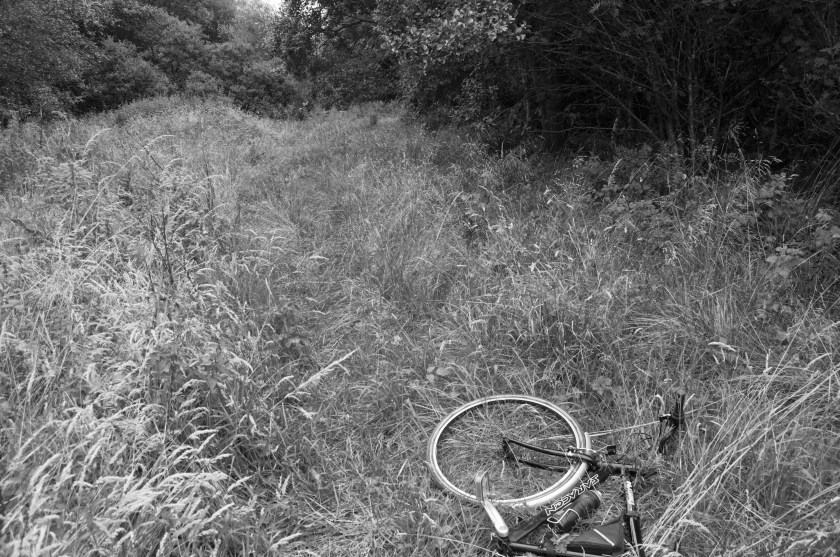
When I was growing up, we were always out on our bikes, out of town, into the local countryside, not too far from home but just enough to feel you were on your own; maybe a bit vulnerable. One time, we took our bikes out to the back of the golf course near the airport. There was a strange tower built there, and a ruined house, so we put down our bikes and wandered into the woods to see what else we could find. Sometime later we came back to find one of the bikes, the new Chopper, stripped of its handlebars, long seat and back rest. It wasn’t my bike, my old bike hadn’t been touched. My friend was distraught, his grandfather had bought it for him from winnings on the pools. It was the end of the world. The bike was left with no way of cycling it back home. We ran out onto the nearby road and flagged down a car, which we had never done before, but it seemed like the thing to do in a crisis. They had seen some boys with towels under their arms, maybe it was the bike parts. I don’t remember what we did next, we must have just pushed the bikes back home. 

When I’m out on my bike in the countryside today, there is a pleasant feeling but also a lurking dark side to the environment. You never know what is around you when you come off your bike and go wandering into a wood, as you never know what you might come back to.