Art-making in academia is pseudo-transgressive, and is boring, tired, over-thought, and ultimately irrelevant. When art is made in a non-academic, ‘real life’ context, there’s no ‘critical criteria’ – it is what it is, there is no fanfare of its status, and is enjoyable to see and experience. When art is promoted with self-appointed hierarchy, awards and critical importance, it is a turn off, but we are encouraged to judge it on these trumpeted credentials and not on the art.
I wrote this yesterday, maybe because I was a bit tired but there is something irritating me about the divide that has occurred between art in/from academia; all that research, discussion and justifying of whatever is so important; as opposed to art made in a public-life context, out-of-academia, just being playful, creative and non-judgmental.
As I’m now out of academia, I feel the divide even more. Which is actually a good thing.
When encountering art out with academia (meaning work or projects which are not announced as such) it is what it is. I can sense the creativity, collaboration and enjoyment that someone has had in making, and exhibiting their work. I don’t really care where it is to be seen and experienced; on the street, in collective space, in a commercial gallery, or in a publicly-funded or museum context. It’s all good.
When encountering art which comes from the academic context, instantly I’m not judging what I see but what I interpret from its context of self-importance. Which leads me to have a nauseous feeling of disinterest. It’s all not good.
What is it about them? What’s interesting? What’s the context and connections?
Firstly, what are their characteristics? Rebellious, awkward, antagonistic, contrary, creative? Not a member of any club, not least this one? Anti-establishment self-promoters? Men of a certain age?
Where have I come across them before?
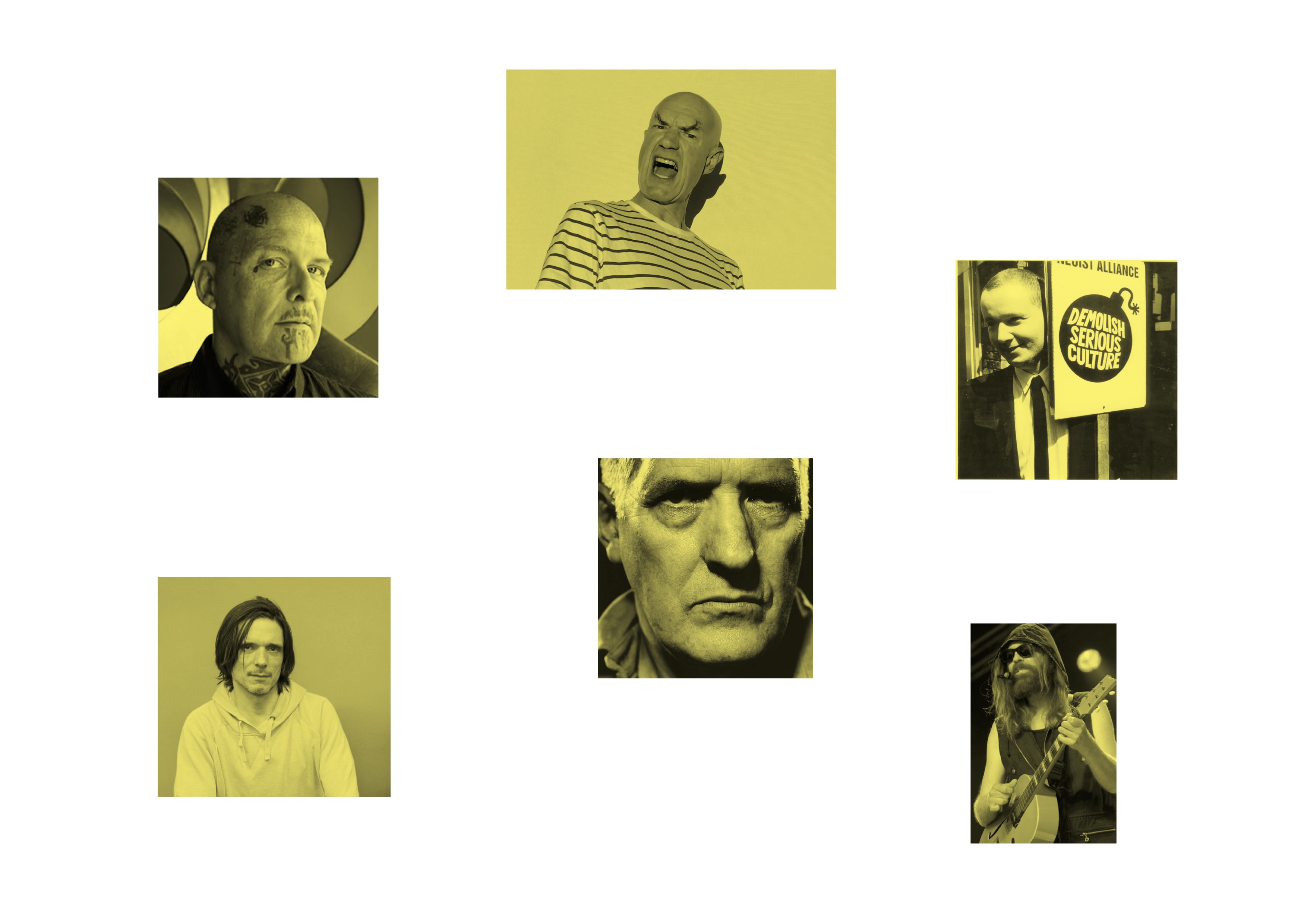
Jeremy Deller (57) Have met, in Glasgow 1996? Doesn’t fit the expected artist role, which is good and questions the practice he is involved in. Deller name checks Drummond in his Art is Magic book in relation to his film on Rave culture.
Bill Drummond (70) Have Met twice, was phoned in 2000 to help arrange his For Sale project in Aberdeen, he turns up in Land Rover and rolls out his carpet, does his performance then off he goes. Then in Stonehaven, book and film performance, 2018? Also in performance is TDB, met Drummond outside to sign book, doesn’t remember the For Sale project encounter.
Julian Cope (65) Never met, bought Teardrop explodes singles in 79/80. Big buddy of Drummond I believe, always seems to be changing gear, project visiting standing Stones in Scotland.
Tam Dean Burn (65) Met with Drummond, and seen around Edinburgh and in films. Saw him recently as singer with Scars, friends know him well.
Stewart Home (61) Never met, read some of 69 Things, had recent contact comment on Instagram saying he had met all the others (before Athey was included).
Ron Athey (61) In presence of him at CCA Glasgow, 1995? when he did performances there. I didn’t go as too scary for me, but seemed like a friendly chap.
I would imagine that they wouldn’t like to be categorised like this; bundled into a tight group, thought of as the same types, but to me there is something intriguing about the creative and well-known outsider. A rattler of the cage, pushing sticks in the spokes, getting themselves in the news for just doing their thing. Or do they purposefully go out to cause debate, conflict, and chaos?
What is it that they do to achieve this recognition and reputation?
I’m writing this as a fan and feel I have a similar outlook on things with these types. The types who shun authority, hate hierarchy, promote self-expression, but are also supportive, loyal, and creative. They are all creative artists of some sort; artist, actor, writer, musician, performer, filmmaker; and a conglomeration of all of these, when it is required.
They are just one of many who go against the grain of what is already happening, they have a knowing strategy to stand apart from what is expected and what everyone else is doing. Trickster, comes to mind again, as we need these types to challenge the convenient and comfortable. But they aren’t that extreme really, really?
They have been like this all their lives it seems, to get to where they are they needed to be rebellious and creative through their teenage and youthful years. They are now middle-aged men, who still have these feelings, and want to do things, but maybe are starting to relax a bit and just let their reputation and their work take the heat.
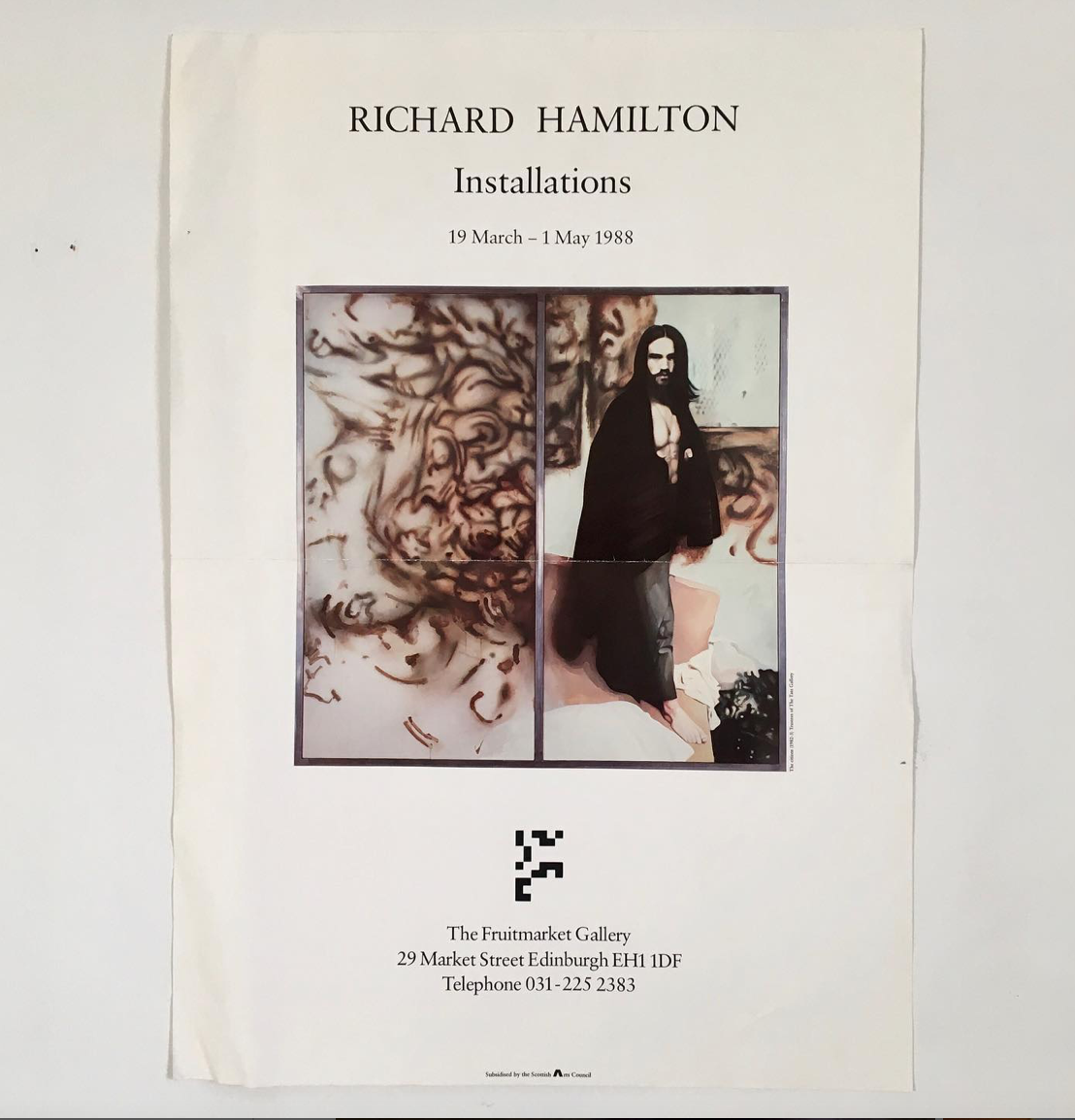
During the day, and throughout the previous week, we had been making and installing Richard Hamilton’s solo exhibition in 1988 at the Fruitmarket Gallery, Edinburgh. It was a very eventful and influential time. Not only did we assist and work with Richard Hamilton, who was an important British artist; pioneer of ‘pop’ art and mentor to many a young artist, including Roxy Music’s singer and songwriter Bryan Ferry, but the activities of the install would make a lasting impression on me in a creative and physical way.
I had studied Product Design at art college in Dundee during the early 1980s, but later I found myself as a member of the installation team at the gallery, invigilating and installing exhibitions. I liked doing this, I was good at problem-solving and being attentive to the art works’ standards but also how they were displayed and taken care of. My design training was good for the job.
Richard Hamilton had initially been employed by Hugh Casson at the University of Newcastle as a Design tutor, to run the first year Basic Course, not a fine art course in the late 1950s. His own artwork was influence by popular cultural media of the times; cars, music, advertising, technology, celebrity, and films. He was also keen on Marcel Duchamp’s ideas and art of ready-mades. But the fine art department did not consider him as a proper fine artist due to his role as a design tutor.[i]
I connected with Hamilton’s work as it was located between what was design and fine art. His work and how he thought was something which interested me. I saw art as products. An integration of functionality, design principals and societal and cultural interpretations and engagement.
In the Fruitmarket exhibition there was a 1979 work, Lux 50 which incorporated the state-of-the-art audio amplifier into the surface of an airbrushed painting, with nearby on-loan Mies van der Rohe designed Barcelona chairs. There was a mocked-up medical operating theatre with a tv monitor playing Margaret Thatcher speeches, a hotel lobby with mirrored column, patterned flooring, fake steps, and a painting of an identical hotel lobby. Another space was a prison cell, which mocked-up IRA ‘dirty protestor’ Bobby Sands’ cell. We had to paint the walls with excrement, made from sawdust and various brown coloured emulsion paints. On the back wall hung a painting, The citizen (1982-83) by Hamilton of Bobby Sands, on loan from the Tate Gallery, London.
The installation was nearly finished. We had constructed the various art works, and all was well, we just needed to tidy up. The heavy wooden Tate storage crate and its additional internal frame was manoeuvred into a space behind the gallery walls. I was on one end, then B-O-O-M, I head-butted the big yellow crate and my left eye started to swell up. Slight concussion began to set in. Richard came down, then went over to M&S and brought me back a sandwich.
I went to hospital for a check-up but it wasn’t too bad, so I found some sunglasses, and we went out, and ended up in a nightclub, where some people thought I was being too cool with my dark glasses.
Many years later I started to develop double-vision when I turned my head to the right. After various sessions and a surgical cutting of a muscle round my right eye at Aberdeen Royal Infirmary, I was asked if I had ever received a punch or strike to my head, as this was probably the cause of the problem.
I then thought about Richard Hamilton and the exhibition installation, and said ‘Yes, I did”.
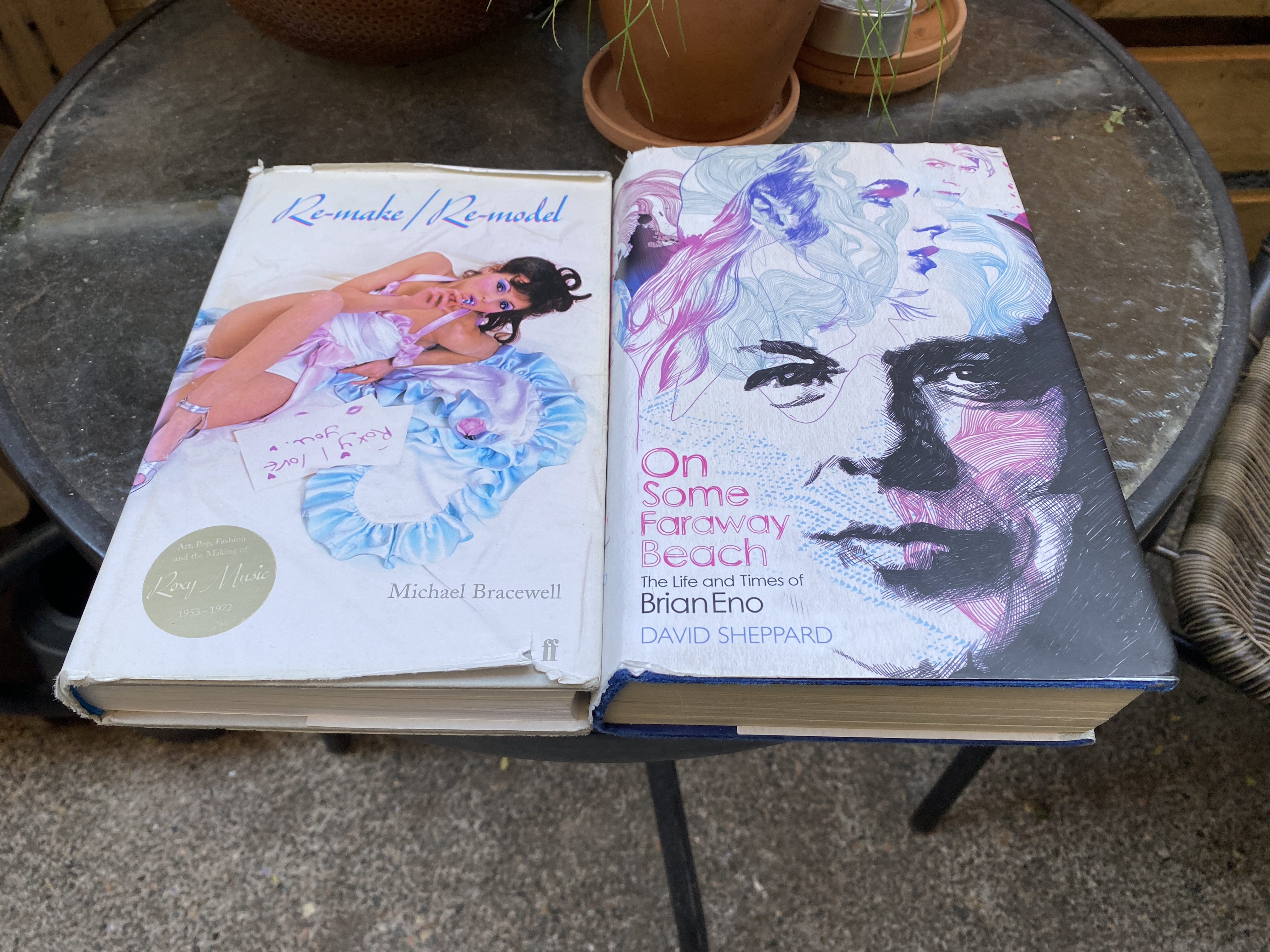
[i] See Michael Bracewell, Re-make/Re-model, 2007, London: Faber and Faber Limited.
How about we put on an artist’s talk about artists’ talks? Really? That’s such a rubbish idea, a talk about a talk, what could be more boring?
I do like an artist’s talk.
A public talk with the artist sharing their work and ideas, really helps us to understand and connect with their work. By hearing and seeing them express their reasoning and doubts about what they have produced, is a great experience and can turn your feelings about the work and the artist.
The events are usually set out like a performance, in that the artist and maybe their guest interviewer or ‘in conversation’ colleague sit at the front of a seated audience, sometimes on a stage, sometimes with microphones, and a projector, with slides of their work or related images and information.
The artists, who do it, are allowing us, the audience, to hear and think about what it is that they make; how projects or exhibitions have been produced, developed, and made by them and their collaborators, who could be fabricators, curators, research with groups of types of people, texts that they have read, and other historical or contemporary works.
Like writers, the artists are now expected to be performers. They are encouraged to go out and talk about their work in a public scenario. Not all are good, some are very articulate but all have something special to tell us. This is helps us greatly. The stories and anecdotes that they tell, let us understand their creativity. The work can be ambiguous or obscure, or even just not very good, so the public talk can be a euphoric moment for individuals in the audience, who might have been in doubt.
Lectures are too formal, and can be tricky to communicate ideas and creative rationale; talks are better, less formal, time for the impromptu anecdote, to go off-script; conversations are organic, when including another mind and voice, who maybe a critical friend of course, but is keen to draw out their own inquiry, they can be helpful or destructive with their questions. Keeping the technology simple or not even involving it, is a good plan. Too much tech can be the downfall of the well-planned talk or lecture. Computer projection and PowerPoint is the devil to some, and not good for the artist really. It seems dangerous to include film or video, simple images are best.
The beautiful sounds and images of the 35mm carousel slide projector has mostly had its moment, although apparently Dick Hebdige, author of Subculture: The Meaning of Style still lectures with broken and dirty slides, hoping that there will be some issues, to give his lectures spontaneous combustions.[1]
Some anecdotes and experiences of artists’ talks that I have attended.
At the Fruitmarket, Edinburgh during the late-1980s, while American artist Nancy Spero talked about her work. Leon Golub, her husband was in the audience making comments with such a rich throaty voice. Marina Warner, art writer talked during The Mirror and The Lamp exhibition, but the slide projector wasn’t working so I had to manually put each slide in on a “next slide” command from the speaker. Richard Demarco, arts promotor talked about Joseph Beuys and his connection to Edinburgh during the Homage to Beuys exhibition, extending the allotted time somewhat with additional input from Scottish artist George Wyllie about how important this talk was.
Design writer Stephen Bailey gave a talk at the National Museum of Scotland, Edinburgh about industrial design, but the only question asked was about how a boiler works and how could it be improved. The design thinker and writer John Thackara’s talk at RGU, Aberdeen came with a health warning that there were no images in his lecture. He even started with an anecdote about someone he had just met on the plane journey up.
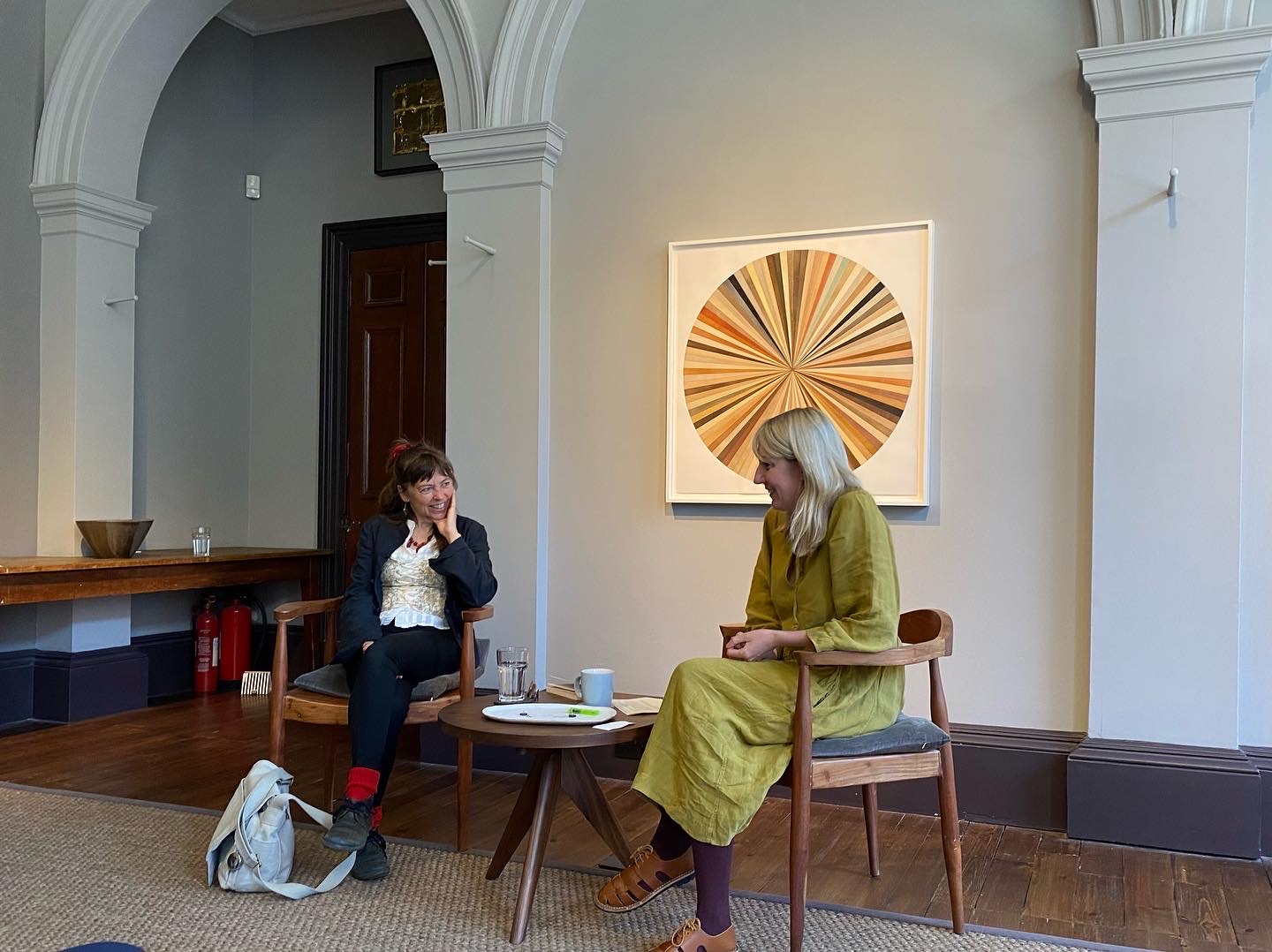
More recently, Scottish artist Katie Paterson had a conversation with the activist and nature writer Jay Griffiths at the Ingleby Gallery (image above). Upstairs, two chairs, no technology involved just an insightful and emotional discussion between them. This event has become key to my understanding of Paterson’s artwork. This could have been where the thoughts of work being ‘So what?’ or ‘And?’ came from but the discussion between the two showed their real and total awareness, thoughtfulness, and dedication to nature’s ecology and how we, as humans should be attentive to the planet Earth’s future, beyond us.
At the National Galleries lecture theatre on The Mound, American artist and filmmaker Amie Siegel was interviewed about her film work, “Bloodlines” – a slow-paced documentary style work which followed the gathering of Stubbs paintings for an exhibition. The film documented the art handlers moving around country homes which were lending their paintings, but while watching the film, there was a moment when the camera came into a large entrance hall, where a horse and fashion model where being photographed. I noticed that the horse turned its head when it saw the camera coming into the hall, breaking the fourth wall. This made me ask about these serendipitous circumstances while making films, and Siegel answered that these weren’t edited out as the process of making the film gave a focus on the actual real animals (horses, dogs, and sheep) in the locations, as well as the animals in the paintings.
Does anyone have any questions?
Then comes the dreaded moment when this is question is asked to the audience, to open it up for us to ask something random, maybe not just a question but an observation, something that you just wanted to share, in public, with everyone. Brian Eno makes a comment that if you ask a question at his lectures and talks, make it short and the answer should be helpful to at least one other person in the room.[2] Hence cutting out the indulgence of the questioner. Which is a good instruction but can be annoyingly restrictive for the serial talk attender with a notebook full of important statements and questions.
‘Taking the Sculpture off the Plinth’ is an inspiring statement relating to the changing dynamics of contemporary art, coming from the late 1960s[1], voiced by the artist Anne Bean, which I recently discovered in Michael Bracewell’s book, Re-Make/Re-Model: Art, Pop, Fashion and the Making of Roxy Music. Bean was a member of the art performance group, The Moodies. The group also included singer and performer Polly Eltes, who played a key role in the creative scene which produced the early makings of Roxy Music. Bean went on to be a pioneering performance artist in her own right, and as a member of the Bow Gamelan Ensemble with sculptor Richard Wilson and drummer Paul Burwell, during the mid-80s and 90s.
The Moodies didn’t last long as a performance group, but key enough to be mentioned in the story of Roxy Music. Their grounding through and connections to art schools for Brian Eno, Bryan Ferry, and the whole scene was an important component to what went on and into the future. Bracewell lays out the background and the various players with much conviction and confidence. He implies that it was the ‘sliding doors’ moment of Richard Hamilton, Bryan Ferry, Brian Eno, Anthony Price, Andy MacKay, Alan Lancaster and others, and their individual creativity, skills, visions and passions which would combine to create not just an art-rock band for a few years (before they became established pop musicians), but a new way for art, music and culture to be produced and experienced. It was a new way of doing things. Some core influences and ideas came from their particular art school experiences through radical teaching ideas and methods by particular tutors. Some tutors invariably got sacked or moved to other departments, when their ideas and influence were seen to challenge the traditional methods and presumed outcomes when making art (particularly painting and sculpture).
Brian Eno was introduced to the ‘Process not product’[2] mantra by tutor, Roy Ascott when he was at Ipswich College, which was a core idea and motivation as he pursued his own work in art and music. Eno’s insistence of being a non-musician, but systematically becoming a very successful music producer and generator of new music concepts and production, much to the chagrin of Bryan Ferry, shows how these early counter actions and concepts on a young mind can last a life time. Ferry made the decision to be a ‘proper’ musician, as opposed to being a painter early on, so chose to develop his art through a more traditional musical career.
Coincidently, in European art museums and galleries in the late 1960s, sculptures were literally coming off the plinths everywhere. A sculpture no longer needed to be elevated on a grand platform, like a precious gem. Pioneering independent curator Harald Szeemann’s seminal exhibition ‘Live In Your Head: When Attitudes Became Form” at Kunsthalle Bern, Switzerland in 1969,[3] exhibited work by mainly male artists who had made their art directly in the museum spaces and outside of the building. Artists such as Richard Serra and Robert Morris, were using the floor and walls, to install and ‘display’ their sculptures. The actions of Lawrence Weiner and Barry Flannigan, were tearing up the building’s structure and depositing materials directly on to the galley floor.
Anne Bean was probably speaking metaphorically, with her statement. Art was still seen as a unique and precious commodity, rather than a concept to connect the artist and their artwork with the audience. It could have been, ‘taking the painting off the wall’ but how and where would you be able to experience this? In practical terms, paintings need some form of structure to hang on, to be a viewed as a painting. But what happens when it is not one thing or the other?
American artist Jessica Stockholder’s contemporary artworks are a combination of the 2 and 3 dimensional. They are installations and sculptures that are attached to the wall at some point of their form. Stockholder considers them paintings as much as sculptures. Made from vast amounts of various materials: wood, fabrics, carpets, fridges, discarded electrical equipment, oranges; the artwork is definitely off the plinth, only to be contained by the physical boundaries of the gallery.[4]
Pop artist Robert Rauschenberg also constructed his art or ‘combines’[5] with whatever form and materials that were available. His art was a healthy mix of printmaking, painting, sculpture, installations, which challenged the traditions of art production. He would willingly use the garbage that he systematically found when he walked around the block in New York near his studio. Picking up whatever he found to use in his art.
Richard Hamilton was the pioneering British artist and teacher who is credited with influencing the young Bryan Ferry with ideas, concepts and creativity from pop and ready-made art. Hamilton was unique in his acceptance to determine the art through its process, and the requirements of the concept, as opposed to just creating more of the same. His art was formed from an array of technical and creative methods and systems. He is contentiously labelled as the artist who termed ‘Pop’ in pop art,[6] even although his art was initially what could be termed, pop, as it featured images from advertising and popular culture, he produced work in relation to science, design, architecture and literature.
Hamilton was also a keen follower of Dada and conceptual artist Marcel Duchamp. Hamilton would remake the Duchamp work, ‘The Bride Stripped Bare by Her Bachelors, Even (The Large Glass)’ 1915-1923, in a way which mirrored the copying or as Hamilton preferred ‘reconstruction’ of a great master’s painting. Hamilton would also call on the assistance of some Newcastle University art students to help him complete his version in 1965.[7] Ferry was also a Duchamp fan, taking the idea of the art ready-made into pop with his first solo album “The Foolish Things’ 1973 which included ‘ready-made’ personal pop standards by Bob Dylan, Rolling Stones, Lesley Gore, The Beach Boys and others.[8] He also titled his 1978 solo album, ‘The Bride Stripped Bare’, directly using part of the Duchamp work’s title.
Therefore, does it just take an opposite view, a counter movement or a different sequence of priority to create a new art. In pop music this was the case, countering what went before as a youthful no-taker of the existing tradition. By turning things on their heads, it makes new things happen. Taking that sculpture off of its plinth was a rallying cry, but it also needs a change of our own minds and acceptance of the unknown to make it work.
[1] Bracewell M. Re-Make/Re-Model: Art, Pop, Fashion and the Making of Roxy Music. London: Faber and Faber; 2007. p. 302.
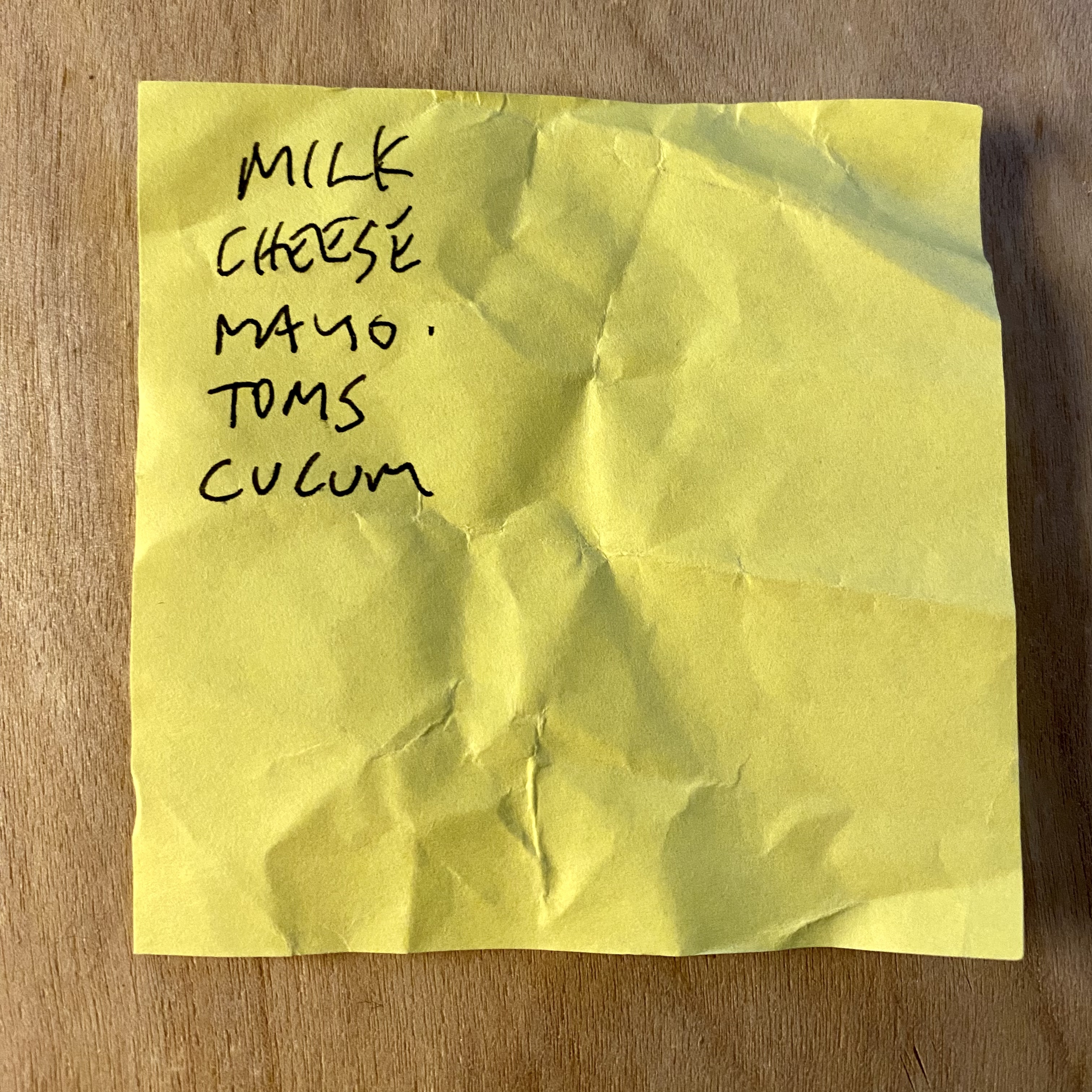
I just can’t remember things like I used to. When I go out, I always forget something; something to take with me or something I need to buy when I’m out. My mind is a sieve. What to do? How do other people remember things? Tie a knot in a handkerchief or get your phone to remind you?
The lists which we have in our heads are ambiguous and random; the lists we write down can also be this, as it’s just a way to trigger our memory. It takes the pressure off. If we didn’t have a way to record things, our minds would be full of all the things we need to do and when to do them. A list is a support mechanism to us. They are our friends, they help us to function in life and not to get stressed out and confused.
A list can be visual too, in a form which runs top to bottom or randomly around of specifically selected reference points. Or even just parts and abbreviations of things. These lists generate a context in which we can see things; things which are personally relatable, or just a confusing collision of words and things. But that’s why they are interesting and are an important activity for our thoughts and communication.
A list of names, things and ideas are always a good place to start. When there is nothing else to determine what you are planning, a list gets it down, and you can see the relation between things. Not just from one to the next but back to the start and randomly around the group of words. Lists represent the past, the present and the future. Things you remember, things that are with us now, and things which we speculate and hope for. They give us a framework of nodes to link what we are thinking about together.
“What like? designing them, or buying them, curating an exhibition of them or just writing about… ‘Chairs’.
Chairs are a real problem. They are all the same and are all different. The apparent success is to design a chair that is comfortable? But a chair that has enigmatic names attached to it – The Designer and the Maker – Designed by Achille Castiglioni / Made by Cassina; Designed by Phillippe Starck / Made by Kartell; Designed by Harry Bertoia / Made by Knoll – is a chair which is just super cool[1].
You once met Castiglioni on that college course trip to Milan, back in the early 1980s. You went to his office, and he sat across the desk; he was just laughing and sweating, probably wondering who you were; these youths from Scotland. Keen as mustard. Keen to show the maestros their ideas for lamps and chairs. You went to the Sottsass Associati office. You found you were in the same room as Ettore Sottsass, he sat at his desk across the room, surrounded by his colleagues. You quickly drew out some of your ideas on bits of paper; college projects, with felt pens, but he was too busy for you; they had bus shelters to get finished and fabricated for Verona. But you did hang out, with Taylor, Weil, Sowden and Du Pasquier from the office.
Your favourite chair is probably the Barcelona Chair, designed by Ludwig Mies van der Rohe in 1929; it features in city bank foyers, in the film, “A Star is Born” (1954) with Judy Garland, and in the installations of the artist Richard Hamilton. They had four in the Bank at St. Andrews Square. Also in the running are the redesigned ‘classic’ chairs by Alessandro Mendini. Taking on modernity and making ‘fun’ of their stiffness; creating an alternative version and in turn a ‘new classic’.
“She is right; you do love a chair”
“Yes, there is something about their scale to our bodies. They are quite subtle; formed and designed to such a fine degree that they look fragile but are engineered from materials that are strong and give you confidence”
“You don’t really want to end up on the floor!”
“They give your body a supportive but manipulative frame to make you ‘comfortable’, physically and mentally, making you feel good”
[1] Super cool? it’s subjective but you know it when you see it.
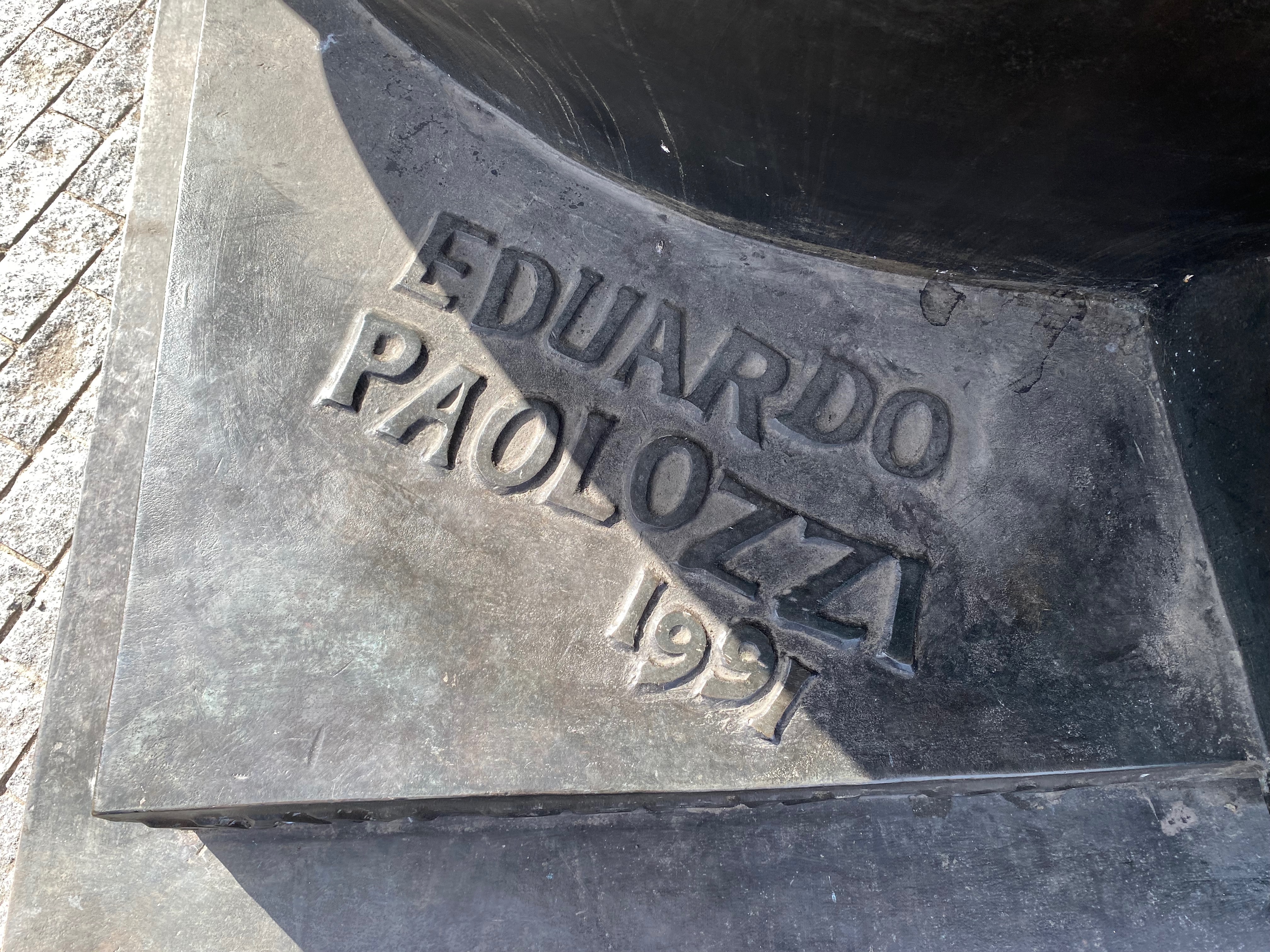
At the top of Leith Walk there is a giant bronze foot sculpture. It’s been moved around a bit recently but it’s back where it was originally intended to be. It’s a great meeting point now, somewhere to arrange a date, and hang out before going on a walk or to the pub.
The big foot, along with a hand and ankle is a sculpture, called “The Manuscript of Monte Cassino” by Eduardo Paolozzi. He was Edinburgh-born, but mostly lived in England. He was knighted and appointed as the Queen’s Sculptor. You were near him once, when he came into the gallery with the art critic while we were installing the Max Ernst exhibition. He was getting a sneak preview, as was his prerogative. There are quite a few Paolozzi works dotted around Edinburgh; at the Portrait Gallery, at the University, outside in the grounds of SNGMA and round the back by the café. There’s one giant one, “Vulcan” inside the café across the road. Last time you saw it, it seemed dusty, it sits there looming over people drinking coffees. You say you hope it has been dusted.
Also, in this gallery is his studio. It’s a simulacrum. All the items which filled his working environment have been gathered together, boxed up and redisplayed in the gallery. It’s a fine experience. There is an enormous amount of plaster casts, books, magazines, tables, toys and knick-knacks. Although you have to view it from one side, from behind a railing, it’s visually very stimulating. You have been to see it a couple of times now, over the years. It’s still the same, you presume. Paolozzi died in 2005, so his studio has become a memorial. It might have been interesting to dismantle and ship the entire building it was housed in. To fully encapsulate the atmosphere, or maybe just leave it where it was and we go to it.
Back at the Foot, you remember another sculpture being sited around here. It was a kinetic sculpture, like a crane-tower of white fluorescent tubes, switching on and off. In your memory from the top deck of a bus, you can still see it; a metal angular structure, the light moving up and down and round. You wonder where it went, hoping it’s still around somewhere, in storage at the Council roads department depot.
I’m sitting on the downstairs deck of the No.1 bus going up the Royal Mile with my mother, heading home from our trip to the Edinburgh department stores. I had just bought the new Kraftwerk album, Autobahn, which was sitting flat on my knees, and I was staring at the cover design of the motorway symbol with anticipation. This music seemed pretty exotic and mysterious to me at the time.
On most Saturday mornings, there was always something my mother needed to buy from these stores: Goldbergs, P.T.’s, Binns, Forsyth’s and Jenners. It was a required excursion, to go ‘up the town’ to these vast stores. They sold everything we needed including school uniforms, underwear, household things… and records. I bought a lot of random records from these stores. The Goldbergs store in particular was a unique experience. It stood on its own at Tollcross with huge sculptures fixed onto its façade. It was also exotic; there were parrots in cages and a top floor canteen. You could go outside onto the roof garden, and find more birds in what seemed like bright-white modernist structures. Very European, not like Scotland in the 1970s, which felt brown and grey, and maybe some orange.
Florian Schneider who was one of the founding members of Kraftwerk, died recently; it made me think of their music and how and where I heard it. To add to my Autobahn record, my Dad used to bring me back records from his school football Easter trips to Germany, so I have some odd German issue releases of Kraftwerk and Neu! albums. I still play them now as they still sound like the future. I’m drawn to the machine-like drumming and the relentless beat. I also admire the musicians’ inventive DIY attitude and direct sound. My own drumming is all 4/4, no infills and intuitive. I learnt to read drumming music at school, to play it correctly but I really rely on my instinct when I play. It makes me feel good.
“What do I know about environmental issues?” I ask myself.
Surely we should all be aware of our carbon footprint, our intake of certain types of foods, the fuels that we burn and the clothes that we wear. But I’m really not sure how consciously I do anything about it. Anyway, are we even able to do anything about it in the relation to the bigger picture? We should try of course, as a responsible human being. Products, materials and processes are being made and created constantly, it seems, so maybe it does come down to our own individual choices, and the decisions we make as we live that will help the situation. I remember seeing Al Gore’s documentary film, An Inconvenient Truth, which was a powerful but perhaps lecturing message, back in 2006. It seemed sort of hopeless at that time as we continued to drive fossil fuel cars, eat meat and buy new stuff.
I’m reading an extract from Malena Ernman book in The Observer Sunday newspaper, Malena is Greta Thunberg’s mother. Greta’s background is described through a timeline of her young life, it’s quite amazing how she has taken the position that she now has from what appeared to be a difficult early start. It appears to me that something triggered Greta to make her individual stance outside the Swedish parliament in 2018, starting the global Fridays for Futures campaign and to get all of us to listen to our children and their voices.
What have we, as older people, been doing all this time? We weren’t really paying attention, maybe we went on marches about student fees, or conscious about racism during the late 1970’s through music and gigs. I don’t think I thought about travel, learning to drive, taking planes, consuming stuff, being aware of where and how our food comes to us until about…now.
I recycle our kitchen waste, I put the recyclable things in the blue bin, we do this without thinking now, maybe it’s because if we didn’t we wouldn’t get our bins emptied. I remember years back taking a huge pile of NME’s to the general public dump out by Turnhouse golf course and just throwing them into the pile of other stuff, now I wish I had still had them, although maybe they would just end up on eBay and not in the recycling bin. And also the time that the old freezer was taken and just put into a large hole by the digger. What on earth were we thinking and doing?
During the mid 1980’s we had a studio where we made sculptures, drawings and functional things, from stuff we found in skips around Edinburgh. It was needs must, we took the discarded and made something new. Installations of objects, painted sculptures and lights. We seemed to make quite a lot of lights out of old metal pipes, reconfigured electrical equipment, and welding, like Tom Dixon and Ron Arad.
So in all this, making more artwork could be seen to be adding to the problem. Unless it’s from recycled materials, or ephemeral things and experience. It’s our individual decision, still being creative but consciously aware of the issues in our production.

 Iain Irving