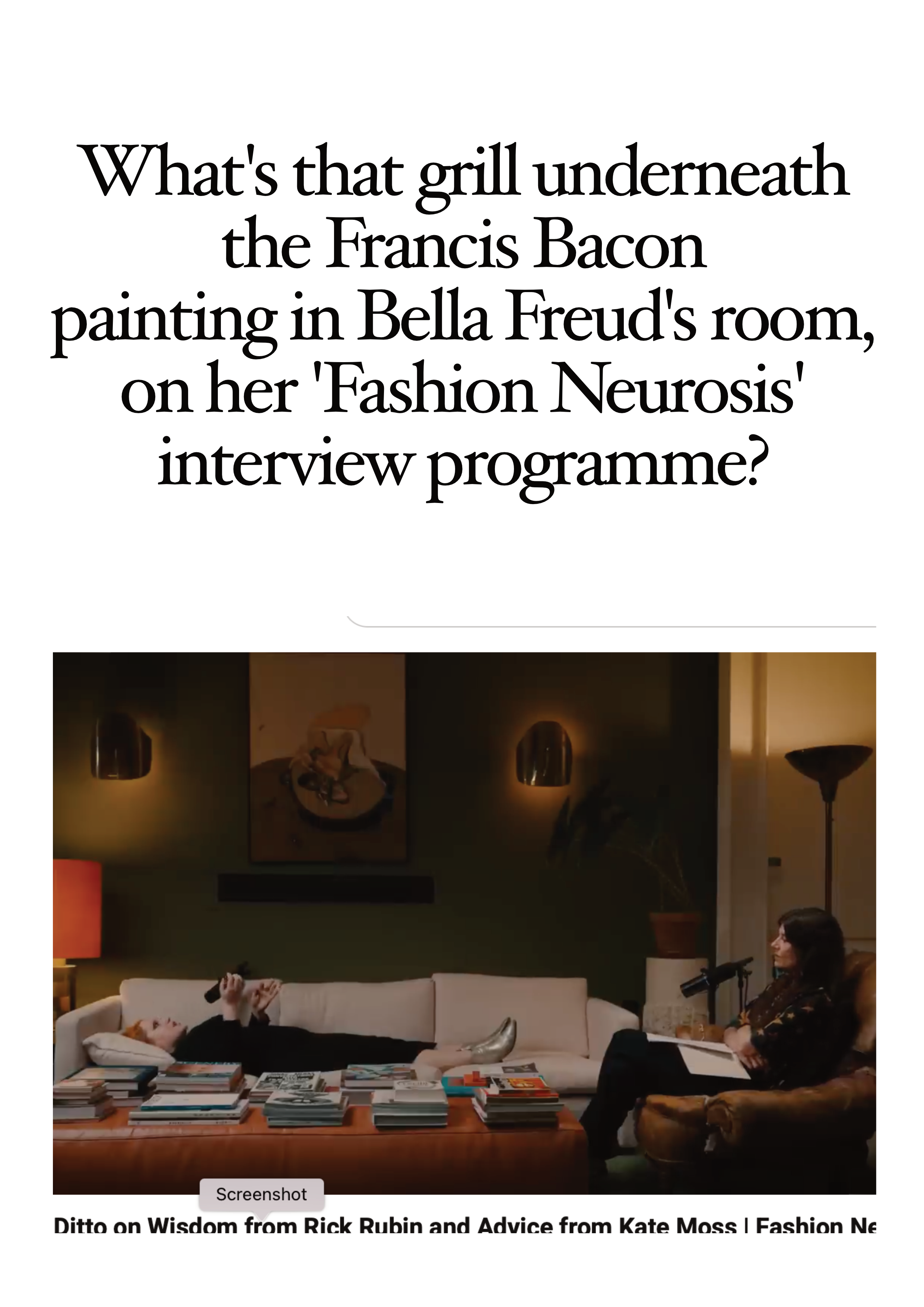
I’m sitting watching the Bella Freud interview programme ‘Fashion Neurosis’ on YouTube. It’s very interesting. Freud interviews her special guests in a ‘Freudian’ manner (Bella Freud is Sigmond Freud’s great-granddaughter). Lots of questions about fashion, family, relationships and sex. She sits to the right in a big leather armchair, while her guest is lying on a large cream coloured sofa. There is a camera directly above the guests’ head and shoulders, so a lot of the time I am looking at their face as they speak. The angle makes their faces look good. They look relaxed. Through Freud’s questions and conversation, I realise that they are very familiar with each other, and the people they know. They have lots in common. They name drop with abundance, but that’s okay, I learn things –
Helena Bonham-Carter lived with her parents until she was 30 years old; Nick Cave doesn’t like women in ankle-boots; Courtney Love comes from quite a well-off family, went to boarding school and knows a lot about fashion brands; Kate Moss has sex with heels on; Nick Knight has achieved success from failure…
Bella also tells us about her father Lucien Freud’s painting of her as a young child and later as a teenager; that she worked in the Vivienne Westwood shop, and looked after the horses for Princess Margaret on the island of Mustique. It is a real opening up of their personal lives, both sides of the conversation.
All very interesting, in fact I’ve started to binge the programme, I can’t get enough, really.
All this Freud stimulus has made me remember my brief encounter with Lucien Freud paintings. I was tasked to collect a number of small early Freud paintings for his 1988 exhibition at the Fruitmarket Gallery. I drove to Drummond Castle near Crieff and met Lady Jane Drummond-Willoughby, who owned the paintings. “Mind the tiger’, she said, as I entered the castle and she showed me the paintings, which were lying on their backs on a large dining table. I packed them up and drove back to the gallery. Freud came to the exhibition but just stayed in the café. I do prefer his early paintings, compared to his later big nude figures, too much paint for me.
Meanwhile, watching more of the ‘Fashion Neurosis’ programmes, I’m becoming conscious of the room they are sitting in. It looks like a spare room in Bella’s house. Behind her are framed images of her ‘Ginsberg is God’ text piece, used on her jumpers and t-shirts, and a colour photo of her with her father. The room is painted an olive-green colour. There are two large brass wall lights, an orange shaded table light, an ottoman in front of the sofa, which is piled with books, and on the wall behind the sofa is what looks like the appropriately titled Francis Bacon ‘Lying Figure’ painting.
But what drew my attention was the large grill below the Bacon painting. What’s it for, and why is the painting hanging above it? I don’t know. I can guess it could be a heater, or a vent where the fireplace has been boarded up. Is it meant to be there for us to question, quietly just lurking there, in the background. Maybe someone is listening to their conversations, through the grill.
Mmm, what’s with these attitudes and ways of being in the world, and most importantly in ourselves?
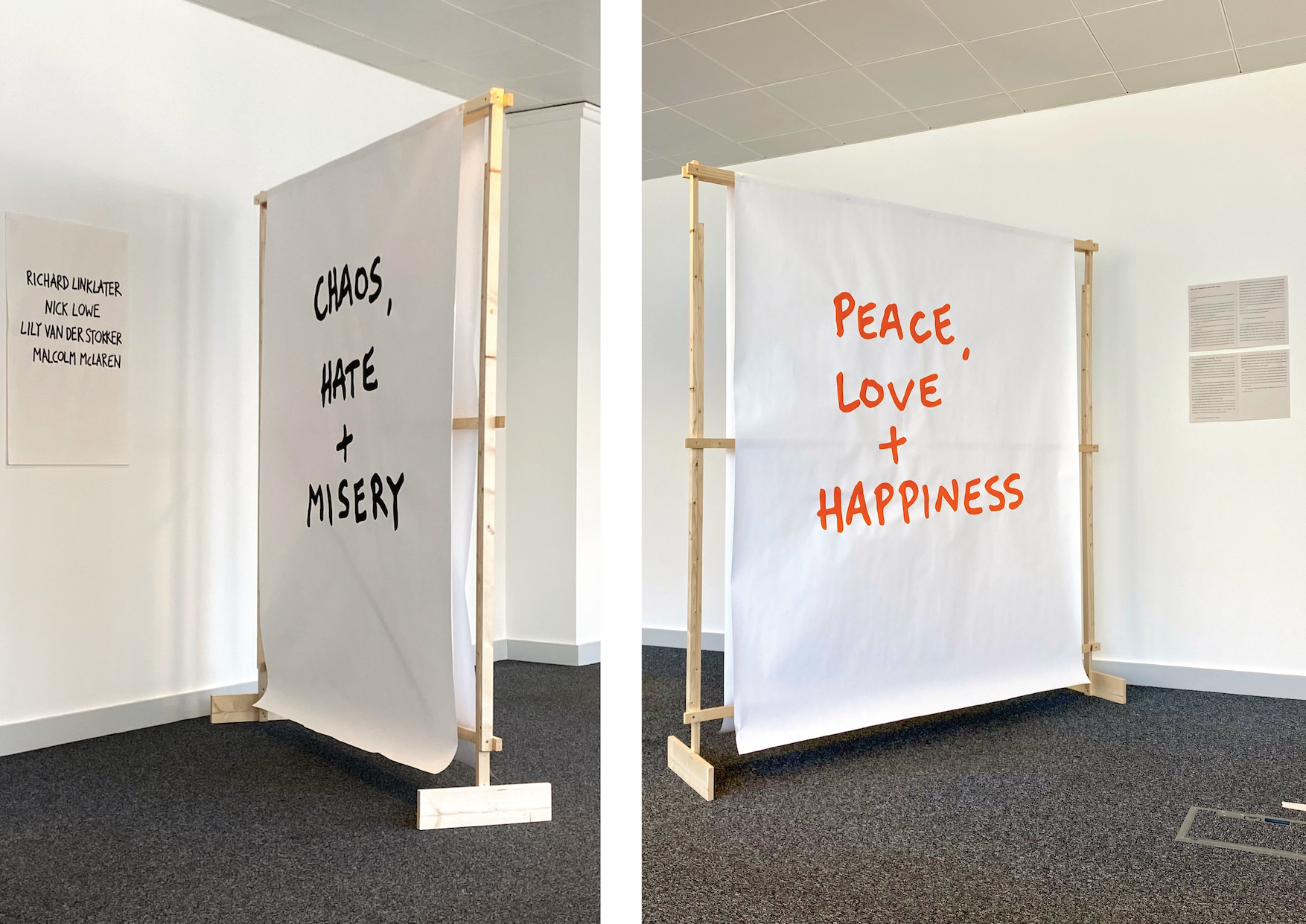
While observing the world we tend to report on chaos, hate and misery. In our own personal lives, we surely want peace, love and happiness. Chaos, hate and misery are somewhere else. Serious conflicts and hate occur not next door, not here, it all just depends on your state on mind, the life we try to lead, and the people that are around us. They help us – our family and friends, a belief that we’re going in the right direction.
I used to be told to make the right choice. I never really understood what this advice was meant to give me. My choice is the right choice, not someone else’s judgement of the choices we make.
In this text, like in life, I’m just improvising as I go, making choices of what I think about, reference and explore.
I still have a VHS copy of the 1990 film Slacker, an early independently funded film, and made with intuition it seems, by its writer, producer and director Richard Linklater. What I remember about the film was its simple premise of the camera following people around in their everyday lives, in the town of Austin, Texas, USA. It was shot as though it was all happening in one day. The camera would follow the characters, many who were non-actors, but were coached on set by Linklater, as they made their way in the city and world. The film progresses by jumping from one character’s path to another, leaving one behind then moving on with the new pickup. The characters did regular local things, but also discussed the world their friends, and issues of the time such as global warming, gender, exclusion and hatred. It could have potentially been a documentary. A day in the life, sort of thing. I loved this film, still do, and think about its rough and ready vibes, and its identification of a type of young person trying to find their way in life. The cast were mostly under 30s, so I was around 30 when I saw it. It was cool, the story was fun, it had great characters and an inspiring sense of the future, the potentials, and a concerned but willing nature to see ‘what’s just round the corner’. The notion that making a choice to either get a bus or a taxi, go with someone you’ve just met, or change your routine, is what we do, sometime without thinking, improvising as we go. It’s also the same in our choice of attitude in our everyday lives.
(Let’s all believe in) Peace, Love and Happiness.
The song, “(What’s so funny ‘bout) Peace, Love and Understanding” is a favourite karaoke choice of middle-aged men. We remember Bill Murray straining to express the beautiful melody and passion in Sophia Coppola’s 2003 film, Lost in Translation. I also love the song, I play it regularly, on my Spotify. There are various versions of the song; by Elvis Costello, Sharon van Etten, Wilco, Deacon Blue, and by the original composer Nick Lowe, written in 1974 for his band Brinsley Schwartz. It has a great sentiment, and serious message for a pop song, it questions why we don’t embrace the good over the bad – ‘the pain, hatred and misery’. Declaring the need for ‘understanding’ makes the song political, looking for cooperation, trust and sharing commitments – ‘a sweet harmony’.
I’m looking for happiness in my life, to be perfectly honest. Although it’s subjective, it’s a happy word, I read it and it makes me feel good. If it has a colour that’s even better. I also have a book by Christophe Andre called, Happiness: 25 ways to live joyfully through art,which was given to me, probably in hope of brightening me up. It’s a difficult task to make ‘happy’ art. Andre identifies various paintings from art history, by such as Monet, Van Gogh, Bonnard and Chagall, in which he identifies different feelings of what might be happiness, but I struggle to see his concept.
So, what is happy art? What art makes us happy? Personally, it’s art which stands out with colour, awareness from the artists that the work is to be enjoyable, remembered, looked at more that once. The Dutch contemporary artist, Lily van der Stokker, makes ’happy’ art, it has a sense of naivety, and a carefree way that it is made, as drawings or room-sized wall-paintings. And colour, lots of colour, playful colour in child-like doodles, shapes and words. But Stokker is an adult, and it makes her happy to produce her work, she even mixes flourecent paint in with her colours to make them even brighter. Her art makes me happy.
But ‘happiness’ is also a strange word. It’s slightly delusional, it even tries to trick us. The Beatles’ song “Happiness is a Warm Gun” which I’ve never listed to until now, is a strange psychedelic hippy song, trying to sound cool but really isn’t, (n.b. I never liked the Beatles, I preferred their individual work) as it sounds like it was written and sung with irony. The band, Goldfrapp, in their “Happiness” song continually ask – “how’d you get to be happiness?”, whatever that means?
(Let’s all challenge and ignore) Chaos, Hate + Misery.
Of course, punk lived off of chaos, hate and misery. Malcolm McLaren, the much admired/mocked erstwhile manager and director of UK punk rock and the Sex Pistols wore a Seditionaries “Cash from Chaos” t-shirt in Julian Temple’s 1980 film The Great Rock ’n’ Roll Swindle. His attitude was intentional, forcing our creativity from chaos. He was challenging the status quo to create new things, and ways of being.
People live in chaos. Perhaps we all do. But when you hear about a chaotic lifestyle, it’s a worry, you try and help. A bit of chaos, might be good, but hopefully there’s a safety-net. But chaos can lead to the end of things. If the world is in chaos, it’s not in good health. It’s unstable. We do a lot of hating really, not full-on hatred, but feeling hard done by, so we give some hate, to a person we don’t even know, or if it is someone we know, we tend not to tell them. Keep it to ourselves, as its not good to be always hating the world and everyone in it.
The message is probably therefore, ‘Be happy’, it’s good for you and everyone around us, but it’s your choice.
I wrote the following short texts in 2003, as a way to start to write about contextual narratives of my experiences in exhibition making, culture, and the world around us. They mention certain artists, their artwork, my work and tasks, and my memories and interpretation of the moments. Looking at them now, there is a naïve enthusiasm, and even wonder, that I was even connected to any of this.
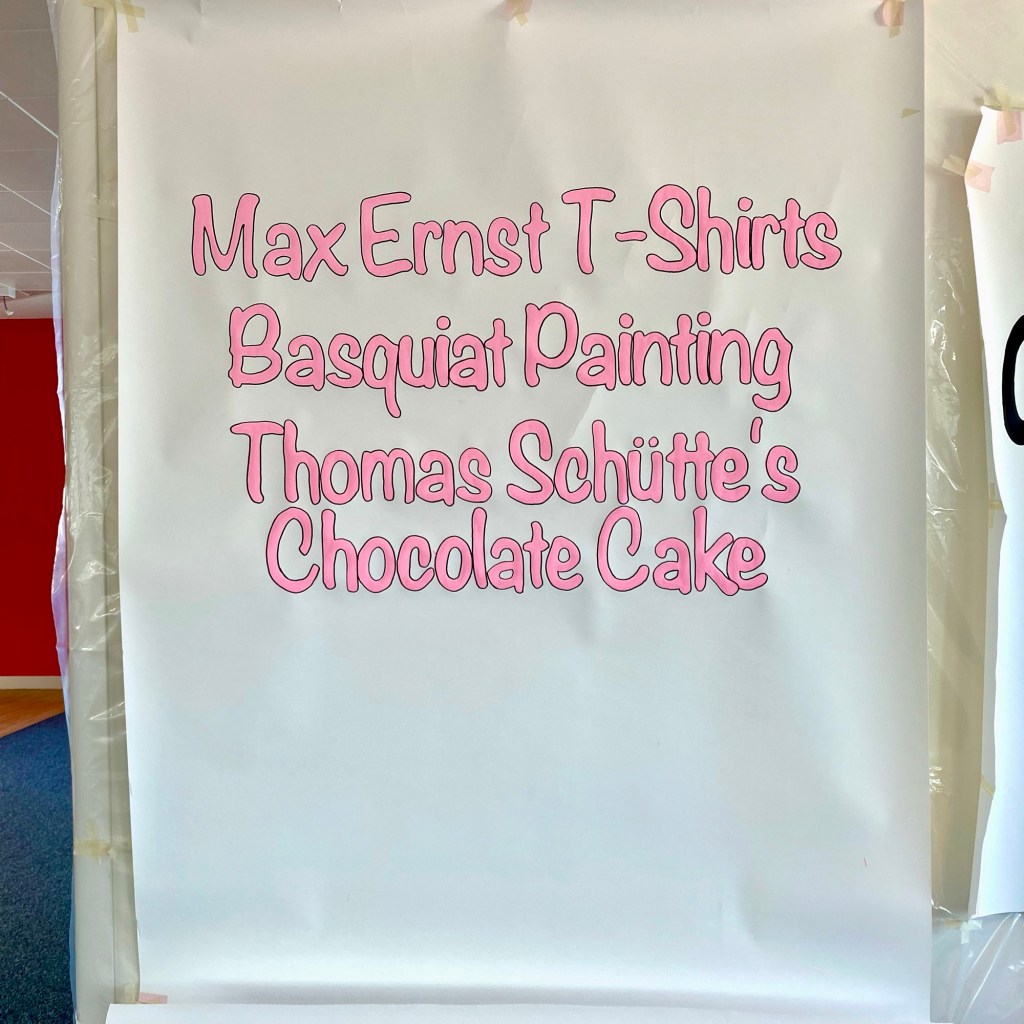
Max Ernst T-Shirts
I’m getting on a long flight plane to LAX and there seems to be a general lack of other passengers. I find my seat and try to relax, but it all passes amazingly quickly and suddenly were banking into a neon cityscape, looking down on the streets and moving cars, just like a movie. I arrive in LAX at 11pm, now what? I’ve got to get to Newport Beach, and that’s at least 30 miles south. Every time I travel, I’m amazed that you always find your way to your hotel, even when you have no idea of where you’re going. I scout around the main exit where there are hordes of people all doing the same, jumping on and off the right and wrong buses, but it seems I don’t need a bus, it’s a van taxi. Orange County? And were off, I hope he knows where he’s going, then it seems he doesn’t and he pulls out some huge street manuals and makes some calls, eventually we’re at the Marriott Hotel, very late and its 90º., I check in. I get to my room and there’s a large basket of fruit and a bottle of South African white wine from the museum as a bit of a welcome, which is nice, and three round chocolates on my pillow. I’m looking at my map, do I walk or take a taxi? the museum doesn’t seem far, in fact it’s just along the road. So, I’m down in the lobby with my large bag of Max Ernst t-shirts, merchandise for the exhibition, on my way out, the concierge wants to get me help but I’m ok, don’t worry, I’ll be fine. It’s only 8am and I’m sweating and walking, which seems to be what everyone else isn’t doing. I’m the only walker with a heavy bag, and I’m getting looked at by the passing traffic, what is he doing? In this heat? I get to the museum and there is a slight earth tremor, I’m sure, but I drag in the t-shirts which are quickly displayed in the museum shop. You carried them all this way? Why not courier them? We did, by me.
The exhibition installation team welcome me with smiles and questions, these guys could be anywhere, it’s the same routine, but these guys are very polite, all have tans, are relaxed and as I find out at lunchtime, all have air-conditioned cars with those seat belts which go over you automatically. We go to Laguna Beach for lunch, a small Mexican café. We see some surfers, my guys don’t do that stuff, never have, it’s just for rough guys they say.
Basquiat Painting
In 1985, The Fruitmarket Gallery held an exhibition of the young NY artist and friend of Andy Warhol, Jean-Michel Basquiat. The show was all his new paintings on canvases, wooden panels and doors. The show was a coupe for the gallery and the director Mark Francis, who always had his finger on the art pulse, and regularly pulled off these unique ‘time is right’ shows. Basquiat came over to Edinburgh for the show, and while he was there, he was asked to paint some paintings right there in the gallery. I think four stretchers were bought in each approx. 100cm x 60cm. He proceeded to get to work, using some photocopies of his drawings and squeezing full tubes of acrylic over the surfaces. He got it everywhere even up the office wall in his enthusiasm. He then went out to Jenners and got a full tartan suit made for himself as he was in Scotland and had the cash.
I missed the opening. I was meant to meet someone on the corner of Cockburn Street but they had already gone in and I missed the whole thing so we just went to the pub and I never ever saw him or met him. At the time my sister was running the Fruitmarket café and all week had been serving him up with various concoctions and choice homemade product. He seemed to love the food and the attention, so in thanks he left one of the Fruitmarket-made painting to her. The artist and his entourage moved on but the painting remained. She didn’t really like it, not her thing. So, it was left to the gallery to do with whatever.
Time went on the gallery put on lots of shows I was involved in many. The directors changed and moved on, the gallery needed cash, there was yet another crisis. “Where’s that Basquiat painting? asked someone, ” Isn’t that now worth something now that he’s dead? It should be but who would want to buy it?, I’m sure there is a market for it , probably in the USA”. So, I was asked to package the thing up, as it had been in one of the offices all this time. I got it down to the gallery store and started building a strong box and packing for the painting to be shipped over to Chicago, there was someone who knew someonelse who might be interested. So, it was crated and labelled to go, but before I did this and never saw it again, Brian wanted to be photographed with the painting, posing in his own imitable way, we had a bit of fun with that painting. Then off it went.
Thomas Schütte’s Chocolate Cake
Nicola White gave me my breakthrough curating opportunity some years ago, she had had an idea for a German sculpture show, which worked on the concept that romantic ‘childlike’ work also has a darker side, the show became ‘The House in the Woods’ and it toured round a few art venues. I wanted to do it but the artists weren’t selected, never mind the work or the catalogue so lots to do, a research trip to get the artists involved was needed. The trip started in Munster at the Skulptur Projekt with Rachel but I was soon on my own on a train to Cologne in search of works for the show. I eventually find the Johnen and Schöttle gallery to meet up with the gallery assistant who probably wonders who I am, but she is extremely pleasant and helpful, pulling out various works and slides of artist’s works for me to consider. They could lend me some older Martin Honert pieces but nothing new as they are too expensive, what about these Pia Strumberg works? their possible, not sure, maybe another show.
Later the next day, I’m wandering about outside the main station in Dusseldorf, home of Konrad Fischer Gallery, which still exists, Kraftwerk, and the dodgiest group of druggy types I’ve ever seen hanging around in a public space, so I quickly shoot off in the opposite direction, only to find I’m going the wrong way on my map, so I turn around, get my bearings, and off to find Thomas Schütte’s flat. He’s friendly but cool, maybe not sure who this guy from Scotland is. I can sense Schütte thinking, “Does he know anything about my work?” “What does he want?” “Can I get rid of him, although he seems to have a sense of humour”? After some time, the ice was broken and a good sign seemed to be that he got his housekeeper to bring through some coffee and chocolate cake. All seemed well, he starts offering me work to use for the show, giving me catalogues and a bit of his opinion on his next guests to his flat after me, Marion Goodman and entourage; that was real business, I was an interesting distraction to business.
I was to meet up with Schütte again on a couple of occasions in the next few years, for the opening of ‘The House in the Woods’ show in Glasgow and also in London for his big solo show at the Whitechapel, that was great, also getting to go to the after-show meal with Mariele Neudecker but she wouldn’t come into the restaurant, too intimidating, so I’m on my own. But not for long, in I go and up to the far end of the very long table where Schütte is holding court, he generously welcomes me and I get settled in for the mindless banter which seems to happen at these things, Callum Innes was there and his Frith Street folk, all very pleasant, nice bit of payback for my hard work.
It’s a rainy chilly Saturday in November, and I’m round the back of the Hibs ground off Easter Road in Edinburgh. I’ve been in to see some artists’ studios on their open studios’ day. All very creative, many interesting young artists working away, making things – sculptures with small hands sticking out of a mound of felt, drawings of lighthouses, cinemas and music venues in Scotland, small Perspex made light-boxes which look like Indian adverts, minimal architectural wall panels – just all dedicating themselves to their art. No compromise really, but their art was for sale. The studio rent is going up and they need their space to make their art. Bit of a dilemma really.
After visiting the studios, I’m outside the building sitting on a bench which is on a high concrete platform which looks like it used to be a loading bay; the building apparently was once a lemonade factory. Around the site there are newer modern flats which overlook the studio buildings and yard. I notice a guy across the yard hanging out and just talking to folk. He is Russell Burn, who was the drummer in the post-punk Edinburgh group, Fire Engines. I know some of the others in the group but I had never spoken to him. I had something I needed to tell him.
In around 1978-79, I had joined a band in Edinburgh. I had been learning to play the drums since I was 14 at school, guided by my drumming teacher Mr Grossart. I got to join the band as my school chum’s brother was in it and they needed a drummer, so I was in a band. The others were at Edinburgh Uni, and a bit political. I knew nothing really; I was still at school. And about to leave not knowing what I was going to do. I eventually went to Duncan of Jordanstone College of Art in Dundee during this time. But while in Edinburgh we would meet and practice the band in the Communist Party bookshop in Buccleuch St, making a dim, and being told by the neighbours to turn our records down. The band started to play a couple of places – The Laughing Duck pub, Edinburgh University Anthropology department student party, supporting other bands such as Another Pretty Face, Metropak and Delmontes – all good fun times. Meanwhile around the same time the band, The Dirty Reds who would later morph into the Fire Engines, were starting to do gigs and an early one was for an Edinburgh University Communist Society event in some venue in the Uni. My band mate, who was at this gig later gave me a small cymbal which he had picked up, as it had been thrown into the audience, and he thought as a drummer I might be able to use it. I never did, it was a bit split, and I had my own cymbals which I still have,
I also still have this other cymbal. I just stored it away in my big old suitcase that I used for my drum kit stands, pedals, sticks and cymbals and forgot it was there. I played my old Olympic drums and cymbals for a while after that but not really getting to play them much, as we moved around from flat to flat. The drum kit stayed in my parents’ house, but eventually it moved with me to our own family home, to languish in the garage for many years until I needed to sell the family home and clear the garage. The old drums were looking well-worn and not something I could really use anymore, although I really wanted to play drums; it made me feel good. So, I found a guy who would take them and trade for a big old ride cymbal. Gladly, they weren’t destroyed, just recycled, which was meaningful. But while setting out the drums and stands to photograph for the trader, I remembered the small split cymbal, which was there in the suitcase. I just slipped it in with all my other cymbals and took them all with me and my new Gretsch drum kit on to Edinburgh.
That small cymbal had crossed my mind a few years earlier when I had watched the film on late 1970s and early 1980s Edinburgh and Glasgow post-punk bands, called Big Gold Dream. The film had many interview pieces with the key people who were involved in the scene and bands at the time. All of them are much older now but very willing to share their stories and give recognition to the moment surrounding the Fast Products and Postcard records birth and influence on modern music culture. While watching the film, I heard Tam Dean Burn, Russell’s brother talking about an early The Dirty Reds gig. He mentions how Russell had thrown the cymbal into the audience, luckily it didn’t hit anyone, just hitting the wall and falling to the floor. It was obviously a key moment in their early anarcho-punk rock performance days to get a mention. A cool sunglasses-wearing Davy Henderson, frontman of the Fire Engines is also on screen saying with a grin, that “there were lots of eventful gigs, involving lacerations and almost decapitations etcetera”.[1]
This stopped me in my tracks. They were talking about the actual moment when the cymbal was thrown out into the audience, before my band mate picked it up and passed it onto me. For a while after realising that it had stayed in their minds too, I was somehow going to tell them that I had that actual cymbal.
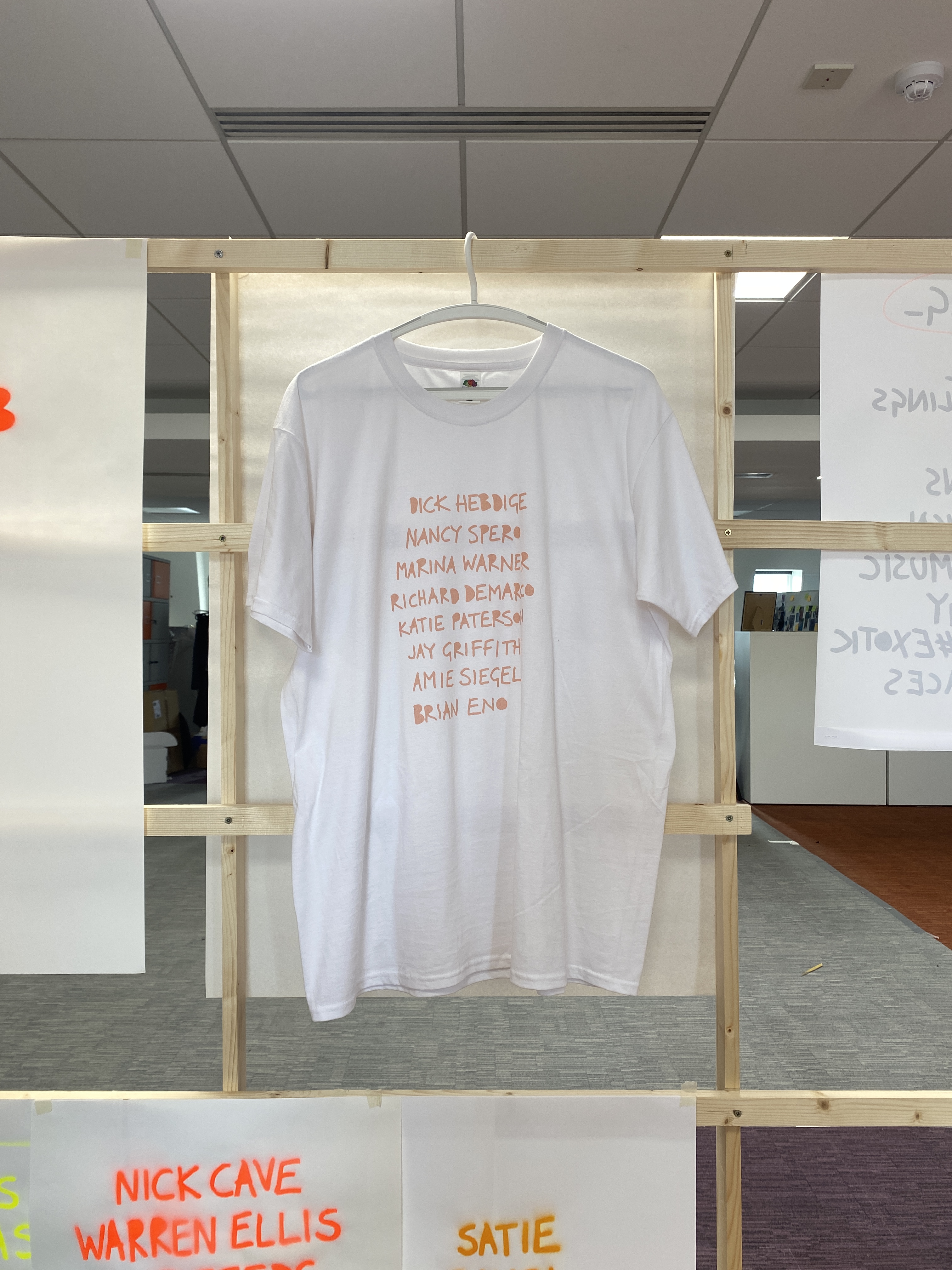
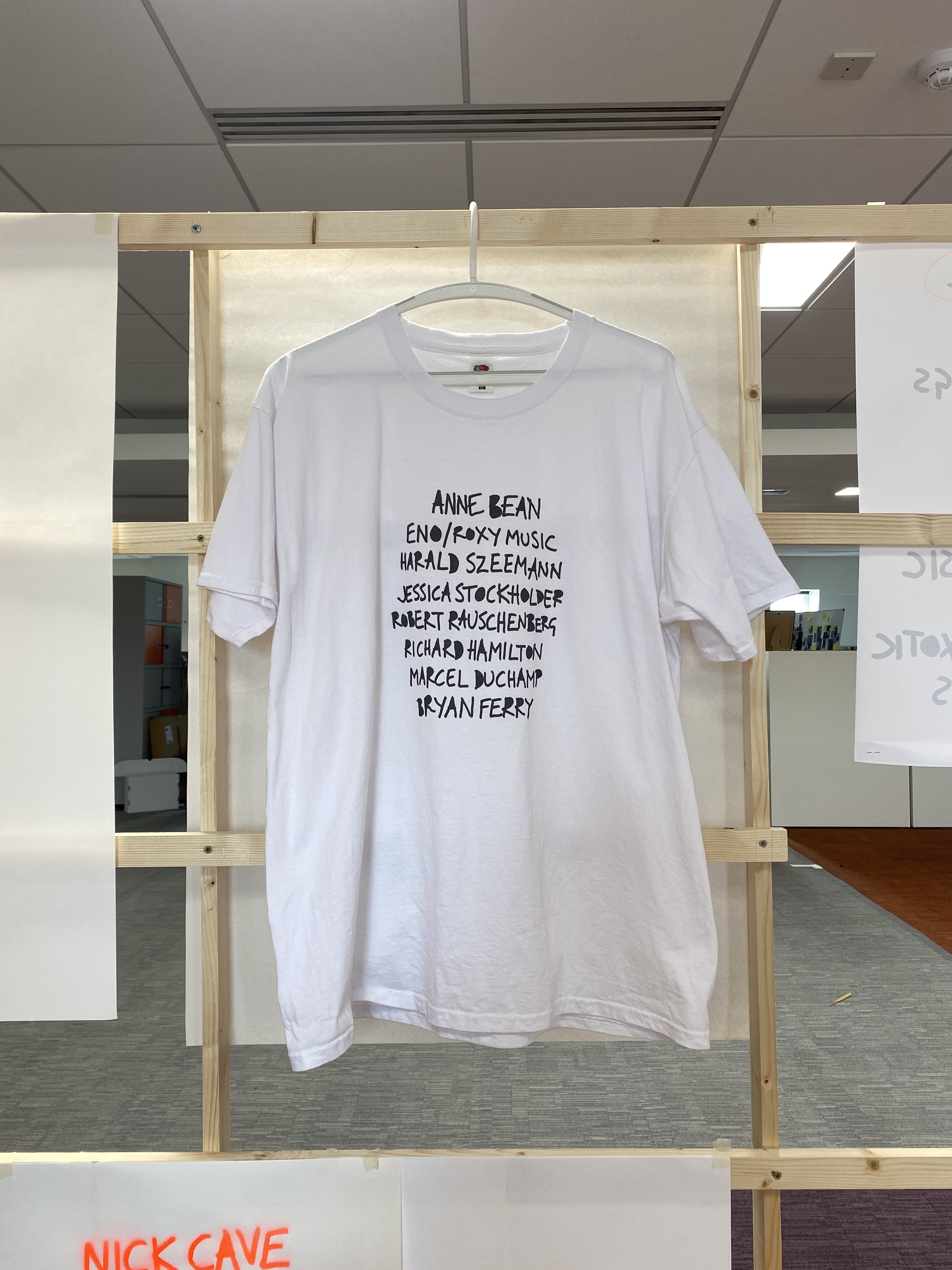
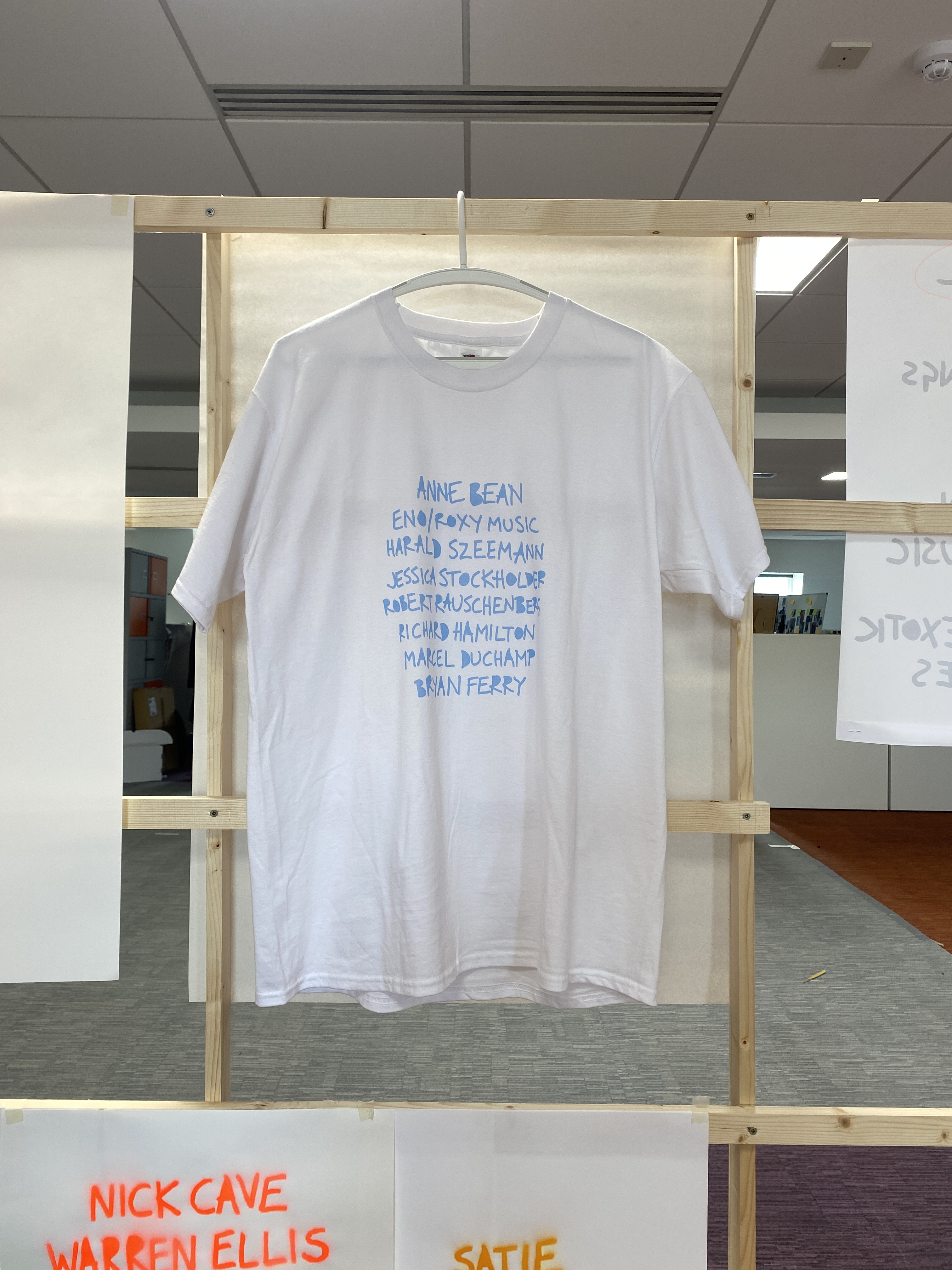
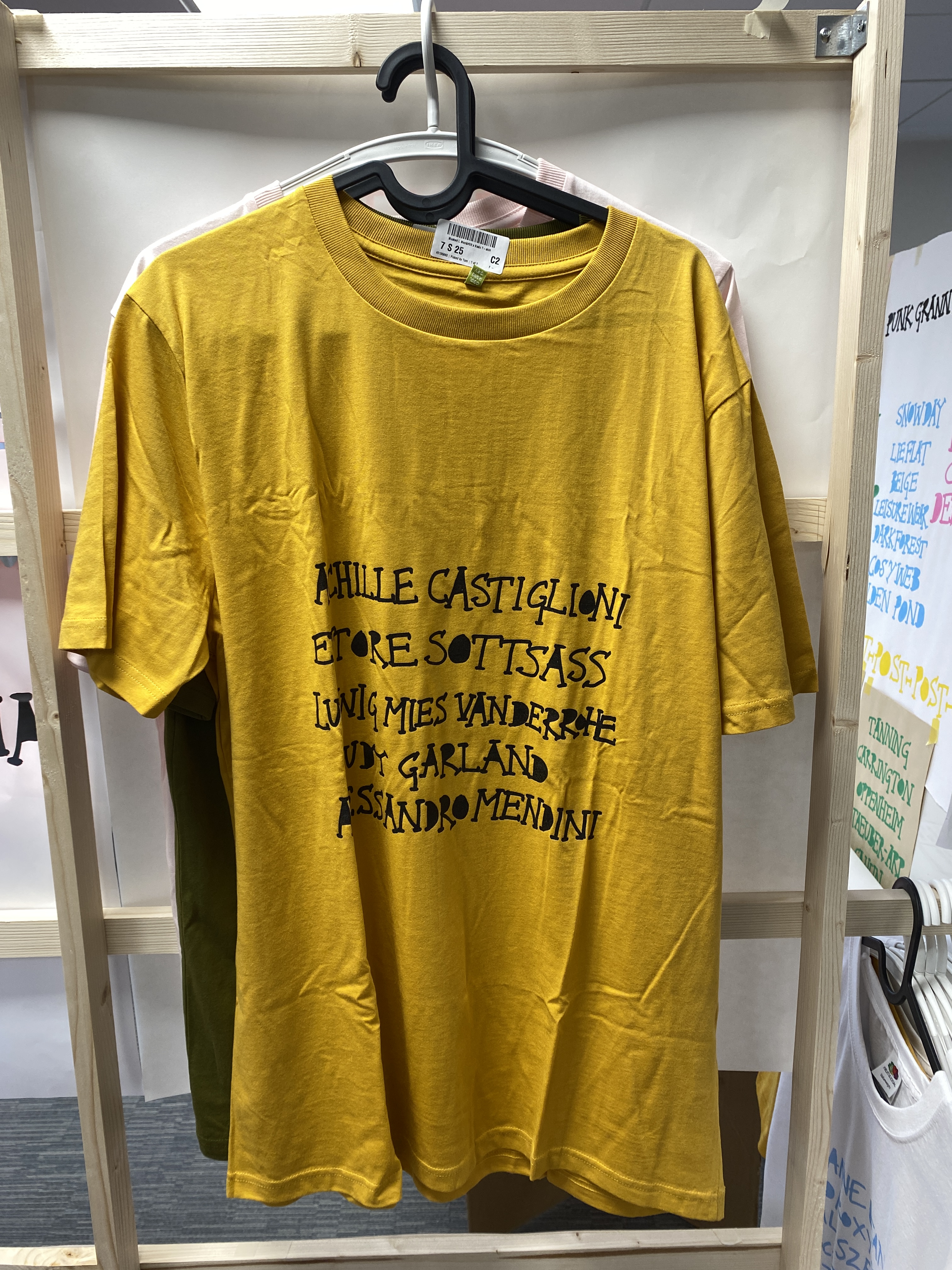
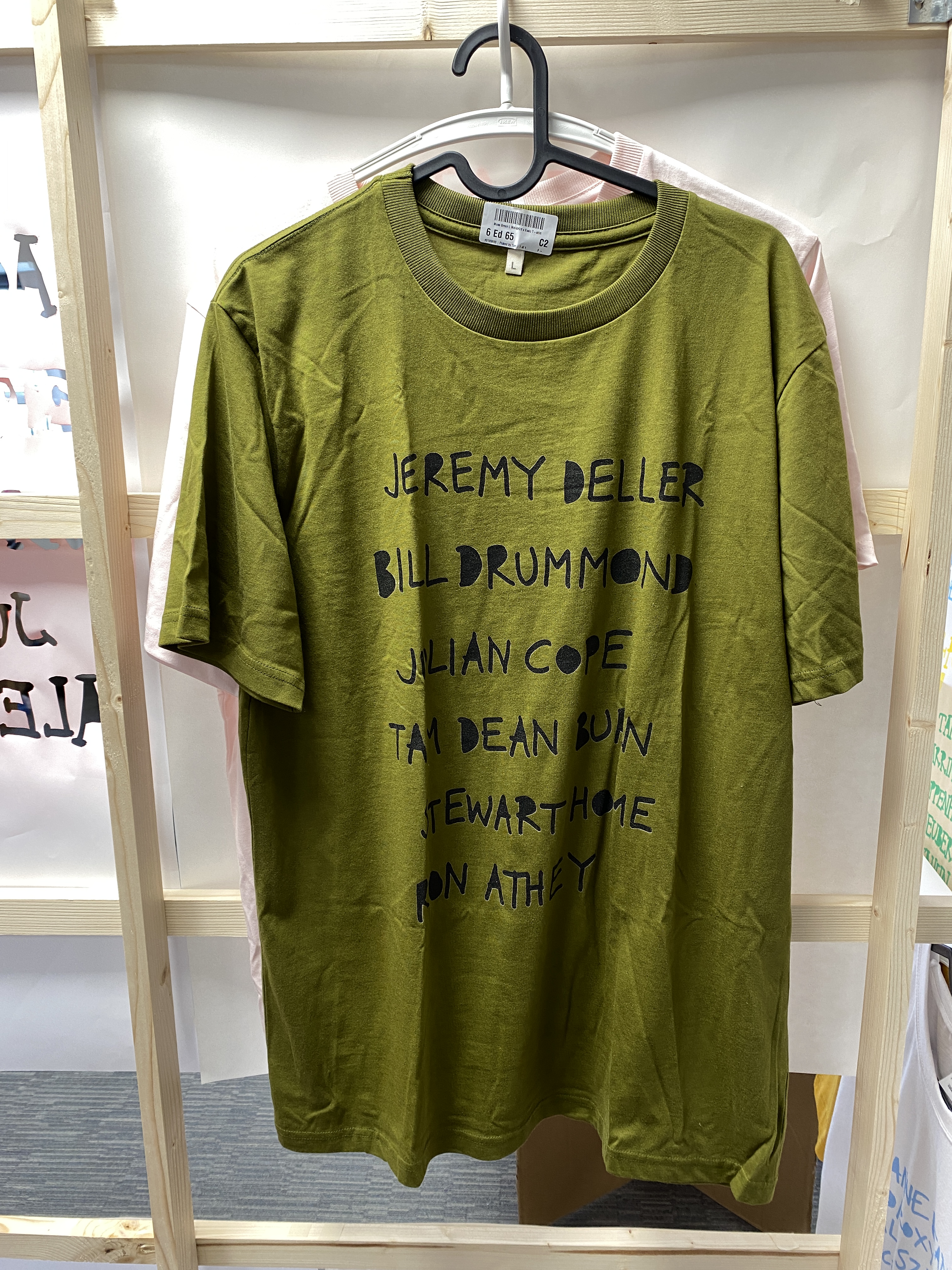
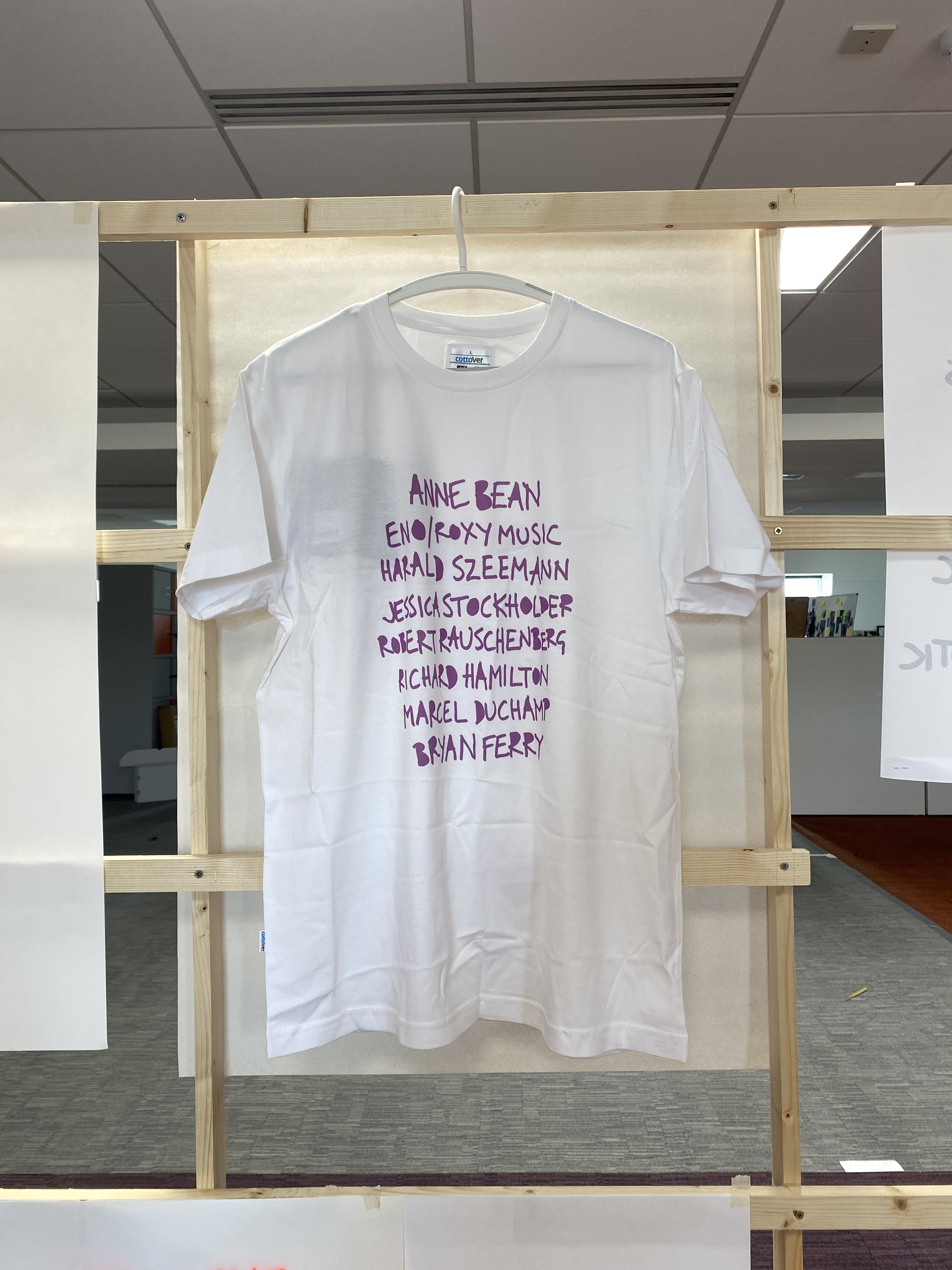
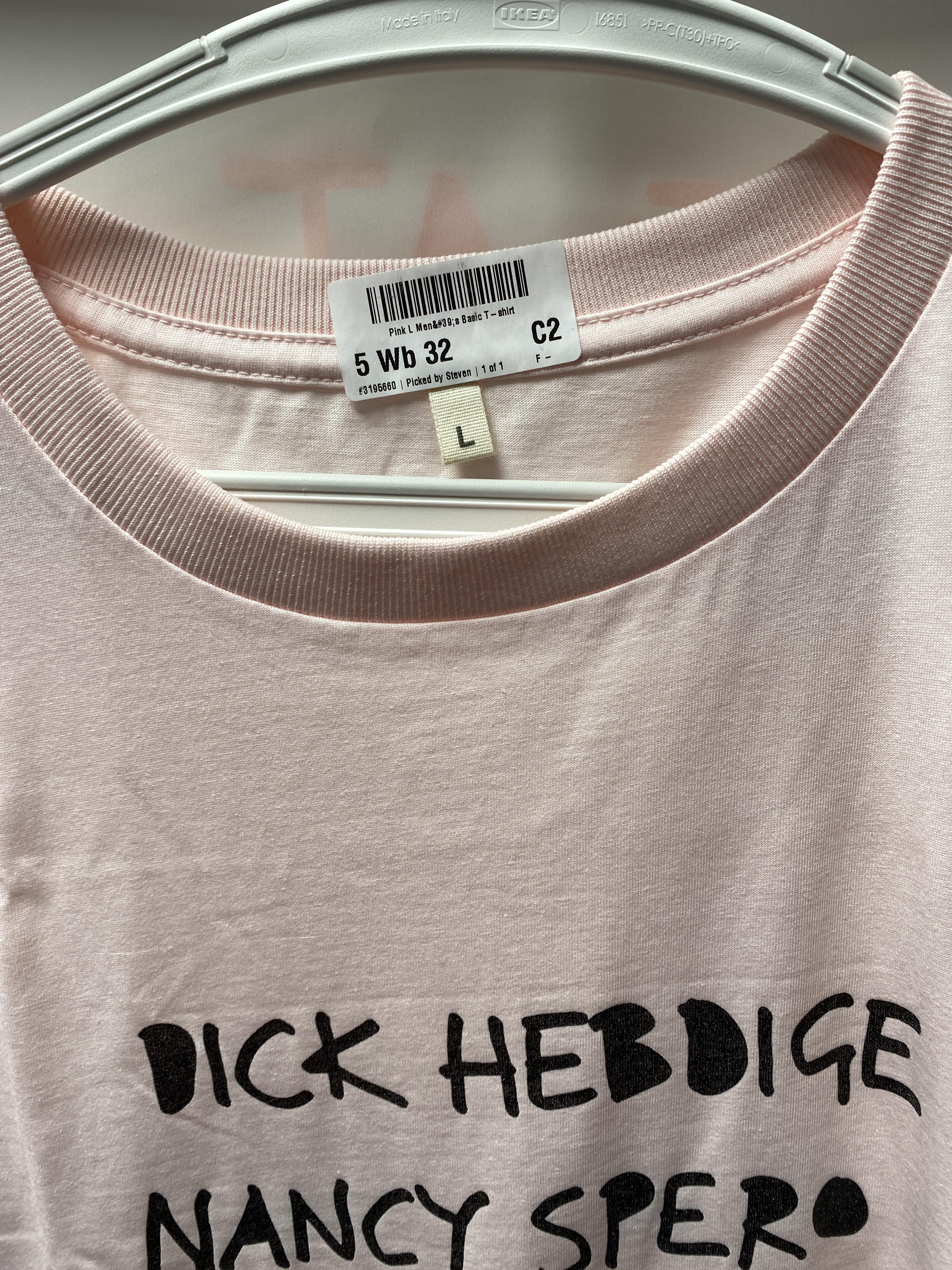
I’ve been printing up t-shirts recently, which have a list of hand-written names on the front. The names are a list of the content of some essays I have written and they are connected by a QR code either on the back of the T-shirt or a card to my website. I see the t-shirts as a publication really, the lists can be drawn on anything really: pieces of paper, cards, cardboard, wood, stickers, anything that works as a surface. The t-shirt seemed fun, but after many trials and errors with types of printing and quality of t-shirts, I think I’m getting them now, at last more right than wrong. Although, when out in shops, I find myself always looking at how others have made their t-shirts and which make they are using.
I had come over to visit these studios’ open day last year and I noticed there was a textile studio over in that other building where I remembered they had t-shirt screen making equipment. So, I go over and try to find the studio. On the way, I see there is a door open to a room which looks like a music studio. It is crammed with drums, keyboards, amps, tapes, CD’s, posters, stickers, toys, and other various music making paraphernalia. Apparently, it’s Russell’s studio.
I go outside and see if I can find him. He’s by the door, smoking and talking to someone else. I linger a bit, and don’t want to butt in, but this is my chance.
Is it okay if I see your studio?
Yeah, of course, you can take your dug in too.
So, I go inside and stand in amongst Russell’s gear. I love gear; musical instruments and equipment. I don’t know why, but it is very special and interesting to me – how things are made, what makes them, the instruments, the cymbals, the drums, the hardware, pedals and microphones. When I’m at gigs I try and get near the stage to photograph the drum kits, and the other instruments’ set-ups; before and after the band has played. It’s the same gear but after the gig the instruments are imbued with that energy and moment, adding to their experience and history.
I go back in to the yard to find Russell.
Hi, I don’t know if you know me, as we’ve never met before. I know some of your other band mates, but I’ve never met you, and I’ve got something to tell you.
I’ve seen you around, what’s up?
I start to tell him that I have the cymbal that he threw into the audience at The Dirty Reds gig at the University, how I ended up with it and where it’s been all this time. He seems relieved but also intrigued that after forty-five years, his lost cymbal has returned, like some metal boomerang that has been circling the planet, until it is remembered, called in and allowed to land.
To be concluded…
[1] Davy Henderson in Big Gold Dream, [Film] Directed by: Grant McPhee. Scotland: Tartan Features; 2015.
I once attempted to get the American artist Robert Gober to take part in an exhibition I was putting together in Scotland. I had never seen his work here before, and I was really keen on showing his sculptures. I also approached some other American artists – Cindy Sherman, Mike Kelley and Jessica Stockholder. I received a few fax messages back saying, ‘thanks but we are too busy,’ apart from Stockholder, who agreed in principal but wanted to know much more about the exhibition. The fax messages are now starting to fade with time. Stockholder eventually sent a framed drawing for the exhibition. I was hoping for some sort of sculptural work, like her other artworks, which are made from found materials and objects: fridges, oranges, timber, strip-lights, carpets, mattresses; some of which are painted, and collaged into enormous room-filling installations. But at least she took part in a small way, and was listed in the participating artists. It was the first time Stockholder had exhibited her work in Scotland.
Robert Gober, and the other American artists contacted for that exhibition, are all now significant names in western art history. They have become the modern masters. Mike Kelley, is still showing, even although he died in 2012, and he continues to have major retrospectives and touring projects.
Gober’s art is well-crafted and handmade. Pieces which represent everyday objects, which live around us, in our homes. They look like the things they are trying to be. Gober has made lots of sculptures that look like sinks, urinals, beds, chairs, plug-holes, dresses, wallpaper, bags of donuts, kitty-litter bags, and even a sheet of plywood. He is a sculptor, and an artist, so he makes things, and things that mean things. He uses sculptural techniques to mould and form his pieces, with plaster, wood, paper and fabrics. He could just go out and buy these items, sign them and call them art, like Marcel Duchamp, but he doesn’t. Gober is directly referencing Duchamp’s ‘ready-mades’ in his choice of objects he makes: this object, which looks like a chair or sink is art. The urinals give it away the connection.
While I was at college, we went to Milan in September 1982. It was a special trip to the annual furniture fair. All the current and contemporary products and objects were on display. We were product design students, but not everyone from the class group came on the trip so we were a small group. Our tutor knew some young designers who were working for Sottsass Associates. These designers had lured Ettore Sottsass to see their work – small lamps and radios which they had blatantly set up in the foyer of the V&A in London, where they were living and they knew he was visiting. From this encounter they were asked to come to Milan, to see how it would go. The designers were Gerry Taylor, who was from Glasgow, and Daniel Weil, who was Argentinian. They had both studied at the Royal College of Art in London. It was the early 1980s, products didn’t concern themselves with environmental or user-friendly concerns. It was the time of post-modernism, messing around with form, colour, materials and creating new products for the sake of it. Sottsass had been designing products in Italy, through the 1960s and 1970s, and we had became familiar with a few of his key products, such as the wire-formed fruit bowls and the Olivetti Valentine typewriter – a bright red plastic object which had a cover with a handle, so turning it into a portable office. These products were only available to us through photographs in library books and product catalogues. So being in Milan to see products directly was influential and important. The year before, Sottsass had established the Memphis design group. There are various reasons why “Memphis” became the project name, the best might be, I like to think, was during a relaxed evening that the designer friends were hanging out in their flat, drinking wine and listening to pop music, particularly Bob Dylan. Memphis quickly became a worldwide phenomenon in the design world which then became highly influential throughout the 1980s. It lost favour as tastes changed but continues to be traded as design ‘classics’, being collected and sold for high prices. Sottsass was maybe looking for sharp creative young designers and Taylor and Weil potentially fitted in. In the creation of Memphis as a project within Sottsass Associates – it originally was just a pet project not intended to make money – they continued to design municipal projects for Italian councils, such as bus stop shelters in Turino, for income. Along with the core designers, Memphis was also overseen by Sottsass’ partner Barbara Radice. When Taylor and Weil arrived in Milan, Taylor was incorporated into the Memphis group, Weil wasn’t. Radice apparently wasn’t so sure about his design work. Weil’s ideas and style didn’t really fit with the Memphis stylebook. His radios, fruit bowls and lamps were maybe too clever; too meaningful, maybe too art.
Weil was a thinker. His products had reference points, there was a point to them: why they were the form they were, why they were designed and why they existed. They referenced Marcel Duchamp’s sculptures and artwork. Those readymades, the found objects, appropriated and turned upside-down to become something else. Duchamp’s readymades are products. They were manufactured to accomplish an everyday task. The snow shovel, bicycle wheel, wooden stool, bottle rack, coat hanger and the urinal. These ‘readymades’, are designed and manufactured objects, which have purpose. It is their selection, altered to non-purpose, with an added signature which made them art. Duchamp’s selected ‘readymades’ were objects taken out of context of their purpose. They were identified by Duchamp for their sculptural essence.
Duchamp seemed a supportive, practical and problem-solving type. He selflessly limited his art making through his career, and gladly participated in the production and organising of projects and exhibitions for other artists. Duchamp also realised that he could potentially make money from making small reproductions of his existing artworks, so he developed and produced his multiple work, La Boîte-en-Valise (Box in a Suitcase) (1935-41).
Daniel Weil made products which he could prototype himself before they were batch manufactured in Japan. His ‘Radio-in-a-Bag’ was simply dismantled radio parts sealed into a clear PVC bag which had been screen printed with colour strips, black and white check squares and the word ‘RADIO’. I saw these for sale in London in the early 1980s, on a previous college trip, but didn’t buy one. There is an example of this radio in the V&A London collection. Weil’s products were integrating a conceptual idea, a new way of thinking about a product and its function, but also producing an inspiring design product. They also encouraged people learn a new way to achieve something.
In 1985, Weil had an exhibition of his work at the Architects Association, London. For the exhibition he also made a box, which was the same size as an LP cover but a box set width. Weil’s ‘Light Box’ housed a wood-effect palette-shaped paper pocket containing cards illustrated with coloured drawings of his products, a booklet of essays about his work, a rolled-up textile with images of his drawing products, etched plastic component boards and behind these items was a black and white checked paper insert. This box was a direct reference to Duchamp’s La Boite-en-Valise box, which had contained small replicas of his readymades and artwork.
On the National Galleries of Scotland website, it states that you can contact them about viewing an artwork from their collection, which is not on exhibition in their galleries, but is stored in their warehouse spaces or in the print room archive drawers. I checked their catalogue as I knew that they had an edition of the Duchamp Box. I had seen it on show, I’m sure, years ago. Yes, it was there, listed, stored in the Modern 2 building print room. I was keen to see it. It’s catalogued as a ‘deluxe edition 2/20’, and if so, it is quite significant in the early stages of production of the boxes. It may be the one which was given to Henri Pierre Roché, who was initially described as ‘a general introducer’ [1] by Gertrude Stein, and became a close friend of Duchamp’s for forty years. So, I contacted the galleries and received an email reply saying that the box was too fragile to be seen, and could only be handled by their conservationists. A bit disappointing, as I didn’t need to handle the work per se. I was aware that it would be very fragile, particularly due to the materials that it was made from. I was informed that a film of the box being ‘handled’ and opened up was available on their website. I had watched this already, but I just wanted to see the work in real life, so that I could take in its aura. It is just made of card, paint, cellulose film, plastic, ceramic and adhesive tape. The deluxe editions had been produced by Duchamp (the regular Box edition, which ran into 300 were put together by the artist Joseph Cornell and Xenia Cage), and included one unique piece made by Duchamp. So, I thought this would be interesting to see, and enable me to make connection with the Daniel Weil’s ‘Light Box’ which I own a copy of.
As well as the readymades, Weil also referenced Duchamp’s ‘The Large Glass’ artwork. He made 3-dimensional versions of the ‘Bachelor Apparatus’, which were perspective studies of elements making up the imagery on the glass surface. Weil took these and made lamps of the ‘Sieves’, made from plastic kitchen funnels, arranged in the same form. The British artist Richard Hamilton of course, had been interested in Duchamp’s ideas and work. He became a colleague friend of Duchamp’s and followed him to Los Angeles in the 1960s, where he discovered American art. His painting of a cheap lapel badge saying ‘Slip It to Me’ was indeed an epiphany to him, of the ‘audacity and wit’[2] in American art, and returning to Britain would work on art which would be considered ‘Pop’. In 1966 the Tate Gallery in London organised a Duchamp retrospective, for which Hamilton was commissioned to remake a new physical version of ‘The Large Glass’ for the exhibition. The original work was in the permanent collection at the Philadelphia Museum of Art, and had been famously damaged in transit, so a replacement piece; a readymade piece, seemed a good solution. These versions of versions, gave each new object an informed context, the ideas and concepts became the reason to make the physical works they became. Weil was trying to integrate Duchamp’s ideas into his own work by making from remade versions of Duchamp’s and by consequence Hamilton’s art.
Unfortunately, my visit to the National Galleries of Scotland storage was not to be. I tried again but I didn’t get to compare and contrast the Weil and Duchamp works. The conservation department were too busy to allow me to view the Duchamp work. But at least I know that it is there, that is being taken care of, wrapped and stored, until a time when it is appropriate to bring it out and enable us to view it. Of course, the irony is that there are new cheap versions of this work available online, as ‘readymades’ of the box of Duchamp readymades and other works. Perhaps they could just make a new version, to be seen and handled, without the danger of damage.
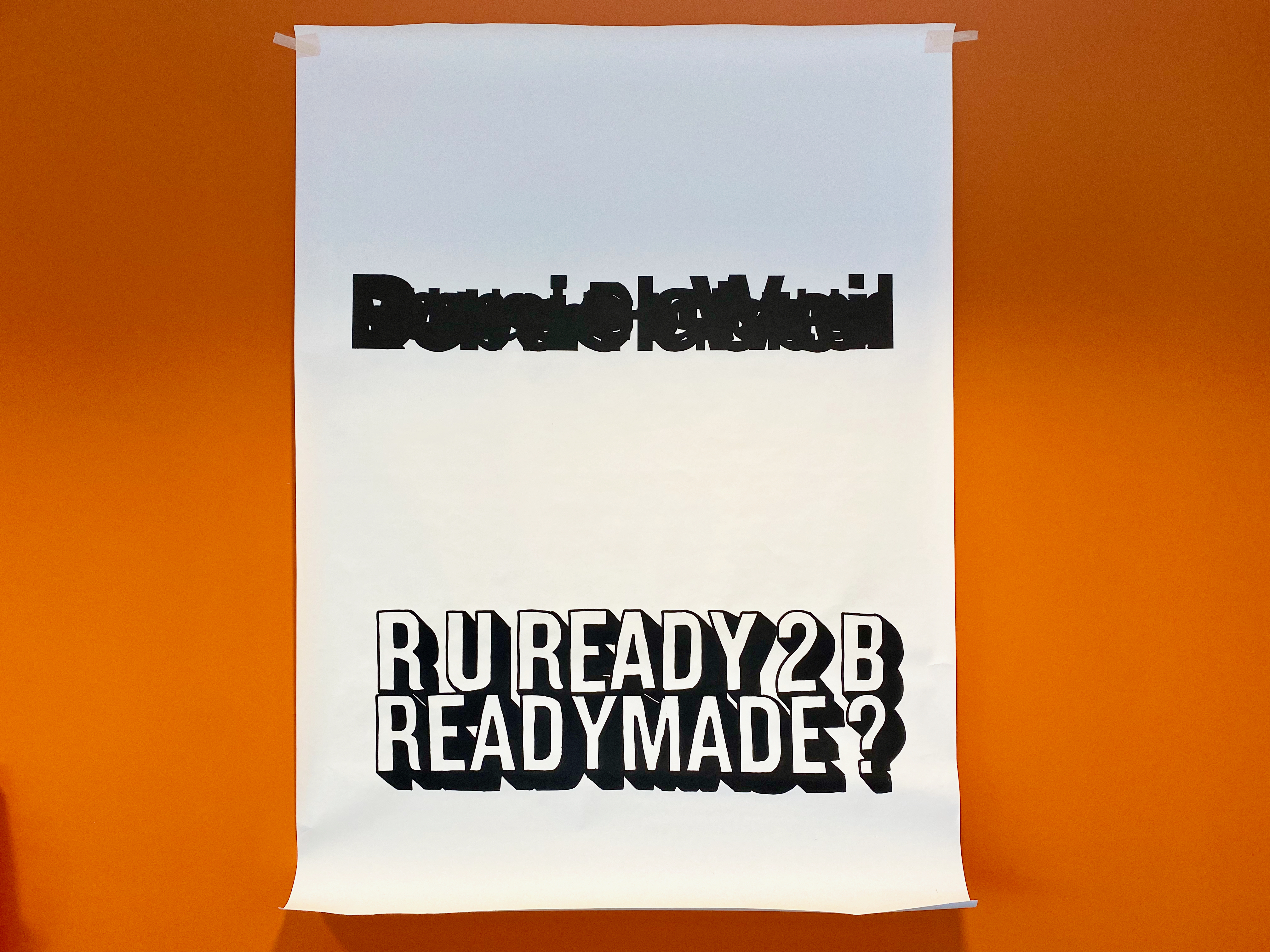
Although Duchamp limited his artistic output, other artists and designers since have made their new work from these sources, producing art and design work, mixing up the subjects, allowing art to be design, and design to be art. The subtle slippage of what-is-what challenged those who thought they knew what things are. New ideas, products and art already exist, we just need to be ready to accept the remakes of the readymades.
[1] Tompkins C. Duchamp: A Biography. New York: The Museum of Modern Art; 2014.p171.
[2] Hamilton R. Collected Words: 1953-1982. London: Thames and Hudson; 1982. p55.
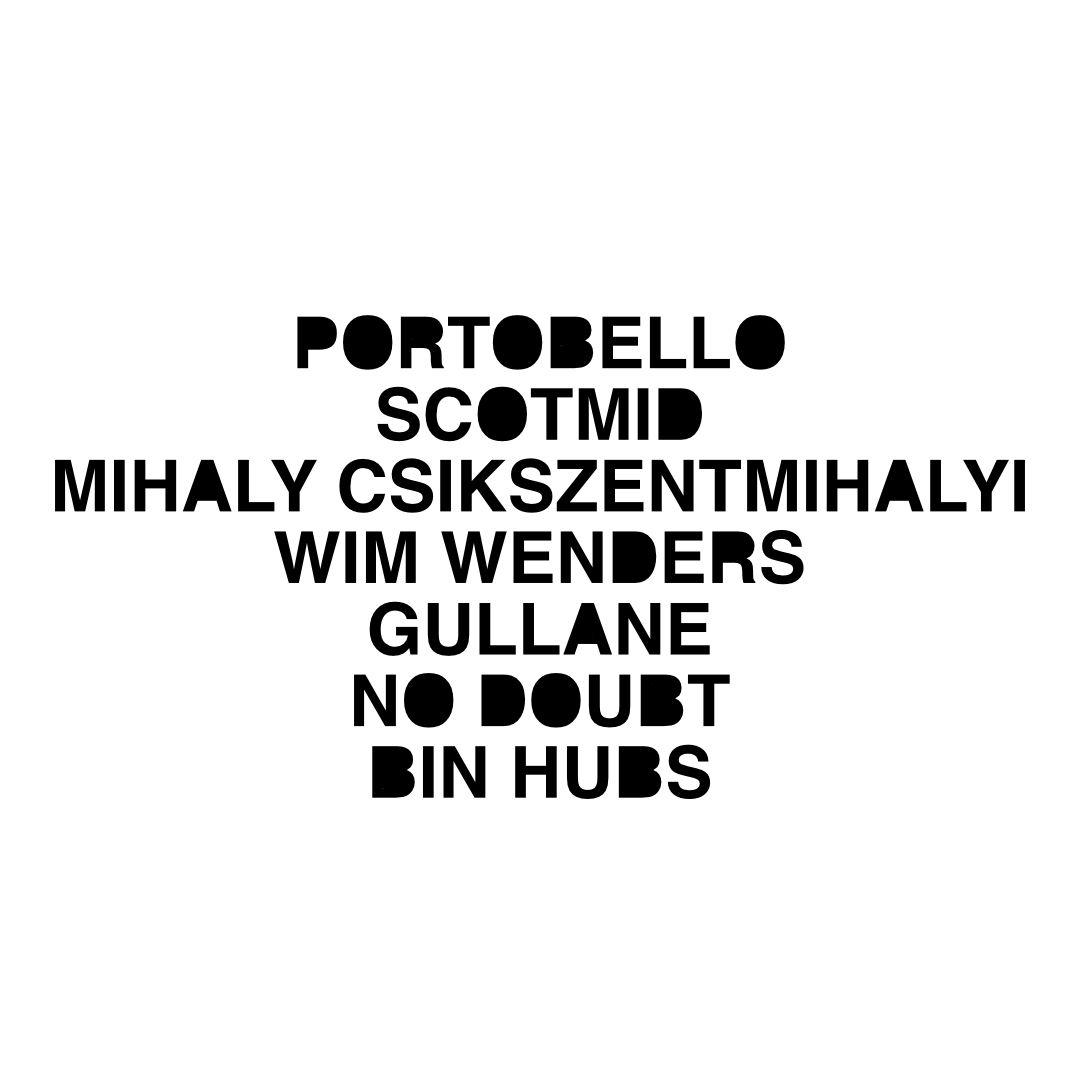
I went out to my car, which was parked in the street just by my flat, and opened the hatch-back door and put Toby, my 15 years-old Border Terrier dog into his travel cage. I then drove through the busy Friday morning Edinburgh traffic, with Radio 3 playing to help with my mood. I decided to take the route out through Tollcross, along Lauriston Place, round past Greyfriars, by the museum, them down the little narrow street onto the Cowgate, through Holyrood Park, passing Meadowbank and onto Portobello.
There was a little car park just off Portobello High Street where I seem to always get a space, so I parked up and Toby got out of the back. It was really cold with a brisk wind that made it feel much colder. I walked along the promenade a bit towards the amusement arcade but then went down onto the sandy beach. Toby always seems to love to run out on the sand but he kept looking at me, so I took a photograph of him standing in the wind looking back at the camera, which I put up on my Instagram. I used to post images all the time but recently have laid-off doing this while I was ill. I just didn’t feel the need to share things.
I continued to walk along the beach, then up onto the promenade, and into that beach café to see if I could get a takeaway coffee, but it was really busy with people queueing up for lunchtime already, so I came back out again and just continued to walk along the promenade. Thankfully there’s no sign of Toby’s limp he picked up the other day when we were in Inverleith Park.
I walked all the way along past the Portobello swim centre, but then turned around as it was so cold in the wind, and came back along the promenade. I checked into the café again but it was still very busy but that’s okay. I decided to take the side road back up to the High Street, maybe get a coffee somewhere, but I noticed that there was a Scotmid supermarket up a side street, so I tied up Toby on the railings outside with his lead and went inside. I selected a meal-deal of a chicken-salad sandwich, an iced-coffee thing and a flapjack, and also bought a Guardian newspaper. Putting my lunch into my bag, I then went back out onto the street, across the High Street crossroads and into Tills second-hand bookshop which was a very nice place, as I’d been in a few times before. I had a good browse along all the shelves to see what they had. There were many very interesting books such as “Finding Flow” by Mihaly Csikszentmihalyi, classic dramas, Philip K. Dick short story sci-fi, a Douglas Copeland novel, “Girlfriend in a Coma”, various editions of “Catcher in The Rye” with different covers; that sort of thing, lots of stimulating reading, writing and graphics.
While I was browsing in the bookshop, I began thinking about the director Wim Wenders’, “Perfect Days” film that I’d seen the day before at the Cameo cinema, in which the main character regularly goes into a little bookshop and finds cheap books to read. He buys various thin books but I can’t remember which ones they were, I need to check back on the film in some way as it would be great to find the very same ones. I really need something good to read just now, as the compilation book of music journalism by Tom Hibbert I bought recently was actually rubbish and not very interesting. He sounds like a bit of an idiotic public schoolboy from the 60s, who gets lucky in the 80s by working his way into journalism jobs on Smash Hits and Q magazine because he knew the people who were editing those magazines. I really need something good to read, something stimulating in its writing, expression and ideas.
In the bookshop, people asked me about my dog, which was always the case when I’m out with him, a mother with small children, and a woman who was sitting in the shop’s window space with her laptop and headphones, which actually looked a bit awkward. So, I came out of the bookshop, went to the crossing then walked all the way along the High Street and into the Portobello Bookshop. It was a bit pricey, retail prices and no discounts, but they have lots of interesting things out on-display, so I looked at various books on music and art then sat on the benches at the front window. I checked my Instagram post of Toby on the windy beach to see if there were any likes, which there was. I then walked back along to little carpark where my car was parked and just sat in the warmth of the car and had my sandwiches that I had bought from the Scotmid. I tried to open the iced-coffee can but it splashed all over the place, which was annoying, although it was quite tasty. While sitting in the car I watched people trying to reverse into tight parking spaces.
It was still only early-afternoon so I decided not to go straight home and drive along the East Lothian coast road which goes through Musselburgh. I took a left out onto Portobello High Street, taking me out along to Joppa to Musselburgh; through Musselburgh, past all the shops and S. Luca’s specialist ice cream shop (est. 1908). Turning left at the roundabout and along the coast road, past Seaton Sands caravan park. Along the left-hand side was the Firth of Forth, and it’s great just to cruise along in the car. It’s cosy and safe, with the radio on. It was still very cold so I just kept driving. I drove through Aberlady then kept going all the way along and all the way up towards Gullane, which is a golfing town. There are golf courses on both sides of the road here, with the golfers firing their golf balls across the road. I then took a turn to the left because I knew that you could go through the side-streets leading down to the little car park above the beach.
I parked up on the grassy parking area. Just sitting in the car for a bit, I then took Toby out the back so he could have a wander about and I took the rubbish from my lunch to the bins. I ate my sweet flapjack bar that I got in my meal deal. Reading my newspaper, I see that Dave Myers one half of the Hairy Bikers TV cooks had died, I read some satirical politics column and the top ten of American singer Gwen Stefani and her band No Doubt’s songs (number one being “What You Waiting For”, although at number 3 was “Hella Good”, which I think was…hella good). There’s also an article about music venues having trouble keeping open and deciding to close down; it talks about the consequences of these venues closing and the effect on the local culture, which was interesting but also concerning. I finished off reading the newspaper and started to head back home. I just decided to drive the same way that I came: along the coast road all the way back past Seaton Sands and through Musselburgh; all the way back to Portobello and then back into town through Holyrood Park, up to the top-end and drove through the Grange area. I carefully followed a woman with lots of reflective gear on, cycling her children in one of those big cargo bikes, all the way to Holy Corner in Morningside. I then drove up Bruntsfield Place and turned left down Leamington Terrace, readily looking for a parking place. I drove down to my flat but had to drive round the block again but luckily found a space that I had parked in before. Parking up, I noticed that the Council had put big yellow signs up on the railings saying not to park where they are going to install all the new bin hubs. This was great, as the bins in front of my flat will soon disappear round the corner. No more breaking glass noises.
I got out of the car, released Toby from his cage and we went into our flat. The flat was empty but I just had a cup of tea and put on the wood-burning stove.
In reflection, I really needed to experience fresh air by walking on the windy beach, and getting out of town and finding some space for a bit. It helps me to cope with things that unexpectedly come my way.
The other night, while still half-asleep, I thought about the parallels and connections between the characters, lifestyles, creativity and the lingering influences of the Dada/Surrealists of the 1920s and the Postpunk/Goths of the 1980s. There was a wild, youthful carefree attitude in both scenes; a determined need to carve out an intellectual but playful creative practice and lifestyle. Both genres shook up the conservativism of the times. They each reinvented ways of thinking and being, through many creative activities, and with no money. A more intimate connection can also be made with artistic couples of these genres, from then and now. The music, art, attitude and style exist in parallel and weave together who was associated within the art and cultural movement of those times.
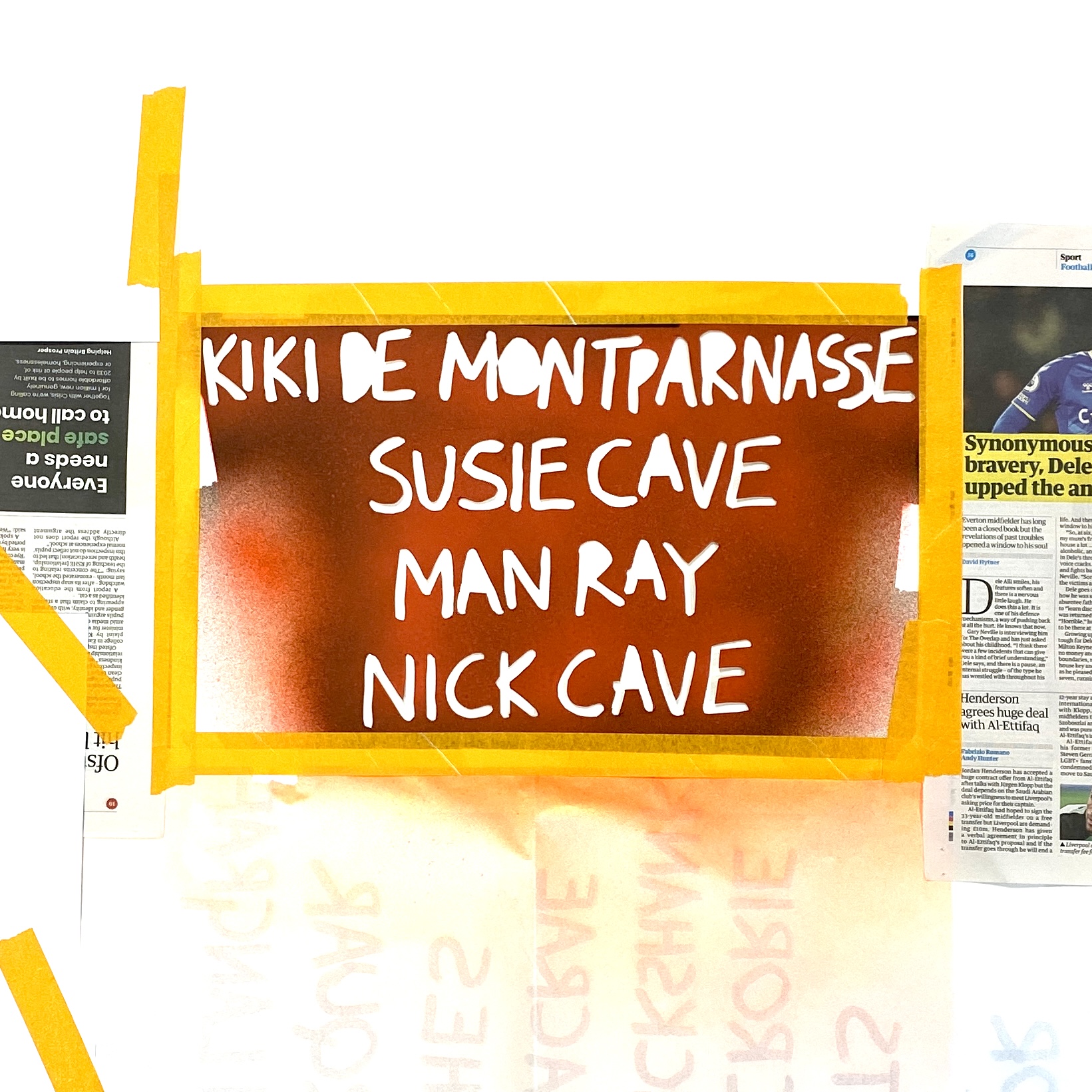
I’ve been reading about Kiki de Montparnasse and Nick Cave. They have partners who are closely connected to their creativity. Susie Cave as wife to Nick, and runs her own fashion label, The Vampire’s Wife, which was named after a Nick Cave short story; and Man Ray photographer and artist who photographed Kiki, developing experimental photography included Kiki as a model. They all have had a sharing role to play, with each other. Whether by being physically included the other’s work (Kiki), giving advice on the titles of projects (Susie), choosing fabrics and giving names to dresses (Nick), or ultimately, being a muse to each other (Nick, Susie, Kiki and Man Ray)
The muse stereotype is typically identified as a female role to the male artist, but in identifying an artists’ so-called muse such as Kiki de Montparnasse and Susie Cave, they were/are playing the same roles. Nick Cave and Man Ray are the male artists, Kiki and Susie are predicably seen as just muses, but they are artists in their own right. They are pioneers from their own background and place whilst being seen as the wife, lover, partner to the male artist.
“To be honest, I find the word muse to be a little demeaning. I haven’t really got time to be anyone’s muse. However, I am a frequent visitor in my husband’s songs, I seem to be always walking in and out of them. His songs look after me. And if I am to be a muse, then I am his and he is mine.” Susie Cave[1]
The issue of the muse doesn’t just relate to the unacknowledged support given but is also in the ownership of initiating work, being the author of the work, or suggestions of what to do, what to call things or what direction to take? It is actually a collaboration, a working together: recognizing the fact that the male artists’ wives/partners are in fact collaborators and are justified to be acknowledged. The fact that they are wives and lovers may be a factor in the shared ownership, which is not formally acknowledged as an understanding or agreement between the partners. It benefits them both. Unconditionally sharing, helping out, collaborating, giving advice.
Kiki de Montparnasse was considered a ‘truly free’ artist by Man Ray, less concerned with money and reputation within their relationship. As Mark Braude comments “Man Ray in some way served as one of Kiki’s muses as well. Perhaps the “drama” of their relationship, as she put it, helped fuel her desire to create new art”[2]. Therefore, Susie and Nick’s, and Man Ray and Kiki’s relationships as muses to each other is a common factor to importantly acknowledge, no matter the age.
Taking a broader view, a conditional collaboration between colleagues, friends and band members becomes a sharing of friendship and brotherly love which needs a more arranged agreement that they are collaborating.
Warren Ellis, Marcel Duchamp, Jean Cocteau, Mick Harvey, have played this role in supporting and collaborating with their musical or artistic partners. They are able to put aside their egos (mostly) and self-interest to share and constructively collaborate. Ellis bided his time in The Bad Seeds, to then move up the ranks, replacing others such as Mick Harvey, to be currently Nick Cave’s main collaborator. They even start dressing the same, sharing domestic geography and lifestyles. The Bella Freud designer suits that Cave wears, with the Gucci loafers, open neck shirts, jewellery and sunglasses, must have had the approval of the Vampire’s Wife. Observing the need for her man to look cool and give off a masculine aura but sensitive aura. The image of men with beautiful suits but low unbuttoned cool shirts, jewellery and mirrored shades captures the mood.
Initially, The Bad Seeds adopted a similar but less stylish look with their cheap suits, shirts, jewellery, shoes, and swagger. It became the band uniform, gave continuity, they were men’s men but with feeling. The dyed black hair still happens for Cave. He looks groomed, but for how long? The shirts unbuttoned to half way under the suit, shows rebellion, confidence, masculinity, sexiness, they are men of a certain age. And Warren Ellis has adopted this too. Whether the suits are of the same quality, but they are a definite style. Do they have a stylist? It must be Susie. Her subtle looks and suggestions being made across the breakfast table. Cave talks about the title for solo project Idiot’s Prayer, which he was just calling ‘An Evening with Nick Cave’ until Susie questioned its banality, suggesting it needed to be something more interesting. So, it was changed. He knew it was better. I attended Warren Ellis’ talk at the Edinburgh International book festival 2021. He was on a big screen online in the art college auditorium; he was full of life, showing us objects round his computer, playing his violin, he was cool and friendly. His musical skills have given The Bad Seeds more emotion, more adult reflection and less of the pervious slightly chaotic rock of early Bad Seeds. It was a more structured onslaught of Cave’s earlier postpunk/goth band The Birthday Party, but the musicians and dynamics of the group, even with Blixa Bargeld and Mick Harvey were less focused, it was a band, who gigged and made records of their songs. Warren Ellis has introduced more improvisation in the development of songs more space, less pace, more emotion, more creativity.
Warren explained in the book festival talk about coming to Edinburgh and busking on Princes Street, in 1988, with his violin, which he then lost, busking gave him money to stay in the hostel. I saw The Birthday Party play live at the Nite Club in Edinburgh on 25th August 1981. I really don’t remember much, other than having a vision of Nick Cave with his shirt off, screaming and lurching, Tracey Pew the bass player in his cowboy hat, moustache and heavy bass twang from the piano strings that he used. Mick Harvey and Rowland S. Howard must have been there, was there any support? I don’t remember.
Cave says, “I feel compelled to create. It’s a force beyond my control, really. And I do what I can to keep the whole creative project alive by constantly trying to surprise myself. In that way things remain interesting.”[3]
His (and our) creativity needs tending, like a garden, our initial ideas and thoughts need editing, pruning, questioned, asked about, criticized. When was an original idea never changed or doubted, when, if ever did something just exist as it was initially thought about/produced, no more than what it was?
The naivety and brutality of the early work by artists, bands, writers, designers and filmmakers are purer even truer, more creative even. The raucous, somewhat out-of-control The Birthday Party, and such bands had this rawness, it is what it is, it’s the way it is made by those involved, at their stages in life, their young minds, hedonistic, wild, free of restraint. There is beauty in naivety, an amateurism, no doubting an attitude to what they are doing. It is when we are older that we start to reflect and sigh. To achieve this raw creativity, is it better to be unrehearsed, unable to play, just deciding to be a band or whatever and just doing it?
Creativity and its work becoming public is when there might be some doubt about things, and the muse needs to help out, and intervene. Helping to give friendly critical advice as what would be ‘better’.
Kiki de Montparnasse appeared as an actor with a small part in Fernand Leger and Man Ray’s Ballet Mechanique 1924 abstract film: all cut and spliced, collaged moving objects, images of Kiki’s lips and face, experimenting with the technology, creating new forms and imagery. While Man Ray experimented with photography producing what was called Rayographs, he photographed Kiki with an African mask, to produce the work Le Violon d’Ingres 1924. There are many variations of this photograph, where he altered Kiki’s face, lips, eyebrows, position, for the photography, but he never altered the mask. Man Ray used a found cultural artefact with the female model, but the work is made by Kiki and the maker of the mask, the photo by Man Ray captures the positioning and relationship of the two things.
Appropriating African art and masks to enhance their art, during this period is a now questionable issue. Max Ernst showed a group of masks at Peggy Guggenheim’s New York flat, and referenced them in his own sculptures. Paris in 1920s was enamoured by African images, jazz, the primitive, Josephine Baker’s performances, and looking south to the Cote d’Azur, where painters Matisse, Braque, Picasso, also Man Ray, Kiki, and others went looking for new places, new experiences and new inspiration.
Perhaps some parallels can be made in relation to African masks and appropriation of a preceding art forms in Nick Cave’s recently produced ceramic figurines, taking their inspiration from Victorian-era Staffordshire figurines. These are something touristy, cheap tacky, and kitsch. He revamped them in his own sculptures as figures of the Devil going through its life, birth to death, as a narrative of the Devil’s existence through storytelling.
Kiki modelled for many painters in Paris in the 1920s, so there are painted portraits some naming her, many not, but Man Ray took photographs. Ones which he could gaze on her body and personality, manipulating them outside and inside the camera. Kiki was a collaborator in these images. She performed to the Man Ray camera and for its viewers. Ultimately, it’s dual authorship, although at the time, it was no recognised as such. Susie Cave appears nude on the cover of the Nick Cave and the Bad Seeds album, Push the Sky Away 2013. This is the most public image which might be seen as comparable to the Man Ray photographs of Kiki. Susie Cave was a model in her early career, but is now a well-established fashion designer in her own right. The association with Cave and the coverage they receive as a dynamic couple, makes me think that they are locked into each other’s lives, creativity, careers and public image. But they have edge, they stick to their ways of thinking and being, and how they see the world. They also have tragedy between them, and Nick Cave has been very public about the recent deaths of his sons, particularly Arthur. It is real life, which is imbued in his music, and in his views on life and religion.
The Surrealists of the 1920s lived the surrealist life as well as making their surrealist art. Nick and Susie Cave, and their associated collaborators and friends are doing the same. Their ‘postpunk/goth’ lives and their art are intertwined.
[2] Braude M. Kiki Man Ray: Art, Love and Rivalry in 1920s Paris. London: Two Roads; 2023. p. 254.
[3] Cave N & O’Hagan S. Faith, Hope and Carnage. Edinburgh: Canongate; 2023. p. 170.
Braude M. Kiki Man Ray: Art, Love and Rivalry in 1920s Paris. London: Two Roads; 2023 Cave N & O’Hagan S. Faith, Hope and Carnage. Edinburgh: Canongate; 2023. Man Ray. Self Portrait. London: Penguin Books; 2012. Dominick A. This Much I know to be True film. Bad Seed Limited; 2022.
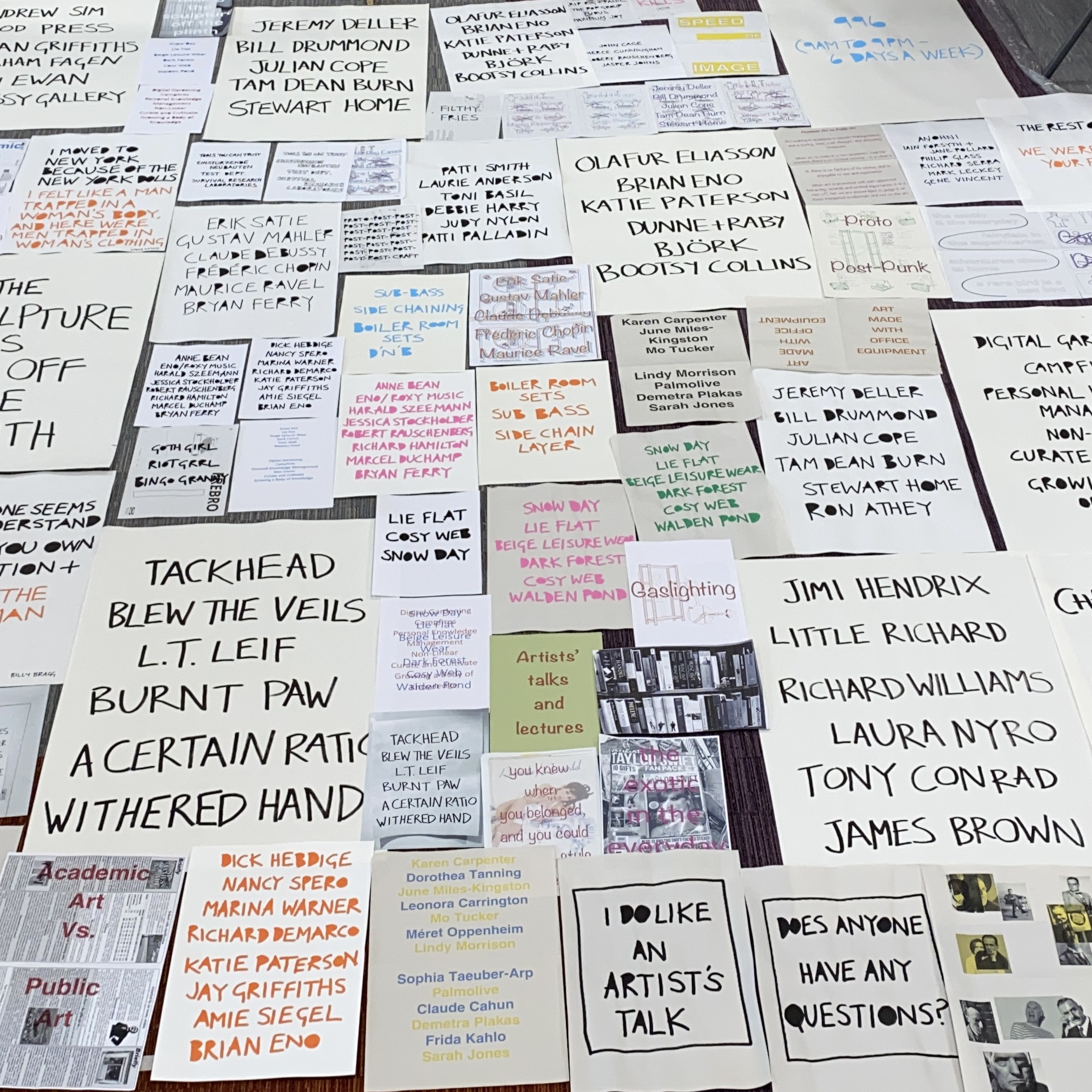
I’ve been making t-shirts. Although, I think of them as publications.
How did I end up doing this? It seemed to be a natural progression somehow, from writing my short texts and essays, to drawing out lists of the named content, making up postcards and posters, then putting the lists onto t-shirts. It seemed logical, and I now see that they make an interesting conversation starter when out and about.
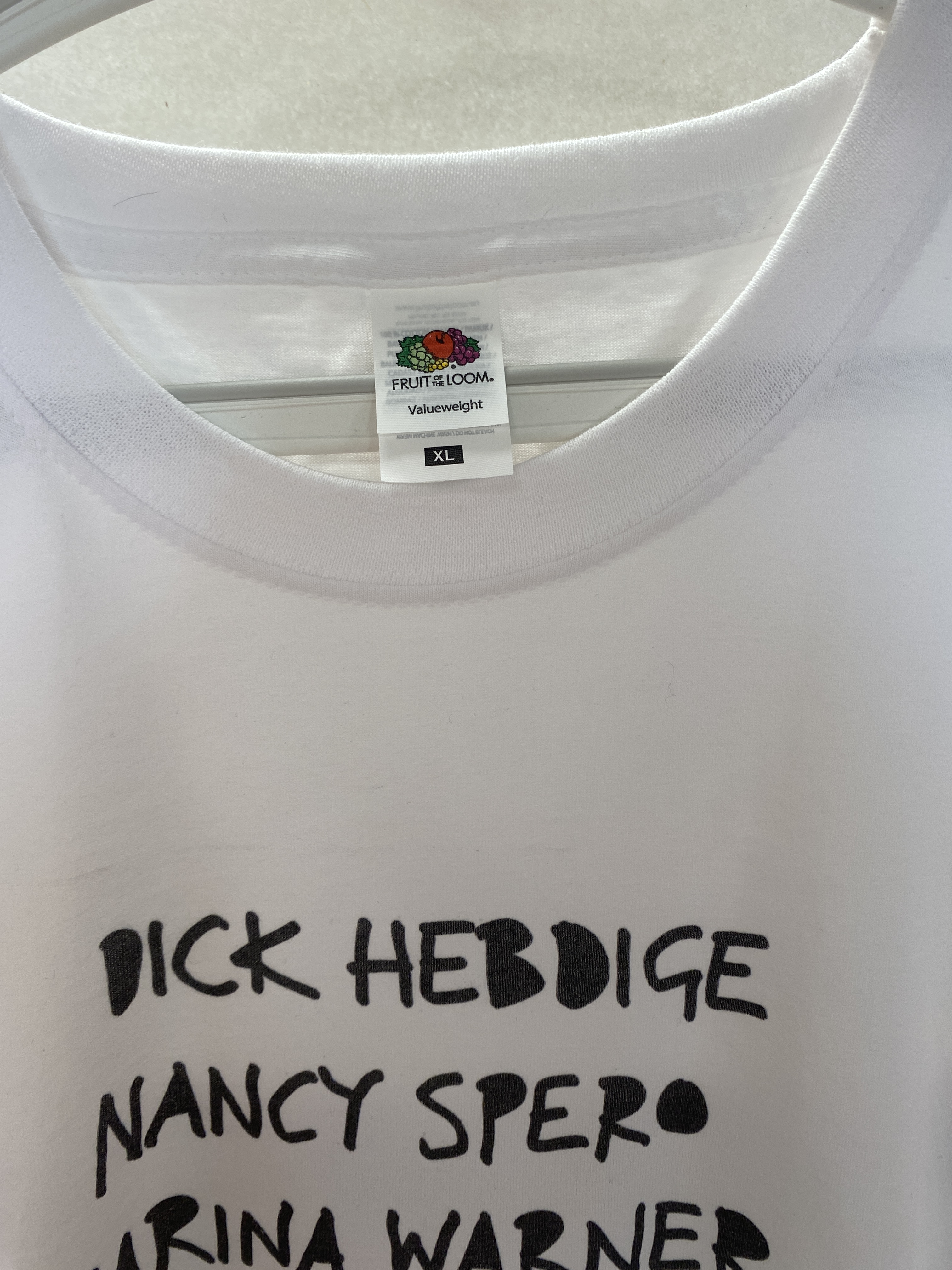
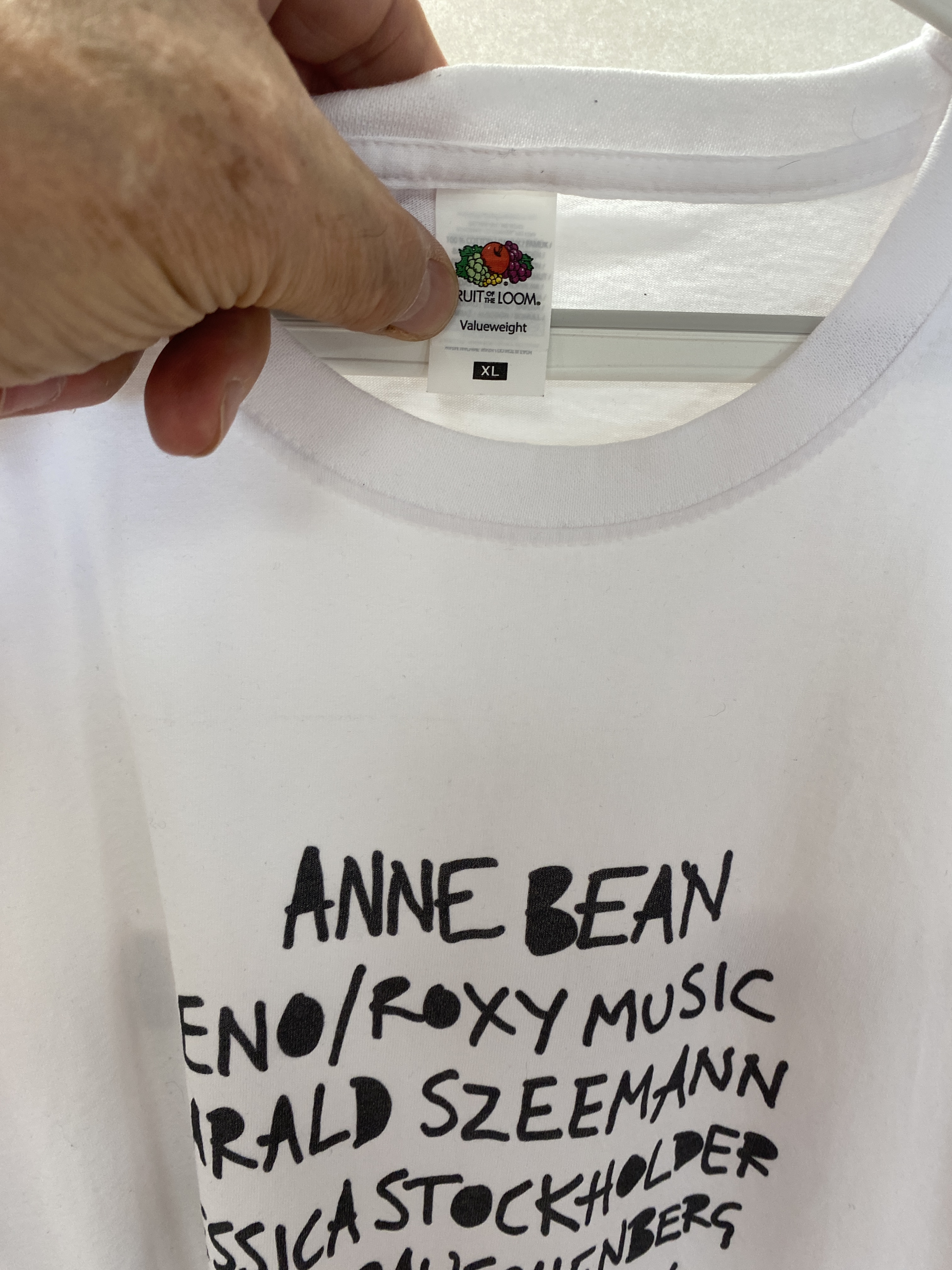
It has been a learning curve, and I now have a rail of various t-shirts which are of three different qualities and types.
S, M, L and XL sizes Valueweight, 100% cotton and 100% organic cotton. White, mustard, olive, pink shirts Black, purple, orange, blue text
In my enthusiasm I tested out a variety of commercial producers, and I learnt a lot in determining quality, such as how well the lists are printed onto the front, the feel and weight of the fabric, intensity of colour in the text and shirt – all good quality control monitoring.
Initially, I thought of just drawing my lists onto the plain t-shirt, like a one-off drawing or publication (which I might still do) but I got carried along with the online methods I could use to make them. They are my prototypes. They are not so much clothing but an extension of the texts, and I realised I could complete the circle by attaching a QR code card to the t-shirt, so that the wearer can scan it and read the related text to their particular list of names that is on their t-shirt, on their phone.
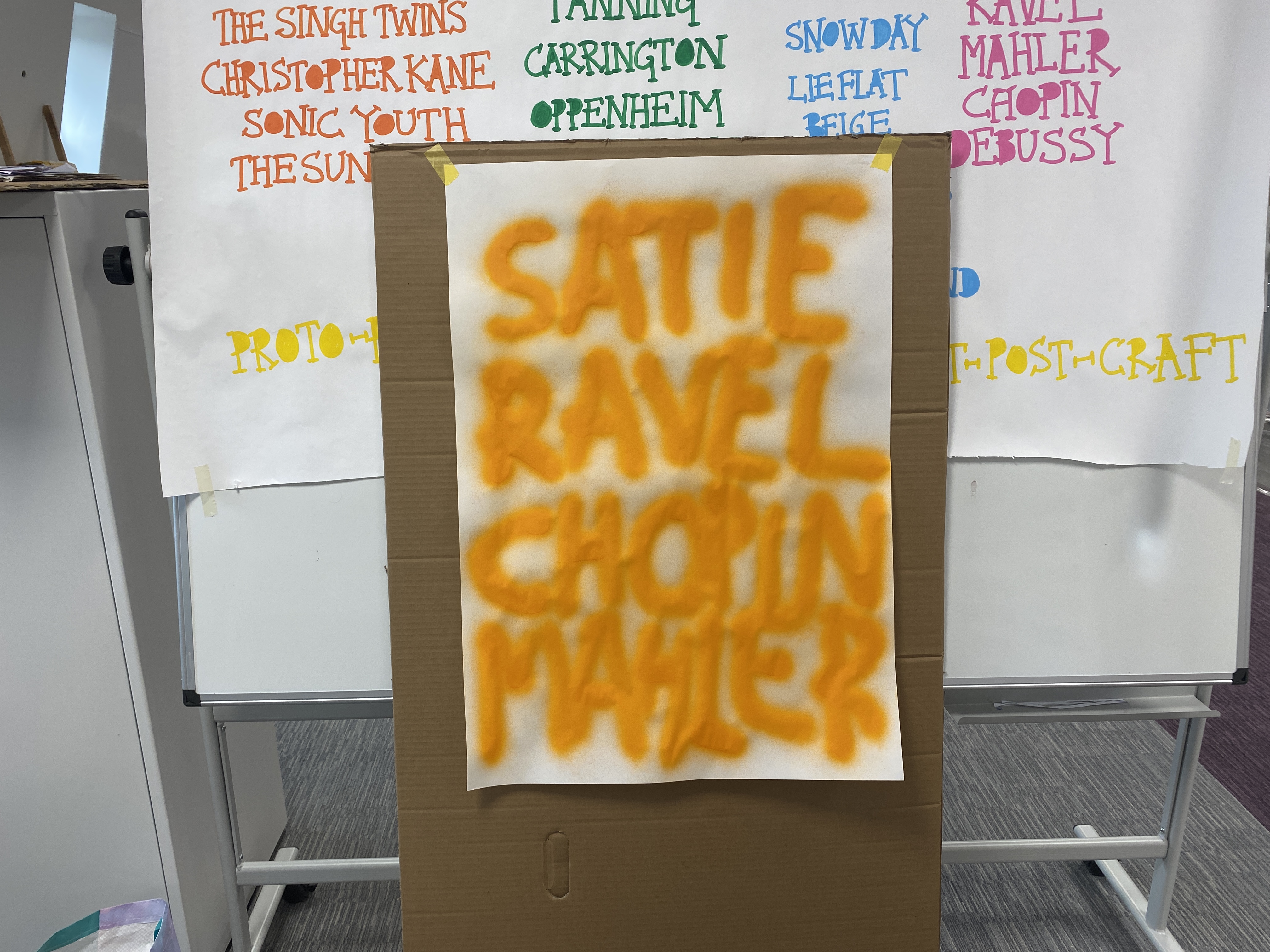
I am down by the canal, and it’s nearly 4AM in the morning. I sense that no-one is around but I’m not entirely sure. I have my new spray paints, and a plan to graffiti the surnames of some of my favourite late C19th / early C20th composers onto the rough wooden wall. I’m doing it during the semi-dark night as I am too self-conscious to carry out my mission in daylight.
It’s done. That was exciting, quite stimulating even.
“Oi, you there, what are you doing? Why do you think that it is OKAY to spray paint those obscure names on this wall. This actual wall, all the way along there and round the corner, has been officially designated and OKAY’D to be a graffiti wall. It’s for young graffiti artists to express their creativity and visual skills. This wall is for CONTEMPORAY visuals and references, NOT ones which are unrelatable, and have NO relevance to TODAY, RIGHT?”
“Well, OK, but I thought that it would be interesting for people to see the names of these composers in a contemporary context. They were pioneering and CONTEMPORAY for their time. They challenged the traditional art forms, with experimentation and they ‘pushed-the-boat’ around, so that NEW things could be heard and experienced. So, I think, ACTUALLY, that they have a good reason to be on these walls, as much as any of the graffiti that’s on here”.
Later that week, I went down to the canal again to see if the names I had sprayed on the graffiti wall were still there, and they were.
The lists of names and things I make are an index or summary of a piece of writing I’ve produced.
My texts explore ideas and thoughts on art, design, music, and culture interwoven with my own personal experiences. As I write these texts, they tend to just flow from one thing to the next. They are influenced and informed by things I’m reading, art I’ve seen, music I’ve heard, observations of things in the everyday, threaded together into a narrative non-fictional text.
Although, sometimes my lists are just a list.
A list has context, content, meaning and function; it is also a beautiful visual thing.

 Iain Irving