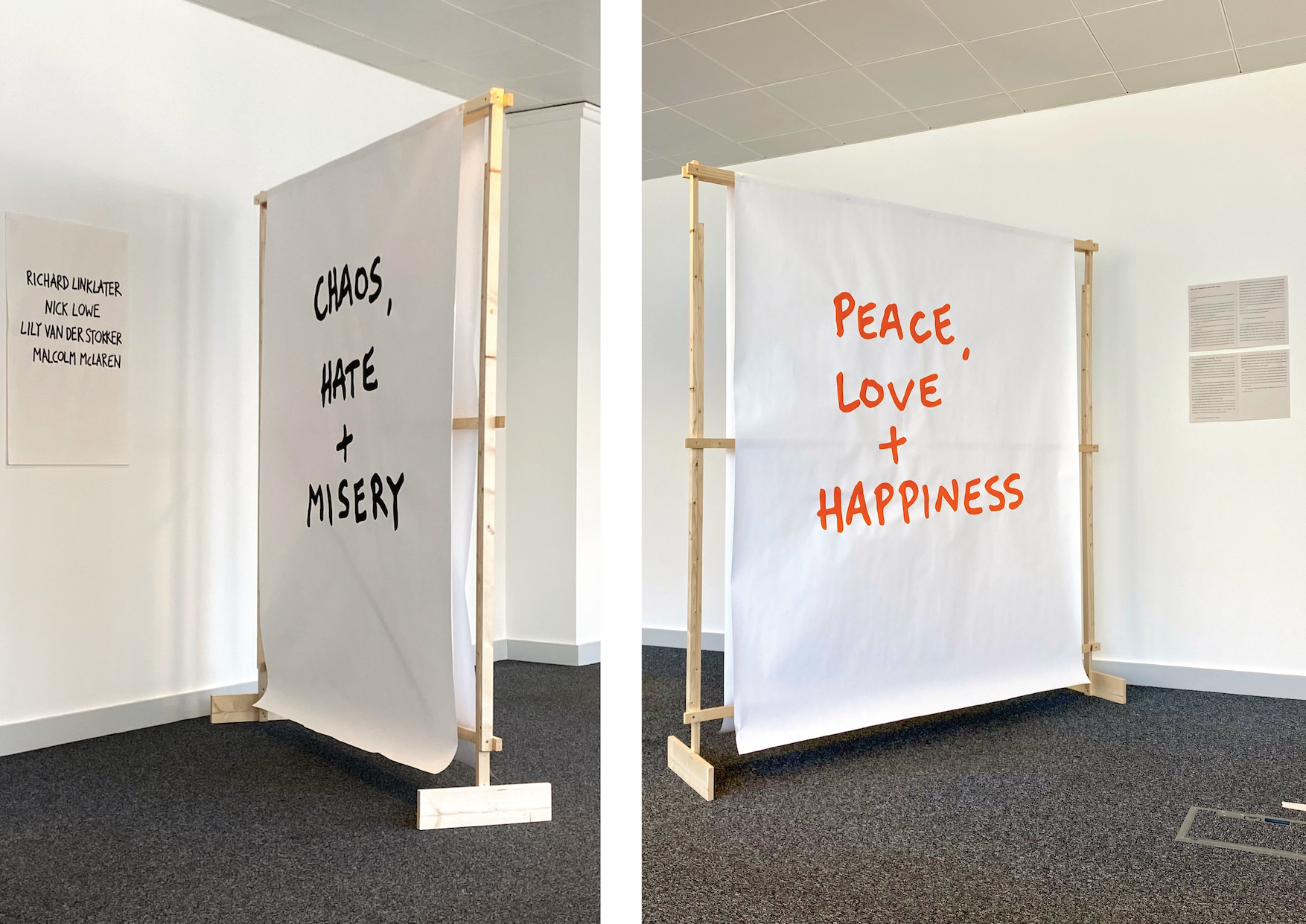
Mmm, what’s with these attitudes and ways of being in the world, and most importantly in ourselves?
While observing the world we tend to report on chaos, hate and misery. In our own personal lives, we surely want peace, love and happiness. Chaos, hate and misery are somewhere else. Serious conflicts and hate occur not next door, not here, it all just depends on your state on mind, the life we try to lead, and the people that are around us. They help us – our family and friends, a belief that we’re going in the right direction.
I used to be told to make the right choice. I never really understood what this advice was meant to give me. My choice is the right choice, not someone else’s judgement of the choices we make.
In this text, like in life, I’m just improvising as I go, making choices of what I think about, reference and explore.
I still have a VHS copy of the 1990 film Slacker, an early independently funded film, and made with intuition it seems, by its writer, producer and director Richard Linklater. What I remember about the film was its simple premise of the camera following people around in their everyday lives, in the town of Austin, Texas, USA. It was shot as though it was all happening in one day. The camera would follow the characters, many who were non-actors, but were coached on set by Linklater, as they made their way in the city and world. The film progresses by jumping from one character’s path to another, leaving one behind then moving on with the new pickup. The characters did regular local things, but also discussed the world their friends, and issues of the time such as global warming, gender, exclusion and hatred. It could have potentially been a documentary. A day in the life, sort of thing. I loved this film, still do, and think about its rough and ready vibes, and its identification of a type of young person trying to find their way in life. The cast were mostly under 30s, so I was around 30 when I saw it. It was cool, the story was fun, it had great characters and an inspiring sense of the future, the potentials, and a concerned but willing nature to see ‘what’s just round the corner’. The notion that making a choice to either get a bus or a taxi, go with someone you’ve just met, or change your routine, is what we do, sometime without thinking, improvising as we go. It’s also the same in our choice of attitude in our everyday lives.
(Let’s all believe in) Peace, Love and Happiness.
The song, “(What’s so funny ‘bout) Peace, Love and Understanding” is a favourite karaoke choice of middle-aged men. We remember Bill Murray straining to express the beautiful melody and passion in Sophia Coppola’s 2003 film, Lost in Translation. I also love the song, I play it regularly, on my Spotify. There are various versions of the song; by Elvis Costello, Sharon van Etten, Wilco, Deacon Blue, and by the original composer Nick Lowe, written in 1974 for his band Brinsley Schwartz. It has a great sentiment, and serious message for a pop song, it questions why we don’t embrace the good over the bad – ‘the pain, hatred and misery’. Declaring the need for ‘understanding’ makes the song political, looking for cooperation, trust and sharing commitments – ‘a sweet harmony’.
I’m looking for happiness in my life, to be perfectly honest. Although it’s subjective, it’s a happy word, I read it and it makes me feel good. If it has a colour that’s even better. I also have a book by Christophe Andre called, Happiness: 25 ways to live joyfully through art,which was given to me, probably in hope of brightening me up. It’s a difficult task to make ‘happy’ art. Andre identifies various paintings from art history, by such as Monet, Van Gogh, Bonnard and Chagall, in which he identifies different feelings of what might be happiness, but I struggle to see his concept.
So, what is happy art? What art makes us happy? Personally, it’s art which stands out with colour, awareness from the artists that the work is to be enjoyable, remembered, looked at more that once. The Dutch contemporary artist, Lily van der Stokker, makes ’happy’ art, it has a sense of naivety, and a carefree way that it is made, as drawings or room-sized wall-paintings. And colour, lots of colour, playful colour in child-like doodles, shapes and words. But Stokker is an adult, and it makes her happy to produce her work, she even mixes flourecent paint in with her colours to make them even brighter. Her art makes me happy.
But ‘happiness’ is also a strange word. It’s slightly delusional, it even tries to trick us. The Beatles’ song “Happiness is a Warm Gun” which I’ve never listed to until now, is a strange psychedelic hippy song, trying to sound cool but really isn’t, (n.b. I never liked the Beatles, I preferred their individual work) as it sounds like it was written and sung with irony. The band, Goldfrapp, in their “Happiness” song continually ask – “how’d you get to be happiness?”, whatever that means?
(Let’s all challenge and ignore) Chaos, Hate + Misery.
Of course, punk lived off of chaos, hate and misery. Malcolm McLaren, the much admired/mocked erstwhile manager and director of UK punk rock and the Sex Pistols wore a Seditionaries “Cash from Chaos” t-shirt in Julian Temple’s 1980 film The Great Rock ’n’ Roll Swindle. His attitude was intentional, forcing our creativity from chaos. He was challenging the status quo to create new things, and ways of being.
People live in chaos. Perhaps we all do. But when you hear about a chaotic lifestyle, it’s a worry, you try and help. A bit of chaos, might be good, but hopefully there’s a safety-net. But chaos can lead to the end of things. If the world is in chaos, it’s not in good health. It’s unstable. We do a lot of hating really, not full-on hatred, but feeling hard done by, so we give some hate, to a person we don’t even know, or if it is someone we know, we tend not to tell them. Keep it to ourselves, as its not good to be always hating the world and everyone in it.
The message is probably therefore, ‘Be happy’, it’s good for you and everyone around us, but it’s your choice.
II
 Iain Irving