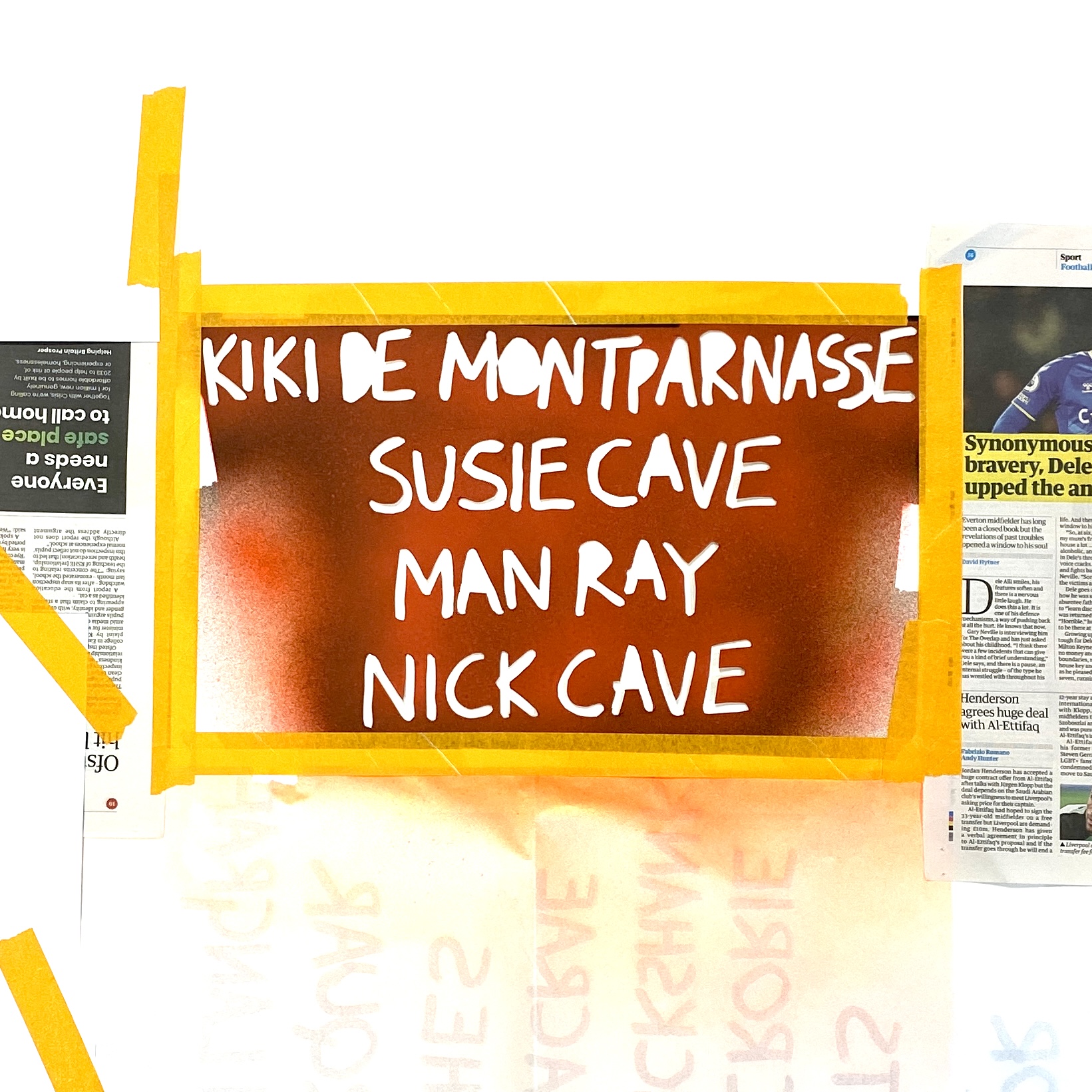
The other night, while still half-asleep, I thought about the parallels and connections between the characters, lifestyles, creativity and the lingering influences of the Dada/Surrealists of the 1920s and the Postpunk/Goths of the 1980s. There was a wild, youthful carefree attitude in both scenes; a determined need to carve out an intellectual but playful creative practice and lifestyle. Both genres shook up the conservativism of the times. They each reinvented ways of thinking and being, through many creative activities, and with no money. A more intimate connection can also be made with artistic couples of these genres, from then and now. The music, art, attitude and style exist in parallel and weave together who was associated within the art and cultural movement of those times.
I’ve been reading about Kiki de Montparnasse and Nick Cave. They have partners who are closely connected to their creativity. Susie Cave as wife to Nick, and runs her own fashion label, The Vampire’s Wife, which was named after a Nick Cave short story; and Man Ray photographer and artist who photographed Kiki, developing experimental photography included Kiki as a model. They all have had a sharing role to play, with each other. Whether by being physically included the other’s work (Kiki), giving advice on the titles of projects (Susie), choosing fabrics and giving names to dresses (Nick), or ultimately, being a muse to each other (Nick, Susie, Kiki and Man Ray)
The muse stereotype is typically identified as a female role to the male artist, but in identifying an artists’ so-called muse such as Kiki de Montparnasse and Susie Cave, they were/are playing the same roles. Nick Cave and Man Ray are the male artists, Kiki and Susie are predicably seen as just muses, but they are artists in their own right. They are pioneers from their own background and place whilst being seen as the wife, lover, partner to the male artist.
“To be honest, I find the word muse to be a little demeaning. I haven’t really got time to be anyone’s muse. However, I am a frequent visitor in my husband’s songs, I seem to be always walking in and out of them. His songs look after me. And if I am to be a muse, then I am his and he is mine.” Susie Cave[1]
The issue of the muse doesn’t just relate to the unacknowledged support given but is also in the ownership of initiating work, being the author of the work, or suggestions of what to do, what to call things or what direction to take? It is actually a collaboration, a working together: recognizing the fact that the male artists’ wives/partners are in fact collaborators and are justified to be acknowledged. The fact that they are wives and lovers may be a factor in the shared ownership, which is not formally acknowledged as an understanding or agreement between the partners. It benefits them both. Unconditionally sharing, helping out, collaborating, giving advice.
Kiki de Montparnasse was considered a ‘truly free’ artist by Man Ray, less concerned with money and reputation within their relationship. As Mark Braude comments “Man Ray in some way served as one of Kiki’s muses as well. Perhaps the “drama” of their relationship, as she put it, helped fuel her desire to create new art”[2]. Therefore, Susie and Nick’s, and Man Ray and Kiki’s relationships as muses to each other is a common factor to importantly acknowledge, no matter the age.
Taking a broader view, a conditional collaboration between colleagues, friends and band members becomes a sharing of friendship and brotherly love which needs a more arranged agreement that they are collaborating.
Warren Ellis, Marcel Duchamp, Jean Cocteau, Mick Harvey, have played this role in supporting and collaborating with their musical or artistic partners. They are able to put aside their egos (mostly) and self-interest to share and constructively collaborate. Ellis bided his time in The Bad Seeds, to then move up the ranks, replacing others such as Mick Harvey, to be currently Nick Cave’s main collaborator. They even start dressing the same, sharing domestic geography and lifestyles. The Bella Freud designer suits that Cave wears, with the Gucci loafers, open neck shirts, jewellery and sunglasses, must have had the approval of the Vampire’s Wife. Observing the need for her man to look cool and give off a masculine aura but sensitive aura. The image of men with beautiful suits but low unbuttoned cool shirts, jewellery and mirrored shades captures the mood.
Initially, The Bad Seeds adopted a similar but less stylish look with their cheap suits, shirts, jewellery, shoes, and swagger. It became the band uniform, gave continuity, they were men’s men but with feeling. The dyed black hair still happens for Cave. He looks groomed, but for how long? The shirts unbuttoned to half way under the suit, shows rebellion, confidence, masculinity, sexiness, they are men of a certain age. And Warren Ellis has adopted this too. Whether the suits are of the same quality, but they are a definite style. Do they have a stylist? It must be Susie. Her subtle looks and suggestions being made across the breakfast table. Cave talks about the title for solo project Idiot’s Prayer, which he was just calling ‘An Evening with Nick Cave’ until Susie questioned its banality, suggesting it needed to be something more interesting. So, it was changed. He knew it was better. I attended Warren Ellis’ talk at the Edinburgh International book festival 2021. He was on a big screen online in the art college auditorium; he was full of life, showing us objects round his computer, playing his violin, he was cool and friendly. His musical skills have given The Bad Seeds more emotion, more adult reflection and less of the pervious slightly chaotic rock of early Bad Seeds. It was a more structured onslaught of Cave’s earlier postpunk/goth band The Birthday Party, but the musicians and dynamics of the group, even with Blixa Bargeld and Mick Harvey were less focused, it was a band, who gigged and made records of their songs. Warren Ellis has introduced more improvisation in the development of songs more space, less pace, more emotion, more creativity.
Warren explained in the book festival talk about coming to Edinburgh and busking on Princes Street, in 1988, with his violin, which he then lost, busking gave him money to stay in the hostel. I saw The Birthday Party play live at the Nite Club in Edinburgh on 25th August 1981. I really don’t remember much, other than having a vision of Nick Cave with his shirt off, screaming and lurching, Tracey Pew the bass player in his cowboy hat, moustache and heavy bass twang from the piano strings that he used. Mick Harvey and Rowland S. Howard must have been there, was there any support? I don’t remember.
Cave says, “I feel compelled to create. It’s a force beyond my control, really. And I do what I can to keep the whole creative project alive by constantly trying to surprise myself. In that way things remain interesting.”[3]
His (and our) creativity needs tending, like a garden, our initial ideas and thoughts need editing, pruning, questioned, asked about, criticized. When was an original idea never changed or doubted, when, if ever did something just exist as it was initially thought about/produced, no more than what it was?
The naivety and brutality of the early work by artists, bands, writers, designers and filmmakers are purer even truer, more creative even. The raucous, somewhat out-of-control The Birthday Party, and such bands had this rawness, it is what it is, it’s the way it is made by those involved, at their stages in life, their young minds, hedonistic, wild, free of restraint. There is beauty in naivety, an amateurism, no doubting an attitude to what they are doing. It is when we are older that we start to reflect and sigh. To achieve this raw creativity, is it better to be unrehearsed, unable to play, just deciding to be a band or whatever and just doing it?
Creativity and its work becoming public is when there might be some doubt about things, and the muse needs to help out, and intervene. Helping to give friendly critical advice as what would be ‘better’.
Kiki de Montparnasse appeared as an actor with a small part in Fernand Leger and Man Ray’s Ballet Mechanique 1924 abstract film: all cut and spliced, collaged moving objects, images of Kiki’s lips and face, experimenting with the technology, creating new forms and imagery. While Man Ray experimented with photography producing what was called Rayographs, he photographed Kiki with an African mask, to produce the work Le Violon d’Ingres 1924. There are many variations of this photograph, where he altered Kiki’s face, lips, eyebrows, position, for the photography, but he never altered the mask. Man Ray used a found cultural artefact with the female model, but the work is made by Kiki and the maker of the mask, the photo by Man Ray captures the positioning and relationship of the two things.
Appropriating African art and masks to enhance their art, during this period is a now questionable issue. Max Ernst showed a group of masks at Peggy Guggenheim’s New York flat, and referenced them in his own sculptures. Paris in 1920s was enamoured by African images, jazz, the primitive, Josephine Baker’s performances, and looking south to the Cote d’Azur, where painters Matisse, Braque, Picasso, also Man Ray, Kiki, and others went looking for new places, new experiences and new inspiration.
Perhaps some parallels can be made in relation to African masks and appropriation of a preceding art forms in Nick Cave’s recently produced ceramic figurines, taking their inspiration from Victorian-era Staffordshire figurines. These are something touristy, cheap tacky, and kitsch. He revamped them in his own sculptures as figures of the Devil going through its life, birth to death, as a narrative of the Devil’s existence through storytelling.
Kiki modelled for many painters in Paris in the 1920s, so there are painted portraits some naming her, many not, but Man Ray took photographs. Ones which he could gaze on her body and personality, manipulating them outside and inside the camera. Kiki was a collaborator in these images. She performed to the Man Ray camera and for its viewers. Ultimately, it’s dual authorship, although at the time, it was no recognised as such. Susie Cave appears nude on the cover of the Nick Cave and the Bad Seeds album, Push the Sky Away 2013. This is the most public image which might be seen as comparable to the Man Ray photographs of Kiki. Susie Cave was a model in her early career, but is now a well-established fashion designer in her own right. The association with Cave and the coverage they receive as a dynamic couple, makes me think that they are locked into each other’s lives, creativity, careers and public image. But they have edge, they stick to their ways of thinking and being, and how they see the world. They also have tragedy between them, and Nick Cave has been very public about the recent deaths of his sons, particularly Arthur. It is real life, which is imbued in his music, and in his views on life and religion.
The Surrealists of the 1920s lived the surrealist life as well as making their surrealist art. Nick and Susie Cave, and their associated collaborators and friends are doing the same. Their ‘postpunk/goth’ lives and their art are intertwined.
References and Bibliography
[1] Wiseman E. Susie Cave interview. The Observer Fashion interview; March 2021. See. https://www.theguardian.com/fashion/2021/mar/14/susie-cave-fashion-designer-vampires-wife-my-imagination-can-get-a-litte-bit-scary
[2] Braude M. Kiki Man Ray: Art, Love and Rivalry in 1920s Paris. London: Two Roads; 2023. p. 254.
[3] Cave N & O’Hagan S. Faith, Hope and Carnage. Edinburgh: Canongate; 2023. p. 170.
Braude M. Kiki Man Ray: Art, Love and Rivalry in 1920s Paris. London: Two Roads; 2023
Cave N & O’Hagan S. Faith, Hope and Carnage. Edinburgh: Canongate; 2023.
Man Ray. Self Portrait. London: Penguin Books; 2012.
Dominick A. This Much I know to be True film. Bad Seed Limited; 2022.
 Iain Irving