How about we put on an artist’s talk about artists’ talks?
Really? That’s such a rubbish idea, a talk about a talk, what could be more boring?
I do like an artist’s talk.
A public talk with the artist sharing their work and ideas, really helps us to understand and connect with their work. By hearing and seeing them express their reasoning and doubts about what they have produced, is a great experience and can turn your feelings about the work and the artist.
The events are usually set out like a performance, in that the artist and maybe their guest interviewer or ‘in conversation’ colleague sit at the front of a seated audience, sometimes on a stage, sometimes with microphones, and a projector, with slides of their work or related images and information.
The artists, who do it, are allowing us, the audience, to hear and think about what it is that they make; how projects or exhibitions have been produced, developed, and made by them and their collaborators, who could be fabricators, curators, research with groups of types of people, texts that they have read, and other historical or contemporary works.
Like writers, the artists are now expected to be performers. They are encouraged to go out and talk about their work in a public scenario. Not all are good, some are very articulate but all have something special to tell us. This is helps us greatly. The stories and anecdotes that they tell, let us understand their creativity. The work can be ambiguous or obscure, or even just not very good, so the public talk can be a euphoric moment for individuals in the audience, who might have been in doubt.
Lectures are too formal, and can be tricky to communicate ideas and creative rationale; talks are better, less formal, time for the impromptu anecdote, to go off-script; conversations are organic, when including another mind and voice, who maybe a critical friend of course, but is keen to draw out their own inquiry, they can be helpful or destructive with their questions. Keeping the technology simple or not even involving it, is a good plan. Too much tech can be the downfall of the well-planned talk or lecture. Computer projection and PowerPoint is the devil to some, and not good for the artist really. It seems dangerous to include film or video, simple images are best.
The beautiful sounds and images of the 35mm carousel slide projector has mostly had its moment, although apparently Dick Hebdige, author of Subculture: The Meaning of Style still lectures with broken and dirty slides, hoping that there will be some issues, to give his lectures spontaneous combustions.[1]
Some anecdotes and experiences of artists’ talks that I have attended.
At the Fruitmarket, Edinburgh during the late-1980s, while American artist Nancy Spero talked about her work. Leon Golub, her husband was in the audience making comments with such a rich throaty voice. Marina Warner, art writer talked during The Mirror and The Lamp exhibition, but the slide projector wasn’t working so I had to manually put each slide in on a “next slide” command from the speaker. Richard Demarco, arts promotor talked about Joseph Beuys and his connection to Edinburgh during the Homage to Beuys exhibition, extending the allotted time somewhat with additional input from Scottish artist George Wyllie about how important this talk was.
Design writer Stephen Bailey gave a talk at the National Museum of Scotland, Edinburgh about industrial design, but the only question asked was about how a boiler works and how could it be improved. The design thinker and writer John Thackara’s talk at RGU, Aberdeen came with a health warning that there were no images in his lecture. He even started with an anecdote about someone he had just met on the plane journey up.
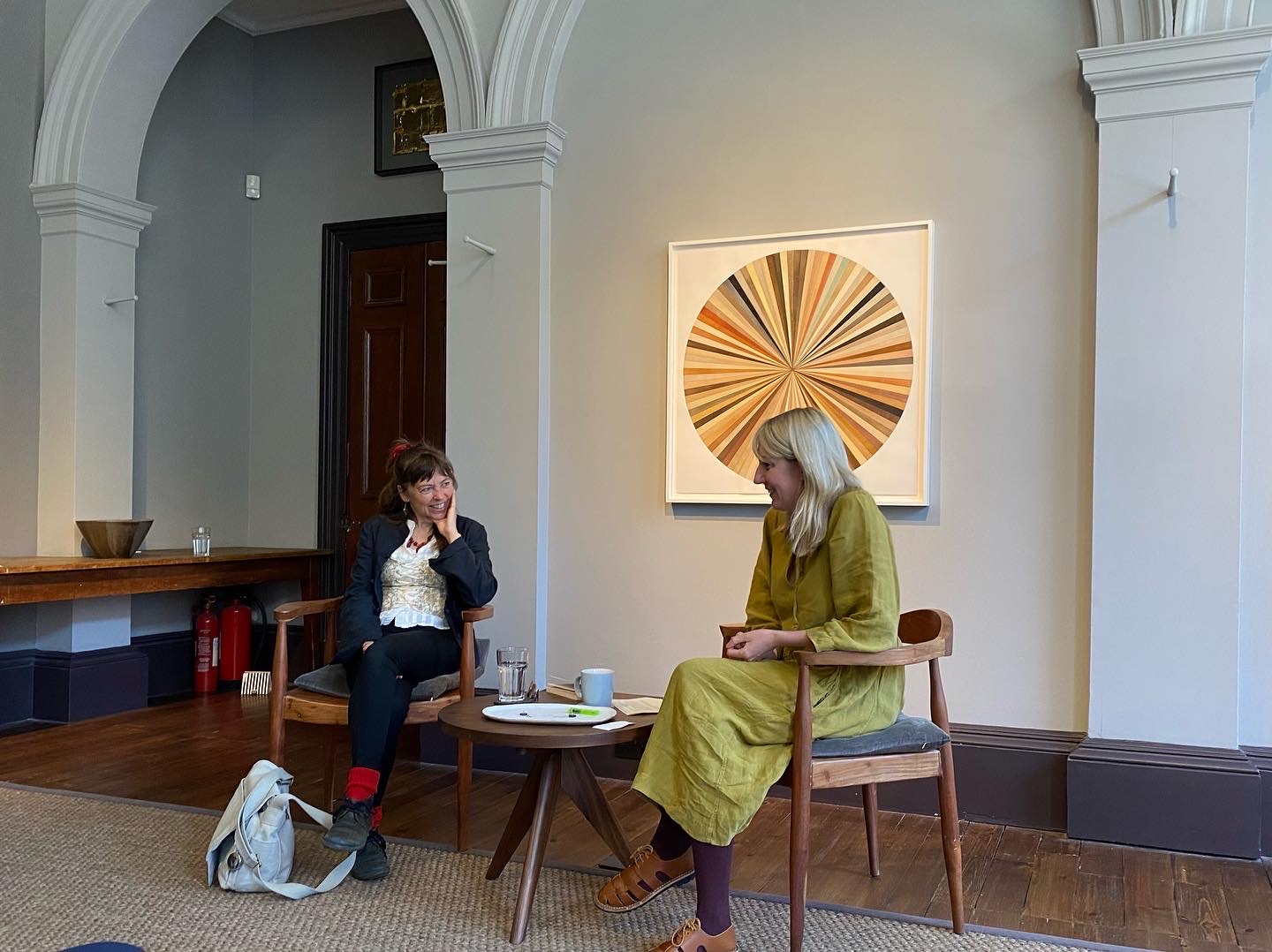
More recently, Scottish artist Katie Paterson had a conversation with the activist and nature writer Jay Griffiths at the Ingleby Gallery (image above). Upstairs, two chairs, no technology involved just an insightful and emotional discussion between them. This event has become key to my understanding of Paterson’s artwork. This could have been where the thoughts of work being ‘So what?’ or ‘And?’ came from but the discussion between the two showed their real and total awareness, thoughtfulness, and dedication to nature’s ecology and how we, as humans should be attentive to the planet Earth’s future, beyond us.
At the National Galleries lecture theatre on The Mound, American artist and filmmaker Amie Siegel was interviewed about her film work, “Bloodlines” – a slow-paced documentary style work which followed the gathering of Stubbs paintings for an exhibition. The film documented the art handlers moving around country homes which were lending their paintings, but while watching the film, there was a moment when the camera came into a large entrance hall, where a horse and fashion model where being photographed. I noticed that the horse turned its head when it saw the camera coming into the hall, breaking the fourth wall. This made me ask about these serendipitous circumstances while making films, and Siegel answered that these weren’t edited out as the process of making the film gave a focus on the actual real animals (horses, dogs, and sheep) in the locations, as well as the animals in the paintings.
Does anyone have any questions?
Then comes the dreaded moment when this is question is asked to the audience, to open it up for us to ask something random, maybe not just a question but an observation, something that you just wanted to share, in public, with everyone. Brian Eno makes a comment that if you ask a question at his lectures and talks, make it short and the answer should be helpful to at least one other person in the room.[2] Hence cutting out the indulgence of the questioner. Which is a good instruction but can be annoyingly restrictive for the serial talk attender with a notebook full of important statements and questions.
[1] Dick Hebdige interview
https://quod.lib.umich.edu/p/postid/pid9999.0004.102/–dick-hebdige-unplugged-and-greased-back?
[2] Brian Eno podcast
https://podcasts.apple.com/gb/podcast/brian-eno-and-peter-chilvers-meet-the-developers
 Iain Irving