That evening we ended up going to a nightclub.
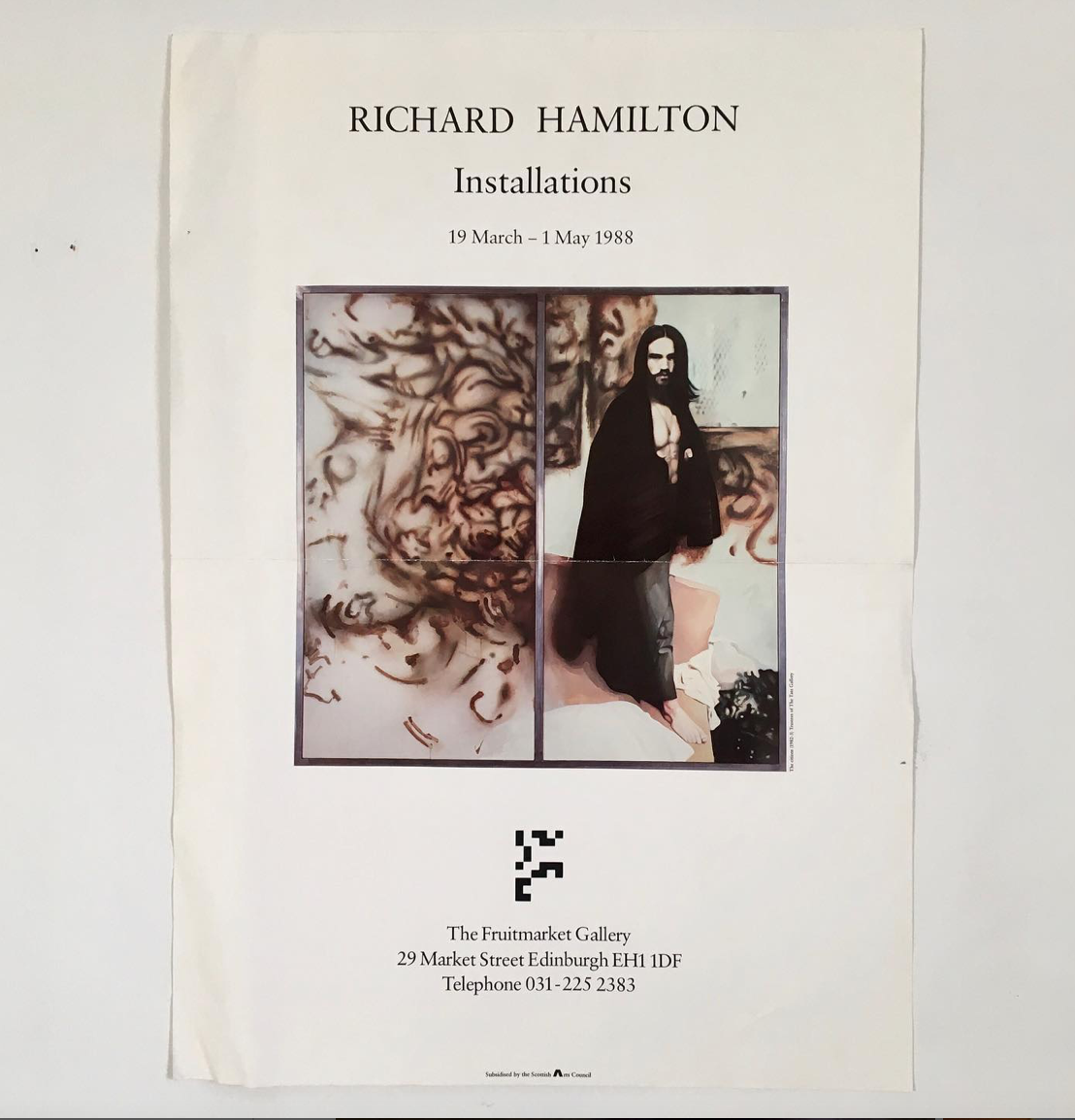
During the day, and throughout the previous week, we had been making and installing Richard Hamilton’s solo exhibition in 1988 at the Fruitmarket Gallery, Edinburgh. It was a very eventful and influential time. Not only did we assist and work with Richard Hamilton, who was an important British artist; pioneer of ‘pop’ art and mentor to many a young artist, including Roxy Music’s singer and songwriter Bryan Ferry, but the activities of the install would make a lasting impression on me in a creative and physical way.
I had studied Product Design at art college in Dundee during the early 1980s, but later I found myself as a member of the installation team at the gallery, invigilating and installing exhibitions. I liked doing this, I was good at problem-solving and being attentive to the art works’ standards but also how they were displayed and taken care of. My design training was good for the job.
Richard Hamilton had initially been employed by Hugh Casson at the University of Newcastle as a Design tutor, to run the first year Basic Course, not a fine art course in the late 1950s. His own artwork was influence by popular cultural media of the times; cars, music, advertising, technology, celebrity, and films. He was also keen on Marcel Duchamp’s ideas and art of ready-mades. But the fine art department did not consider him as a proper fine artist due to his role as a design tutor.[i]
I connected with Hamilton’s work as it was located between what was design and fine art. His work and how he thought was something which interested me. I saw art as products. An integration of functionality, design principals and societal and cultural interpretations and engagement.
In the Fruitmarket exhibition there was a 1979 work, Lux 50 which incorporated the state-of-the-art audio amplifier into the surface of an airbrushed painting, with nearby on-loan Mies van der Rohe designed Barcelona chairs. There was a mocked-up medical operating theatre with a tv monitor playing Margaret Thatcher speeches, a hotel lobby with mirrored column, patterned flooring, fake steps, and a painting of an identical hotel lobby. Another space was a prison cell, which mocked-up IRA ‘dirty protestor’ Bobby Sands’ cell. We had to paint the walls with excrement, made from sawdust and various brown coloured emulsion paints. On the back wall hung a painting, The citizen (1982-83) by Hamilton of Bobby Sands, on loan from the Tate Gallery, London.
The installation was nearly finished. We had constructed the various art works, and all was well, we just needed to tidy up. The heavy wooden Tate storage crate and its additional internal frame was manoeuvred into a space behind the gallery walls. I was on one end, then B-O-O-M, I head-butted the big yellow crate and my left eye started to swell up. Slight concussion began to set in. Richard came down, then went over to M&S and brought me back a sandwich.
I went to hospital for a check-up but it wasn’t too bad, so I found some sunglasses, and we went out, and ended up in a nightclub, where some people thought I was being too cool with my dark glasses.
Many years later I started to develop double-vision when I turned my head to the right. After various sessions and a surgical cutting of a muscle round my right eye at Aberdeen Royal Infirmary, I was asked if I had ever received a punch or strike to my head, as this was probably the cause of the problem.
I then thought about Richard Hamilton and the exhibition installation, and said ‘Yes, I did”.
[i] See Michael Bracewell, Re-make/Re-model, 2007, London: Faber and Faber Limited.
 Iain Irving